Pages

Showing posts with label Produce of the Week. Show all posts

Friday, May 30, 2014

Friday Coffee Break: A Little Fennel in my Life

http://www.naturaskinclinic.co.uk/Skin-Friendly-Artichoke-and-Fennel-Salad
I didn't like it. The aroma of licorice overpowered my senses. And so I avoided it. The seeds, the bulb, the fronds, all of it. But this prejudice, for that's really what it was, began to ebb when I first tried a dish my mother cooked up. The strong flavours I had formerly despised melted away into caramely sweetness. Later, I would find that the slender stalks of the wild plant proved light and crunchy, with mild dulcet undertones.

Fennel (or finocchio, as you do) has a long and illustrious history of cultivation, dating back to ancient Egypt. It's probably best known for its prominence in Italian cuisine, and litters Greek and Roman mythology. In much of the Mediterrannean region, the plant can even be found growing wild in fields and on the sides of roads (according to legend, the battle of Marathon took place on a field of fennel). It has spread throughout Europe now, and made its way across the Atlantic fewer than three hundred centuries ago.
 
Traditionally used to ward of bad humours and evil spirits (especially on Midsummer's eve in Medieval Europe), fennel is beneficial in aiding digestion and can quell hunger during fasts. Seeds are used to flavour dishes, the herbaceous fronds used to flavour breads, the stems make a nice salad, and the bulb is prized for its many culinary uses.

And so we come to the dish that broke my
antipathy. It's really quite simple.

Lentiche con Finocchio Caramellato
1 cup dry lentils, cooked in 2 cups vegetable stock
1 medium fennel bulb, coarse chop
1 medium onion, coarse chop
2 large peppers, sliced (Italian fry or gypsy peppers are nice)
1 clove garlic, minced
1 tsp honey or agave
1 tbs olive oil
Salt to taste

1. Heat oil on medium-high in a large skillet. Add onion and fennel together and cook (preferably covered) until the onion starts to become translucent. 
2. Add garlic, peppers, and honey. Cook covered for 15-20 minutes until the fennel is soft and caramelly. For another 5 minutes, include the lentils and a pinch of salt. Turn off heat and allow to sit for at least ten minutes. In my opinion, it's better to give more time for flavours to meld.
3. Serve warm with tasty crusty bread.

Monday, May 26, 2014

Frugal Foodie on a British Pound: That's the Way the Millet...Crumbles?

3,000 year old fruit?
Let's go back, I don't know, say five or six thousand years ago. Last Friday I learned a bit about how archeobotanists (with the help of other archeologists) infer past diets and agriculture from a combination of presentday farming and crops and the preserved remains of ancient civilizations. Seeds are a particular gold-mine, because when carbonized (turning into charcoal through burning), they persist for a long time and retain valuable information about climate and soil conditions. From these bits and pieces of long-abandoned settlements, pottery shards, and preserved crop elements, archaeologists cobble together some semblance of how agricultural system were structured and functioned millennia ago. Moreover, they are trying to think about how people did things in the past can inform present practices and even adaptation to future conditions. Cool! I seemed to have missed my calling in the agricultural archeology world ... 

Ok, but returning to our little date with the time machine. Geographically speaking, we are where one of the staples of resource-poor regions originate: Africa. While having at least a 10,000 year history of cultivation in East Asia, millets are thought to have originated in tropical western Africa, and there have the greatest variety. It dominated ancient diets across the region, and was a central part of intensive multi-crop systems - probably because they do well under poor soil conditions and low moisture. Today, millet (and pearl millet in particular) play a critical role in feeding much of west Africa and the Sahelian region, in addition to India and other parts of Asia. Until recently, with the gluten-free craze, millet has largely been viewed from the lens of bird or livestock feed in industrialised nations like the US. That seems to have changed a bit, as I can now obtain "millet flakes" in my local healthfood shop.

Be warned: by itself, millet flakes are rather bland and cardboardy. But they serve as a nice base for a gluten-free crumble! Rhubarb season is full swing, so naturally it served as the base for this tasty spring dessert.

Rhubarb Millet Crumble
2/3 cup millet flakes
1/3 cup oat flour
1/3 cup turbinado sugar
1/3 cup vegetable oil
1/2 tsp powdered ginger (or 1 tsp grated fresh)
1 tbs sesame seeds

2 cups chopped rhubarb
1 tsp orange zest
1/2-2/3 cup sugar

1. Mix rhubarb, zest, and sugar together and pour into a small casserole dish. Set aside.
2. Combine millet flakes, oat flour, sugar, ginger, and sesame seeds. Add the oil until everything is coated. Layer onto the rhubarb mixture.
3. Bake in 175C (about 350F) oven and bake for 25-30 minutes. The rhubarb should be soft and melty, and the topping crispy and starting to brown. Makes a tasty brunch dish. Enjoy!

Also, I seem to really like (and write about) rhubarb a lot...

Monday, May 12, 2014

Frugal Foodie on a British Pound: Signs of Spring

Not asparagus, but my baby sunflowers!
As exams approach rapidly, I seem to find an increasing variety of ways to procrastinate. But what better way than by sharing with you, my dear readers, the arrival of spring in the United Kingdom. At best, the weather here for much of the year can be described as 'dreary'. It is damp, chilly (but not freezing), and blustery. And then the sun comes out. Because we so rarely experience cloudless skies, sunbreaks and the azure heavens evoke a certain thrill, an excitement that one doesn't experience in places like the SF Bay Area (or even Washington, DC, for that matter). When the sun comes out, it quickly becomes apparent the extent of habitation in the city - as people come out of the wood-work, rush to the parks and the fields for sport and lounging.

For me, the signs of this spring renewal are tied tightly to certain floristic indications. Regardless of whether in my childhood home, the Nation's capital, or across a large body of water, the emergence of spring will always be intrinsically linked to asparagus. It is a perennial shoot in the lily family that emerges for only a short period in more northern climes - usually in May and early June. While available year round, imported from tropical regions, there is something particularly special about the ephemeral enjoyment that local and fresh asparagus brings during the spring.

Like many of the plants we consume, our ancestral interactions date back at least a few milennia. Evidence of cultivation and the stem's regal role in cuisine is found in ancient Greek and Roman writing, including the first known recipe book! Probably best known in French culinary tradition, asparagus made its way from the Levant to French monastery gardens in the 15th century, before negotiating a place on English and German tables a century or so later. It is high in micronutrients, and prized for its delicate flavor. 

Unlike the past three years, asparagus is not compromising the majority of my diet during the month of May (as much as I wish it were). And despite the title of this post, asparagus is also not a staple for those on a tight budget (unless you happened to have the foresight to grow your own). However, it is such a vital part of the season that it would just not do to leave it be. Thus, a dish that exudes springiness, despite its slightly elevated price tag (still only a couple of ££)...

Spring Polenta
1 cup boiling water (more as needed)
1/2 cup dry polenta
1/2 onion, chopped
1 tsp olive oil
5 leaves lemon balm
1 sprig thyme
Salt to taste

6 spears asparagus, cut
1/2 cup cherry tomatoes, halved
1 tsp olive oil

1. Place asparagus and cherry tomatoes on an oiled baking sheet and roast in a 180C oven for about 15 minutes, until asparagus is soft.
2. Meanwhile, heat oil in a pot over medium-high heat. Sautee onions until translucent and then add water. Bring to a boil before adding polenta. Mine tends to cook quickly, so I need to stir almost constantly for about 10 minutes, but follow the directions on whatever type of polenta you are using.
3. Once it is beginning to thicken, add the herbs and cook until it is no longer gritty (you may need to add more water). 
4. Toss in the tomatoes and the asparagus stems. Top with the crowns and serve!

Monday, January 20, 2014

Frugal Foodie on a British Pound: Lost in Translation

It dawned on me only recently. For the longest time, I could just not figure out what swede was. Did it refer to the Scandinavian people (I'm sure in some contexts it did)? Perhaps it was shorthand for a posh pudding, like Swedish rolls? And then one day, while helping with a veg stand at market, I commented on the beautiful rutabaga. The what? Ah yes. Rutabaga. Such a distinctly American word (with roots in the Swedish rotabagga), that of course there must be a softer term used across The Pond. Swede is this cabbage relative's preferred name in England, Wales, Australia, and New Zealand, though yellow turnip sometimes wins out. We all could just go by the scientific name, Brassica napus rapifera (a cross between cabbage and turnip).

This (often quite large) root seems prevalent in mashes and roasts. However humble, this veg played a central role in food security in northern reaches of Europe (in fact, there is a whole institute devoted to the rutabaga)! Swede predates potato as a staple in Ireland, Norway, Sweden, and Finland, thought to have originated in Scandanavia and first described in the early 17th century. By the early 19th century, it had also reached North America and was prevalent throughout England. It can grow in rough and cold climates, providing an essential dose of vitamin A and C, as well as important nutritious fodder for livestock.

Considering swede's history characterised by humble origins and economy, I thought that it rightly belonged in a student's budget. It is dense, keeps well, and with roots (haha...) in peasant subsistence, comes pretty cheap. Combined with two of my other winter mainstays - potatoes and pumpkin - rutabaga serves as a satiating light supper or side dish.


Swede Baby Cakes
1 medium rutabaga, grated
2 medium purple potatoes, grated
1 cup winter squash, grate (I used buttercup)
2 tbs arrowroot or flour
1 tsp salt, to taste
1 tsp cumin, to taste
1/2 tsp cinnamon (optional)
1-2 tbs olive oil, for cooking

1. Mix together all ingredients in a bowl. Pressing down, turn bowl sideway and let some liquid drain out.
2. Heat oil in a skillet over medium-high heat. Drop a piece in; when it starts to sputter the oil is hot enough. Taking about 1/8 of the mixture, form a patty, flattening between your hands. 
3. Place in the skillet and allows to cook for about 5-8 minutes, checking that there is a nice golden color before flipping. Repeat on the other side. Remove once both sides are browned, plate, and serve with applesauce or something lovely like that.

Need more ideas for swede? You can also honey-roast it, mash it with carrots, add chickpeas and casserole it, or even turn it into a curry!
 
Back into the swing of things, check out more healthy bites on Wellness Weekends!

Wednesday, August 7, 2013

My Munchable Soapbox: A Farmers Market Week

For those of you who are unaware, this week is National Farmers Market Week, first recognized by USDA back in 2000. Farmers markets have connected producers straight to consumers for thousands of years, from the banks of the Nile in ancient Egypt to the streets of Paris to the waterfront in Seattle. While the concept is rather simple - farmers truck their goods most often to a metropolitan center, where a high volume of city-dwellers can come to buy fresh produce - only in the past few years have farmers markets seen strong increase in demand in the United States.  In fact, the first of this variety surfaced only within the past four decades, serving as a counter to the increasingly industrialized and commercialized agriculture sector. In 35 years, the number of farmers in the States has diminished, the proportion of heavily processed and generally unhealthy food-like substances on grocery shelves has grown, and Americans are increasingly distanced from the land. Yet, numbers are telling, and the farmers market county has surpassed 8,000.

The farmers market differs in so many ways from modern-day supermarkets that serve the sole purpose of providing a venue at which to buy groceries. As I stood this past Sunday behind our check-clothed tables, filled with the mid-summer harvest, this distinction struck me full force. This weekend marked the third anniversary of my move to Washington, DC, and very nearly the same for working at this particular farmers market stand. Not surprisingly, such milestones often induce a particularly contemplative state of mind, a bit of self-reflection and assessment. Prying into the hovering question of what motivates me every Sunday to roll out of bed at 6:15am, spend the next 7 hours setting up tents and tables, constantly replenishing fruits and veggies, and chatting up customers who stop by.

But that's just it. What sets the farmers markets, in spite of their rapid proliferation, apart from their impersonal super counterparts is what ultimately attracts the consumers, the works, and the farmers. It's the fact that I refer to E as 'my farmer' and feel both a sense of responsibility and pride in what he produces and we sell. It's the fact that week after week, month after month, and yes year after year (even in DC!), the same people come back to buy their weekly scone fix, box of blueberries, or the rhubarb jam they can't find anywhere else. It's the fact that the farmers experiment, trying out varieties that would never grace a supermarket shelf or staying on the cutting edge of innovative methods to combat pests or weather the far-from-normal bouts of rain and drought. Finally, it's the fact that almost everyone I come across at market is there because they feel driven, have a mission, or simply care. Perhaps that's a 20th/21st century phenomenon with markets, stemming from a dissatisfaction with 'big ag' and a passion for simple pleasures; arising out of a different flavor of necessity than a century or more ago.

So next time you find yourself wandering amid white tents on a calm weekend morning, ask yourself what drew you there. What is it about a market filled with farmers, bakers, and craftspeople that love what they do, that keeps bringing you back? Enough musings for one morning...go eat some height-of-the-season peaches!

Monday, November 26, 2012

Best of MMM: Garlic Breath

Greetings mid-flight to Qatar! (ok, I may have scheduled this in advanced...) In honor of a Middle East favorite, I'm re-posting a classic chickpea hummus recipe. Read on to learn more about the key ingredient...GARLIC!
So, I almost didn't write an entry today, because I am currently in a produce desert - yes, I am watching two teenage girls for the rest of this week (and last), and their diet consists largely of sugar, sugar, and some fries and pasta thrown into the mix. Ouch. I can't believe I used to eat that! Well, inspiration struck, and I decided to highlight the Italian's go-to ingredient: Garlic!

This bulb hearkens from the onion family, and has both culinary and medicinal value. While our modern-day varieties probably originated in Asia, wild garlics come in many shapes and sizes and have found their home in many habitats. If you want to try your hand at growing garlic, stop by your farmer's market and grab a head of garlic. Then, around September or October (around 6 weeks before the first frost), separate the cloves and pop each into the ground pointy end up. By June, you will have a new head for each clove planted! They are hardy plants and great for our PNW climate!

Mention of garlic's uses extends back as far as biblical times. It holds claims to a variety of medicinal benefits, such as fighting fungal and bacterial infections, promoting heart health, and decreasing the risk of cancer - to name a few. While not necessarily clinically proven, garlic has been used for thousands of years to combat many ailments.

What we know it best for these days is its culinary prowess. While a necessity in pasta dishes, stir fries, and marinades, there are a few garlicky comestibles I just adore. The first is nice and simple...Roasted Garlic! The simple process of sticking a head of garlic in the oven produces this slightly sweet, highly aromatic, buttery goodness.

1. Wrap a head of garlic, doused in a little olive oil, in aluminum foil with the opening on the top. Place on a pan, pie tin, whatever, and put in oven.
2. Bake at 400F for 30-45 minutes, until cloves are soft.
3. Spread on toasty bread or use in bean dip...or just eat it straight!

Hummus

2 cups soaked and cooked dried chickpeas or 1 can of the beans
1 tbs sesame tahini
2 tbs lemon juice
2 tbs olive oil
2 cloves garlic (or three, roasted)
a few pinches salt
cumin (optional)

1. Stick it in a food processor and hit it! Adjust proportions to your taste. Serve with veggies and/or pita.

The Garlic Fries look absolutely heavenly. Try using purple potatoes for color or German butterballs for rich creaminess. Some fancy Roasted Garlic Bread is also a kicker ... cheese optional!

And for all of you garlic fanatics, for whom this post just doesn't cut it, don't forget to make a trip to Gilroy, CA. The Garlic Capitol of the World hosts a garlic festival every year at the end of July!

Friday, April 6, 2012

Fifty Second Friday: Oldies but Goodies

I've been blogging at My Munchable Musings for two and a half years now. While my own life has gone through quite a bit of transformation during that time - moving from west coast to east, starting a job, etc. - the blog has always been here for me. But in two and a half years, things can also get buried, lost, forgotten. So, to rekindle old flames, I did a bit of archival work this week and dug up some of my favorite recipes and posts. If you are new to the blog, this is a really good representation of its content.

Hot Topics:
Musings on Meat: here, here, and here.
Battling Hunger: here, here, and here
Confessions of a Chocoholic: here, here, and here.
Sinister Sides of an Early Spring: here, here, and here.
Another Year as an Eater
Ode to a Bike Basket
 

Recipes:
The Most Amazing Birthday Cake Ever
When Life Gives you Apples, make Applesauce
How to Beet the April Shower Blues
Spinach and Strawberry Salad Tries Dessert
Farms in my Backyard and a Pie
Of Mung Beans and Millet

Produce of the Week:

Produce of the Week - What to do with Rabes? 
Produce of the Week: Rhubarb 
Produce of the Week: Kohlrabi Monster!
Produce of the Week: Figs

Monday, July 11, 2011

In a Pickle

Peter Piper may have picked a peck of pickled peppers, but the rest of us are not so lucky. Our vegetables don't grow pre-pickled. Pickling is merely a process of preserving food by brining (using salt and water to ferment) and storing in an acid (vinegar). So, it's understandable that when people find themselves swimming in a sea of the produce, they often turns to pickling to preserve the summer bounty (not to mention save freezer space!). Learn to pickle cucumbers here.

Pickling actually goes back way further in history than I would have expected. Historians place the advent of pickling to over 2,000 years before the common era. Mesopotamian deli, anyone? Like many foods with historical roots, pickles were not only viewed as food but also important for good health. Ancient Egyptians used pickles for beauty; Ayurveda - an ancient Indian medicinal tradition - recommends pickles to aid digestion; during the age of exploration pickles provided a much needed supply of vitamin C to combat scurvy.

So why are we talking about pickling? Well, I recently came into some cucumbers (ok, so they didn't just magically appear; I sought them out). Now I never really cared much for pickles as a youngster, but recently they've begun to grow on me. While there are a multitude of ways to take your pickles - sweet or dill; cucumbers or chard stems - you will find a constant formula in the recipes: sea salt + vinegar + seasonings. Looking for inspiration ... and an actual recipe? Visit these wonderful blogger below:

Quick pickled zucchini - 101 Cookbooks
Pickled sugar snap peas - Smitten Kitchen
Carrot and ginger quickie pickle - Chocolate and Zucchini
Pickled beets - Fat Free Vegan

Have you ever tried pickling something or have something you really want to try?

Tuesday, December 28, 2010

Produce of the Week: Spinach


It's winter. That means two things: I'm freezing a good portion of the time, and very little is still growing. This time of year, I normally subsist off of storable produce, like root veggies, winter squash, and cabbage. But my roomie left some organic spinach in the fridge, so let's talk about this little leafy green this week.

A native of southwestern Asia, this member of the amaranth family has become a staple salad green in the States. With ancient origins in Persia, spinach then migrated to India, Nepal, and China. In the early 9th century, spinach made its way to Sicily and proceeded to be quite popular in the Arab Mediterranean, and finally mid-15th century a delicacy in Europe.


Spinach is also a super-food - high in iron, calcium, and a bunch of other micronutrients I've never heard of. Granted, conventionally-grown spinach is a hotbed for pesticide residues. And it found itself at the heart of scandal in 2006 with an E. coli outbreak and 2007 in a salmonella scare. Still, spinach has got it going on! It is full of antioxidants and quite versatile in the kitchen. I decided to take it on an Indian spin for dinner.

Curry Aloo Saag
1 small potato (diced)
2 cups chopped fresh spinach
1/2 tsp mustard seeds
1/2 tsp fenugreek
1/2 tsp curry powder (more to taste)
salt to taste
spritz of olive oil

1. Heat a skillet with olive oil and pan fry potatoes until tender (can also prebake in oven). Add mustard seeds about halfway through.
2. When mustard seeds start to 'pop', add spinach and fenugreek. As spinach wilts, add salt and curry powder. Cook until spinach is wilted to desired level and potatoes fully cooked.

What else can you do with spinach?

Try a hearty Indian palak dal to get you through the winter cold.
Another beans and greens recipe with spinach and chickpeas.
Ricki of Diet, Desserts, and Dogs has an awesome recipe for a "meaty" lasagna.
Her May SOS Kitchen Challenge also revolved around spinach, so check out all those recipes.
This baked spinach and pasta with roasted garlic sauce looks amazing.
I've been wanting to make this spinach and artichoke hummus forever.
In the summer and early fall, try out spinach and zucchini soup.
Check out my spinachy baked goods from last spring!

Well, that's all folks. Eat spinach, stay healthy, keep warm.

Monday, December 20, 2010

Produce of the Week: Jerusalem Artichoke


Ah, to be in Washington State again! While Washington, DC can be an exciting place for a young, starry-eyed, non-profit worker to live, it is lacking the distinctly Pacific Northwest flavor I crave. One of those flavors I have been craving is the Jerusalem artichoke - AKA sunchoke. This latter name is actually more appropriate, as the root is related to a sunflower and not an artichoke.

Neither an artichoke nor from the Holy Land, the sunchoke is native to the North American Eastern seaboard, where Europeans first encountered them at Cape Cod, MA in 1605. Why these tasty tubers haven't succeeded in becoming a Thanksgiving staple, I just couldn't say. The French seemed particularly taken with the sunchoke, or rather tompinambour. Despite some periods of disfavor (and suspected connection to leprosy), sunchokes served as a source of nourishment and sustenance during war, famine, and exploration (if Lewis and Clark ate it...). Learn more random sunchoke trivia here.

We may not have the colorful bounty of spring and summer right now, but I love the abundance of root veggies. It may not be the most creative of uses, but roasting these beauties in the oven is by far my favorite preparation method.

Agave-Roasted Root Veggies
4 baby beets
4 baby carrots
1/2 large rutabaga
1 small sweet potato
4-6 sunchokes
1/2 onion
1 tbs olive oil
1 tsp sea salt
sprinkle of thyme
a good drizzle of agave

1. Chop vegetables, toss in oil, thyme, and salt.
2. Spread out on a pan and drizzle with agave. Roast at 400F for 20 minutes. Flip and roast for another 20-25 minutes until soft.
3. Enjoy!

If you want to try something new, try out one of these fun recipes:
Jamie Oliver makes a lovely sauteed j-choke and garlic dish.
Sunchoke chips on Bon Appetit!
Serious Eats posted a recipe for turnip, apple, and Jerusalem artichoke soup.
A nice light salad with hazelnuts!
Another soup recipe with carrots and squash ... sub veggie stock.
Veganize this potato and sunchoke puree with olive oil and almond milk.

Monday, November 29, 2010

Produce of the Week...eh, What's Up Doc?

The final countdown ... two days left of Vegan MoFo. No longer will I feel compelled to post every day; nor will you, my dear reader, be overwhelmed by reading material. However, produce of the week will continue to chug along. This week, live in the studio, that enigmatic yet every-day veggie: carrots!

Carrot's history is elusive; it most likely began in Europe or parts of Asia. First archaeological records of wild carrot seeds date back 10,000 years, but the cultivated version originated in Afghanistan 5,000 years ago. At this point, people merely used its seeds for medicinal purposes. And you can thank the Dutch for the sweet varieties we munch on today. For a much more involved history of this taproot's history with humans, check out the Carrot Museum. They have some fun recipes from WWII, as well!

Besides dipping some carrot sticks in dip, there are endless possibilities with the beta-carotene-filled veggie. I for one am quite the fan of roasting...

Moroccan Roasted Carrots
3 medium carrots, chopped into sticks,
1/2 tsp cumin
1/4 tsp paprika
1/2 tsp cinnamon
pinch salt
2 tbs orange muscat vinegar or lemon juice + drip of agave
1 tbs olive oil

1. Whisk together oil, vinegar, salt, and spices. Coat carrots in dressing.
2. Roast in a pan at 375F for 40-45 minutes, until very tender. Turn halfway through.

Some other killer recipes include:
Heidi from 101 Cookbook's Carrot Almond Salad and Carrot Oatmeal Cookies!
Just Carrot Soup - minus the cream...
VeganLisa has a lovely Apple Carrot Slaw.
Carrot Cake on Fatfree Vegan is a good go-to.

Sunday, November 21, 2010

Produce of the Week: Celeriac

No no, kids, that is not some sort of kidney disease or strange organ prepared for consumption; it is simply the root of a celery plant! Now I thought I had posted about this last winter, during my exploration of new root veggies, but apparently I neglected this ugly dude. And while roots fall squarely in the festive-fall-holiday-spirit camp, I will defer my discussion of this week's Thanksgiving theme until my Tuesday post.

Celery root is essentially a type of celery selected for its hearty underground mass as opposed to its fibrous pale green stalks. Unbeknownst to me, celeriac has a long history of cultivation dating back to Homeric times (800 BCE!). It became popular in European cuisine during the 17th century, but remains an oddity in the United States. Still, it serves as a marvelous source of vitamins and fiber ... getting your bang for your buck in this low-calorie veggie.
Despite its unappealing exterior, celeriac is really quite tasty. I usually serve it up with some other roots (beets, turnips, carrot, sweet potatoes, rutabaga, sunchokes, etc.) tossing the lot in olive oil, salt, and thyme. Then roast it in an oven at 400F for an hour.

Others are a bit more creative:
While I'm not familiar with the "remoulade", apparently Inna Garten makes a mean one!
This Celery and Squash Gratin can easily be made vegan with your choice of fat and almond milk!
Celery Root Slaw, for a nice little winter salad.
Fat Free Vegan provides a tasty Celeriac Soup recipe.
Or if you want to be adventurous - Celery Root and Apple Soup might be a better option.
NPR weights in!

Monday, November 15, 2010

Produce of the Weeks: Olives...sort of

On the third week of Vegan MoFo and we’re still going relatively strong. This week we will be traveling to the Mediterranean, to take a peak into cuisine and food issues centered around one of my favorite regions of the world. And one cannot venture into this culinarily wealthy realm without talking olives. Sadly, these puppies are by no stretch of the imagination local to the mid-Atlantic. However, it is the harvest season in regions in which olives grow well, so let’s celebrate this amazing produce item!

This small tree species is native to eastern Mediterranean coastal areas. While it may be pretty, we are most interested in the fruits. The olive has figured prominently in classic literature and historic records that document the fruit’s importance to diet and culture of the region’s inhabitants. It holds significance for both war and peace, polytheistic and monotheistic religions, ancient athletic competitions and modern body care. The commercial production predates the Greeks, making an important contribution to Minoan civilization on Crete. In fact, the oldest olive tree has been radiocarbon dated to 2000 years old! At present, olive trees spans the globe in location of Mediterranean climates, such as California and parts of Australia.

Six subspecies and thousands of “cultivars” or varieties make up the group we call olives. In that respect, your local gourmet market’s olive bar is a sorry representation of the true diversity of this fruit. Even with all this variation and globe-trotting, over 2/3 of olive production takes place in Spain, Italy, and Greece (and Spain is more than half of that).

Deriving its Latin name, Oliva, from its Greek origins, the olive also inspired the words for “oil” in many languages. Olive oil is one of the pantry staples that no good Italian (or half) can do without. While I don’t actually like olives in their whole form, I use the oil for almost all my cooking (and some of my baking). That said, it’s difficult to find recipes where the oil itself is the star of the dish.

Why-Should-I-Ever-Buy-Premade-Again Hummus

Hummus is one of those side dish/appetizers that makes or breaks an evening at a Mediterranean restaurant. It is also ridiculously easy to make at home! There are all sorts of variations, but I like the classic. You can also easily reach the desired consistency with water and lemon juice instead of lots of oil, however, the best hummus experiences I’ve had resulted largely from the fragrant olive flavor that builds depth in a good hummus.

1 cup dried garbanzo beans, soaked and cooked until very soft.

1-2 large cloves of garlic

juice of one lemon

1 heaping tbs of tahini (sesame paste)

salt to taste

olive oil to desired consistency


Other tasty recipes:

101 Cookbooks once again delivers with olive oil crackers and kale and olive oil mashed potatoes!

Diet, Desserts and Dogs provides a tasty beans, garlic, and olive oil recipe (classic Italian!). Also, while I'm on the topic of DD&D and Italy, Ricki is giving away a gourmet Italian food basket from Lucini...mmm...

Roasted kabocha squash with olive oil sounds fantastic and sauteed kale with garlic and olive oil is perfect for this time of year.

And if you are looking for some dessert, try the toasts with chocolate, olive oil, and sea salt or lemon rosemary olive oil cake.

Resources:

http://en.wikipedia.org/wiki/Olive

http://www.oliveoilsource.com/page/timing

http://www.ynetnews.com/articles/0,7340,L-3967357,00.html

Saturday, November 6, 2010

Produce of the Week: Sweet Potato

Vegan Month of Food is in full-swing, and we are on to week numero deux. After playing around with different ideas, I finally decided that this week my posts would center on the common theme of Asian and African food dilemmas. These two continents house a good half the planet's population, not to mention the poorest, most food-insecure portion. So, each night (and hopefully not this late) I will discuss an issue or an article tied to my food.

Well, right now I am actually covering three bases: Vegan MoFo, Produce of the Week, and this month's SOS Kitchen Challenge! Our star of the evening is a tuberous root, it comes in various shades of browns, oranges, and purples, and hails from South America. As one of the staple crops of the indigenous groups and local farmers, it is no surprise that this very very distant relative of the potato was domesticated 5,000 years ago! Of course now, it is cultivated throughout the tropical regions of the world and holds a place as a nutritious, calorie-dense crop. The wikipedia article is actually really fantastic, so I will let you peruse that at your leisure while I continue.

I recently ran across this video on the website of an organization called ONE. While we've already determined that the sweet potato is a native of the Americas, this highlights the important role that the tuber is playing in the livelihoods of people in developing nations around the world. There is considerable work taking place on the breeding of sweet potatoes, so check out this article courtesy of the International Potato Center.

So what did I make with my sweet potatoes? Well, I happened to grab a bit at Teaism last week before yoga and had this fabulous sweet potato salad! I had to recreate it, so here is my attempt (not quite the same, but very tasty!)

Miso Sweet Potato Salad
2 medium sweet potatoes, cubed
1 recipe miso dressing (below)
Oil to coat pan or toss cubes

1. Preheat oven to 375F. Stick potato cubes in a pan, somehow oiled so the taters don't stick.
2. Roast for 20 minutes. Flip. Roast another 15 or so, until tender.
3. Coat in dressing. Enjoy!

Sesame Miso Dressing
2 tbs tahini
1 tbs miso (I used brown rice miso)
1 tbs agave nectar
1 tsp soy sauce
3 tbs water
What else can I do with sweet potatoes? Better question is, what can't you do? Anywho, here are a few exciting things to try out with my favorite root!

I'm smitten with Smitten Kitchen's sweet potato wedges and the curried lentils!
Loving my Indian food, I was drooling over this sweet potato naan.
If you are more of a Mediterranean type, try 101 Cookbooks' sweet potato falafel.
And Grist recently put out a sweet potato pie that looked very rustic!
Finally, yum.

Saturday, October 30, 2010

Produce of the Week: Cauliflower


It has been quite an eventful weekend. Between the insane Rally to Restore Sanity, running club, and working the farmers market, there has been little time to veg (haha). However, between all the fun and games (and excessive chocolate eating/baking that we will discuss in upcoming blog entries), I managed to look into one of my favorite produce items.

Cauliflower, the brassica that stole my heart. Named for the latin terms cabbage and flower, cauliflower happens to be of the same species as broccoli, kale, and brussel sprouts. Cavofiore (same translation) is a Mediterranean veggie through and through, originating in Cyprus probably around the time of the Romans and settling very comfortably into Italian cuisine. Mid-16th century saw chouxfleur make its way in France, where it became quite a delicacy. By the early 19th century, the white heads of cabbage flowers had made it over to North America!

While a cold-weather crop (November 1st and chilly...), cauliflower is also extremely sensitive to weather conditions. It is hard to grow, which could be why it's not the cheapest veggie at the farm stand. That said, I am so much in love with this vegetable, I am willing to fork over the cash. So, what do I do with mon petit choux fleur?
As with most vegetables, I like to stick cauliflower - drizzled in a little olive oil and salt - in the oven on 375F for 30 minutes or so. But there are so many other wonderful uses for cauliflower:
101 Cookbooks presents a lovely sauteed simple cauliflower recipe.
Smitten Kitchen has a recipe for cauliflower, almonds, capers, and raisins.
Aloo gobi + peas from NY Times!
Cauliflower mashed is also fantastic.
Diet, Dessert, and Dogs has a really interesting Cauliflower Soup recipe.
And I have to say, I am exceedingly curious about these Cauliflower Cookies!

On a parting note, I wanted to let you all know that I am attempting to participate in Vegan MoFo 2010. This means that I will be attempting to post 5 times a week...eeps! I have some ideas, but beware that the posts may be slightly shorter and potentially less substantive than my usual posts (but collectively, they should be the same). Let me know if you have any requests or suggestions!

Friday, October 22, 2010

Produce of the Week: Taters

Mashed, baked, roasted, fried, this starchy tuber can find its place in just about any dish, and any cuisine. After a long hiatus from my weekly produce updates, photos, or regular entries, I thought I would reenter the blogging scene with a friendly face. If anything, potatoes are a comfort food to which many people turn when they need a quick and easy meal or snappy side dish. The role of potatoes as a staple go much deeper than our modern, everyday use, though.

Domestic potatoes date back 4,000-5,000 years in the southern region of Peru, but this tuber in the nightshade family has been consumed by people for at least 10,000 years! As with most plants hailing from the Americas, the potato was first introduced to European diners by the Spaniards, during the 16th century. So popular and easily cultivated was this crop, that it became a staple, with the classic example being Ireland, whose fate rested essentially on a single variety. Read more about this tragic failing and the Irish potato famine of the 1840's.
While we now rely on a very limited gene pool for 99% of our potato needs, there are endless varieties (well, approximately 5,000), with hundreds found in single valleys of the Peruvian Andes. Much of the genetic diversity of this ancient plant still exists, but our present cultivation tactics foster "efficient" downsizing of diversity. Potatoes rank fourth among the major crops grown in the world, after corn, wheat, and rice. A vast pool of information exists on the history and present cultivation of potatoes, so explore as you see fit.

As I have eluded to already, there is a wealth of uses for potatoes, as there is also an abundance of varieties...even available in our humble farmers markets.

Three Potatoes, Three Ways

1 small purple potato (I will admit to living in ignorance of the variety...)
1 small pink potato (I used early rose, but there are some varieties with pink flesh!)
1 small yellow potato (German butterball was my choice, but there are plenty of choices)
Olive oil to coat the pan
Salt to taste
Nutritional Yeast
Garlic Powder
Pesto (that you made during the summer and froze, right...?)
Rosemary

1. Preheat oven to 400F. Coast a baking pan generously with olive oil.
2. Purple potatoes - just slice thinly (but not potato chip thin) and stick on the pan with a little sprinkle of salt. Consume with pesto.
3. Pink potatoes - simply slice thinly, as with the purples, layer on pan, sprinkle with salt and rosemary.
4. Yellow potatoes - mix yeast, garlic powder, and salt on a plate. Coat each side of sliced potato in mixture. Lay out on baking sheet.
5. Bake 25-30 minutes until a nice crust forms, but the insides are soft and cooked through.

Wasn't that easy? Well, if my roasty potato array didn't quite meet your needs, here are some other recipes from around the blog-o-sphere that might:

Heidi from 101Cookbooks once again delivers with an Autumn Potato Salad and some Kale Mashed Potatoes.
Smitten Kitchen has a lovely recipe for Potato Rosemary Bread (brush in olive oil for a beautiful glow).
Sweet Beet and Green Bean serves up Potato Leek Soup (I opt to leave out the non-dairy milk).
Go Indian-style with a curried version.
And of course, no potato page would be complete without a gnocchi recipe (I like adding salt, and using AP flour).

So, enjoy the potatoes as they roll in. Store them in a cool, dark place. And compost them if they turn green-ish (well, it's actually only toxic if you eat an exorbitant quantity of potatoes...)

Wednesday, September 29, 2010

Produce of the Week: Tomatoes!

Photo by Tara Maxey

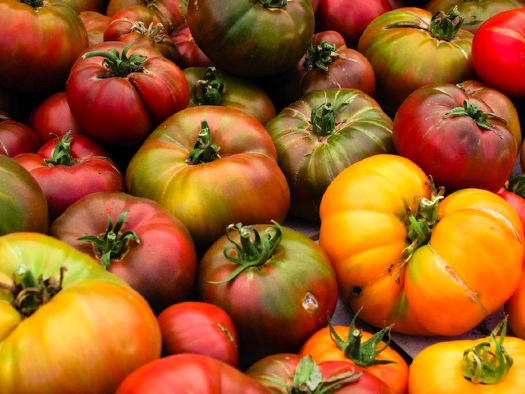
The last of summer drifts away as the leaves begin to turn and flutter to the ground. But even as the weather turns (and let me tell you, the weather has definitely turned from warm and sunny to chilly and rainy), tomatoes are still around to brighten the day...for another couple of weeks.

Native to South and Central America, the tomato made its way from Montezuma's garden to Cortez's Spain (and subsequently the rest of Europe) in the early 16th century. The Italians embraced these beauties most heartily and were the first to actually cultivate the plants outside of the Americas. As a fruit from the Nightshade family, the tomato was thought to be poisonous by many, but it finally caught on in the rest of Europe and jumped over to North America in the early 18th century.

I find it fascinating that a crop that presently epitomizes a region, such as tomatoes in Italy or potatoes in Ireland, originated from a land across an ocean. Tomato breeding has led to a smaller scope of domestic diversity than the initial range of the wild plant, yet there are still more varieties (especially with the resurgence of heirloom tomatoes) than most people can handle. Take a look at this article on the impacts of tomato domestication and explore a snippet of tomato biodiversity.

As with many of the crops we have explored, tomatoes have an interesting and complex history of travel and domestication. But tomatoes are also incredibly versatile; there are just so many ways you can cook with them! Dice 'em, roast 'em, stew 'em, dry 'em, can 'em...this time of year, though, my thoughts turn to ways of preserving summer for the coming winter.

I attempted my first canning enterprise this past week. I'll get back to you in a few months as to whether they we properly canned (or whether I fell victim to botulism...). Try out this recipe for Roasted Tomato Sauce and read this sound advice before canning. I also might branch out and make tomato jam or oven-dried with my next batch of tomatoes...

Other fun recipes for end-of-summer tomatoes:
The Italian in me goes straight for bruschetta, crispy bread and drizzles of olio.
Panzanella for end-of-summer festivities
Classic and easy rustic tomato salad (basil may be getting harder to come by this time of year)
Moroccan tomato soup (dice your own tomatoes!) is perfect as fall sets in.
If you are in the mood for Indian, cauliflower tomato curry might be up your alley.
Seriously, tomatoes over polenta is fantastic and flexible (just leave out the cheese)
And Bitman blogged about season's last tomato sauce, so hop on board before it's too late!

Enjoy your season's end bounty. Stay tuned for some exciting posts in the coming week (conservation, blog action day, and one-year birthday)! Over and out!

Tuesday, September 21, 2010

Produce of the Week: An Apple a Day

image courtesy of Telegraph UK

Happy Autumnal Equinox! If any fruit epitomizes the autumn season, the apple would be it. And there is such a spectrum: from sweet to tart and tangy, crunchy to soft (and often mealy). Apples have an interesting history and a distinctly American character. Which is why this fruit is making a second appearance on Produce of the Week.

But apples are not American in origin. One of the achievements to emerge from the fertile crescent, this fruit made its first appearance in Kazahkstan at the birth of agriculture around 10,000 years ago! In the earliest of human civilizations, from Chinese to Egyptian to Indus, apples played a role as sustenance and luxury. The importance of apples should not be undermined, or written off as the common lunchbox fruit of today.

Apples pervade history and literature: as the impetus of Adam and Eve's fall in the Garden of Eden; the fruit of love and temptation throughout Greek mythology; cameo appearance in the Odyssey. Their reputation spans the spectrum, from virtuous to corrupt, health food to dessert. A world traveler, the apple has diversified into over 7,500 varieties worldwide. The fruit itself carries the genetic material for vastly different offspring; grown from seed, such apples are good for little more than hard cider (thank you Johnny Appleseed)! The gamut of apples today stems from long-term breeding and grafting practices of orchardists.

If ever asked about my favorite use for an apple, I would have to respond that nothing surpasses the joys of biting into a crisp and juicy piece of raw fruit. However, a close second would have to be a tasty apple crumble pie! If you don't want to go to the hassle (whatever, pies are easy) of making a full-fledged pie, try this individual-sized dessert I whipped up for this month's SOS Challenge.

Crispy Apple Bake (a healthful twist on an apple crisp)

1 medium gala, honey crisp, ambrosia, or other sweet and crisp apple

1/4 cup unsweetened almond milk

1/4 cup oat bran

1/4 cup rolled oats

1/2 tsp cinnamon

2 packets of sun crystals or powdered stevia to taste (the former is part real cane sugar, which caramelizes to provide a nice crispness)

1. Cut apple in half and remove seeds/core. Place on top of foil in a pan or baking sheet.

2. Combine all filling ingredients. Stuff into the apple halves.

3. Wrap in the foil. Bake on 400F for 20 minutes. Uncover. Bake for another 5-10 minutes, until apples are soft and oats are crisp.

4. Eat warm, as is or with some soy ice cream! (photo is actually of my apple crumble pie, but same idea, just no bottom crust!)

What else can you do with an apple? Possibilities are endless ... but my blog post isn't. So here are a few to try out:

Heidi's Broccoli Crunch or Curried Apple Cous Cous (this sounds familiar...)

Smitten Kitchen's Cabbage, Apple, and Walnut salad (minus the blue cheese and creme fraiche)

Just-a-tad-early-for-Thanksgiving Apple Stuffing

Baked Squash and Apples (sub olive oil for butter)

And don't forget kids, "an apple a day keeps the doctor away"... so enjoy the wealth and variety of fruit this fall!

Tuesday, September 14, 2010

Produce of the Week and the End of Summer

I honestly don't know where August went. Maybe to the invisible DC-housing monsters that haunt me on a daily basis? As such, I will plead lack of baking paraphernalia, cookware, and well, time, as my excuse for not posting or completing last month's Daring Baker's Challenge (which I will do someday). Despite still not having settled into a place of my own, I have managed to freeze away four gallon bags of sliced peaches. If anything, this was a successful hoarding of summer's bounty.

But peaches are not our produce of the week. Pattypan squash are a variety of summer squash (as is the traditional zucchini). Native to the Americas, squash has been consumed by humans for at least 7000 years. All falling under the same species, squash have a long history as part of Native Americans' diets - along with beans and corn. If you have ever been to a farmers market in late summer, you have probably witnessed the immense varieties. Squashes tend to be quite promiscuous, their flowers being openly pollinated by bees.

Most of the dishes I make with zucchini stem from the Italian tradition. Granted, Italy's warmer temperatures and sunny skies lend themselves better to growing zucchini than most other European countries. But there is so much more to do with zukes than sautee them with some tomatoes!

Ok, here is what I uncovered (and have yet to try):
Heidi of 101 cookbooks has a slew of recipes - most of them are very un-vegan, but I liked the sound of the Vegetable Cianfotta, the Spinach and Zucchini Soup, and a Chickpea StirFry.

NY Times made my day with a Summar Farro Salad and a Zucchini Panzanella Salad.

I also really like zucchini taking an Indian twist. So, Honey and Spice's Curry recipe caught my attention. You can also just sautee up some zucchini with mustard seeds, curry powder, and onions.

Finally, Sweet Beet and Green Bean has an awesome recipe for a gluten-free, vegan zucchini pizza! Or, you can check out my concoction I brought to work:

Scrumptious Zucchini Bread

1 large patty-pan squash (about 3 cups grated)
1 1/3 -1/2 cup turbinado sugar
2 tsp cinnamon
1 tbs starch
1 1/3 cup flour
½ cup corn meal
¼ cup oil
½ cup almond milk
2 tsps baking powder
½ tsp salt
(optional) heaping handfuls of chocolate chips

1. Whisk together sugar, oil, and milk. Incorporate zucchini fluff.
2. Add in all dry ingredients and mix until just combined.
3. Throw in some chocolate chips, if you want.
4. Split between two loaf pans (or 4 small) that are oiled and floured. Bake at 350F for 35-45 minutes, until a knife comes out clean. It will be moist, but that's what is so wonderful!

Next post (hopefully soon): The Meat of the Issue, followed by some apples.

Saturday, August 28, 2010

Produce of the Week: Minty Morsels and a Meaty Movie

Summer is such a fantastic time for produce lovers. So much good, fresh flavor over-flowing! One little leafy plant, often considered a weed as it rapidly takes over all available space in your garden, adds a nice clean taste to summer meals.

Mint, genus Mentha, spans an extensive range of species and varieties. Due to a rhizome (runners) rooting strategy, they spread quickly and are hard to oust once established. Spearmint, one of the most popular varieties, has a long history dating back to biblical times. Mid- second millennium, it was touted in England for its use to relieve ailments (especially digestive ones) and aid wound healing. Even today, many of us enjoy sipping mint tea (fresh mint leaves steeped in water are fantastic) when a stomach ache comes on.
Well, this month's SOS Challenge embraced this tasty herb. I had several lofty dessert plans, including something chocolaty or fruity. But, alas, I went the savory route with a light tabouleh dish. This recipe does not really require proportions and such; it's more based on ones own tastes.

Height of Summer Tabouleh
1 cup bulgur wheat
2 cups boiling water or vegetable stock
2 medium tomatoes
1 large cucumber or several small ones
Handful of mint, chopped
Dash of white wine vinegar
Coarse sea salt, to taste
Olive oil, optional

1. Pour boiling water over bulgur. Let sit for an hour or so, until all the liquid has been absorbed into the grain.
2. Add chopped veggies, herb, vinegar, and salt. Toss. Dish out. Enjoy!

Wow, that was pretty simple! My minty dessert that evening was a delightful figgy dish. Make it vegan with either cashew ricotta (whiz some raw cashews, silken tofu, lemon juice, and pinch of sugar in a food-processor) or non-dairy vanilla yogurt. I'm a honey-eater, but agave would be fabulous, as well.
And since mint spreads like an epidemic, I'm sure if it's growing in your back yard, you have plenty more of it. Celebrate the end of summer and the peak of eggplant season with this minty dish from Calabria from Scratch.

Make Heidi's amazing Moroccan Baby Carrots or her Curried Apple Couscous...yes, I am drooling right about now. Smitten Kitchen has a lovely Mango Slaw recipe, and keeping on the sweet stuff, check out NY Times Mint Sorbet! And don't worry, Bobby Flay has us covered in the beverage department, with a nice refreshing Mint Mojito.

So now that you are all nice and situated with your refreshing drink, lounging in the remnants of summer sun, take a chance to watch my friend's awesome video on CAFOs and our commercial livestock industry. He brings up excellent points about the accumulation of waste and its impacts on the surrounding environment.