Pages

Showing posts with label nutrition. Show all posts

Sunday, May 1, 2016

Optimizing Below the Line

The week's food for Live Below the Line 2016
Over the years that I've been involved in the Live Below the Line challenge, friends have voiced concern about whether I consumed enough calories over the week. My response has been to address them in a cursory fashion - it's only for five days, no real harm done. This year I thought it would be useful to provide a bit more detail on how my dietary choices for the week stack up. It's  interesting, because even in the microcosm of a week of impoverished eating, we can glean insights about the trade-offs confronted when living at the poverty line. And maybe consideration for these trade-offs happens overtly, making calculated decisions over the week as I have done, weighing the costs and benefits of consuming adequate calories versus avoiding often highly processed foods. Or perhaps not so overtly or consciously contemplated (we don't all like playing with spreadsheets...), where foods are chosen that induce happiness or make you feel full or are just plain convenient. For many, in the end it's still an economic choice.

On looking at the spread of food I picked up for the week, it actually not only looks adequate, but relatively varied and nutritious. However, it quickly becomes apparent that optimizing solely for calories leaves some gaps in variety and micronutrients that are sought after in a balanced  diet. In years past, I've forgone additional grains in favour of a nice cabbage or a few extra sweet potatoes. But this was also possible given that I only undertake this 'challenge' for a week. For those who don't have the option to go back to their 'regularly scheduled programme' after five days, a calorie deficit day-in and day-out, months and years on end, can be wearing and debilitating. In this year's breakdown you'll notice that starchy staples (I include split peas) make up over 85% of calories and over half of my budget. FAO estimates that over 70% of calories in the developing world come from carbohydrates in contrast to less than 40% in developed countries, which seems to check out. 

Item
Calories per Day
Other Redeeming Qualities
Cost
Rolled Oats (750g)
600
High in fibre
$1.05
Brown Rice (1kg)
700
Protein
$2.29
Split Peas (500g)
330
Protein and fibre
$1.60
Potatoes (500g)
90
Um…
$0.50
Sweet Potato (240g)
40
Beta carotene/vitamin A
$0.48
Pumpkin (675g)
65
Beta carotene/vitamin A
$0.99
Carrots (400g)
30
Beta carotene/vitamin A
$0.52
Onion (170g)
15
Flavonoids
$0.26
Canned Tomato (400g)
15
Vitamins C & E; lycopene
$0.59
Salad (120g)
5
Vitamins A, C, & K; Iron
$0.30
Bananas (600g)
100
Potassium
$0.75
Salt (25g)
0
Iodine; flavour enhancer ;)
$0.05
Curry Powder (15g)
0
Anti-inflammatory properties
$0.50
Cinnamon (2g)
0
Anti-inflammatory properties
$0.12
TOTAL
1990 kCal/day

$10.00

The trade-off perhaps also helps to explain why the food security discussion has for so many years focused on quantity over quality (it could also have something to do with the history of food aid...). Getting people enough food is far easier and cheaper than getting the right food to them. Some effort has gone into the breeding and integration of fortified crops like golden rice and orange-fleshed sweet potatoes, both of which try to address vitamin A deficiencies, particularly among malnourished children. More recently, development groups have tried promoting home gardens as a means of introducing variety and nutrient-dense foods into both rural and urban diets. In developed countries, we are less plagued by a reliance on cassava, maize, and rice, and moreso on processed foods that replace nutrient-dense whole ingredients with cheap fillers and additives.

Finally, let's turn to the situation here in Australia. It has been quite a shock to me, finding the cost of food here in Brisbane greater than either Washington, DC or Oxford (check out the related posts for past budgets...). I think part of the reason the breakdown this year is so carb-heavy - and I should note it's the highest calorie count of the five years - is because fruit and veg is so gosh-darn expensive. This in and of itself is astonishing considering how conducive the weather is to growing crops year-round (kinda like California...) - 2/3 of Australia's land is devoted to farming, although 90% of that is for grazing animals and livestock. According to the Queensland Farmers' Federation, the state produces the majority of the country's banana, pineapple, mango, mandarin, avocado, beetroot, and  tomato harvest. That said, there are a couple of things that could be driving the prices up: Australia is a large country, concentrated in urban hubs (with a tiny part of the population growing food distributed across the vast rural areas), so the distance food travels is generally high; water is scarce and irrigation is usually a necessity; and a small number of retailers (well, two) dominate the sale of food. So for now, I will have to make due with produce from the 'sale' shelf and large quantities of rice over the next five days. At least it provides ample fodder for contemplating 'nutrition security' and the everyday challenges of making dietary trade-offs when faced with financial constraints.

Don't forget, You still can donate this year!

Related Posts:

Tuesday, February 26, 2013

What's Cooking? Spicing Things Up

Spices have long had a certain mystique to them. The dried seeds, roots, bark, or fruits of a plant have been used for thousands of years to add flavor, color, and complexity to culinary concoctions. Herbs and spices were sought for medicinal purposes, to cure the bad humors. Used in religious ceremonies and for preservation or embalming, spices made their mark in the historical record. Movement throughout much of the ancient world was due in large part to trade of spices. And during the middle ages, these coveted commodities fetched a grand price on the European market. They inspired conflict and war, and spurred on exploration and an age of discovery around the globe. It's interesting to consider that the now commonplace cinnamon or pepper were once treasured status symbols of civilization.

What I find fascinating about spices, though, is why they have such potent flavors and medicinal properties. According to a Cornell study now a decade and a half old, found that chemical compounds in common spices act as anti-bacterial agents. Not surprisingly, those same chemicals are what ward off pests that threaten the plant's survival. And if you are a proponent of cultural evolution, you can see how taste might be influenced, and more likely to survive to the next generation, in circumstances where cooking used a lot of spice to kill of bacteria in food. In Ayurvedic tradition, herbs and spices are also noted for their impact on digestion and properties that affect the constitution (such as heating and drying). Ginger, cumin, and turmeric all support strong digestion, and pepper and garlic have powerful antibacterial properties.


Good Health Curried Peas
1/2 onion
1/2 shallot
1 tsp mustard seed
2 cloves garlic
1 tbs olive oil
1 tsp sesame oil

1 cup split peas (soaked overnight)
3 cups vegetable stock (or water in a pinch)
1 carrot, chopped
1 parsnip, chopped
1 sweet potato, cubed
1 cup kale, chopped (optional)

2 tsp salt, to taste
2 tsp turmeric
2 tsp curry powder (or additional turmeric, cumin, cayenne,
1 tsp cumin
1 tsp cayenne chili pepper
1 tsp fresh ginger, grated

1. Heat oils in a sauce pan over medium heat. Saute onion and shallot, with mustard seed, until translucent, about 5 minutes, and then add garlic.
2. Pour in water and bring to a boil. Add split peas and allow to cook for about 15 minutes. Continue to cook another 10 minutes with carrot, parsnip, and sweet potato. 
3. Conclude by adding in the array of spices, adjusting accordingly for your taste, but don't be shy! Allow to simmer another 15-20 minutes. Serve in a bowl as soup, or reduce the amount of liquid by 3/4 cup and serve with rice.

Mmm, tasty and fortifying! Find more culinary marvels on Slightly Indulgent Tuesdays and Wellness Weekends.

Photo credits: Riyaad Minty (top); Colin Houston (bottom)

Wednesday, May 9, 2012

My Munchable Soapbox: Mid-Week Musing


Embarking on my third day of the Live Below the Line Challenge, I have to admit to slightly dreading the next three days of lentils and barley. The monotony of eating the same (bland) thing, in large quantities, every day, has gotten old fast and taken its toll on my poor stomach. Not that it is not filling; just not satisfying. But I was optimizing for calories and protein, not for taste, variety, or micronutrients. And while my diet this week could be a lot worse - primarily pasta and other refined carbs - it is also missing some key elements necessary for a healthy body.

However, this choice between quantity and quality of calories is a common dilemma faced by those on a limited budget. The UN FAO estimates that urban households in Africa and Asia spend up to 50% of their food budgets on cheap "convenience" foods. If you can imagine the convenience foods in the U.S., it is not a huge leap to comprehend the nutritional deficiencies of such a diet in developing countries, as well. One proposed approach is urban and peri-urban horticulture, establishing school gardens, and utilizing vacant space. Some organizations like Bioversity International are promoting a diversity of agricultural crops to improve nutrition.

Here in DC, there are also community gardens scattered throughout the city. One, Common Good City Farm, seeks to increase the food security and nutrition of the surrounding low-income community. Those making less than living wage in the city are eligible for work-for-produce arrangements or reduced-cost community supported agriculture packages. The farm grows a wide range of fruits and vegetables, from peaches and figs to kale and okra. Particularly for urban residents who may not be able to afford the high cost of fresh produce in town, this can add some much needed diversity and color to an otherwise highly processed diet.

So, what have I learned so far, what would I do next time? Under the same circumstances, living in a city where food (as well as everything else) is notoriously expensive? Hands down, I would sacrifice quantity for quality. Give me some spinach, even frozen, and a can of tomato paste, and I would be ten times happier.

Wednesday, January 11, 2012

My Munchable Soapbox: Guiding our Food Choices

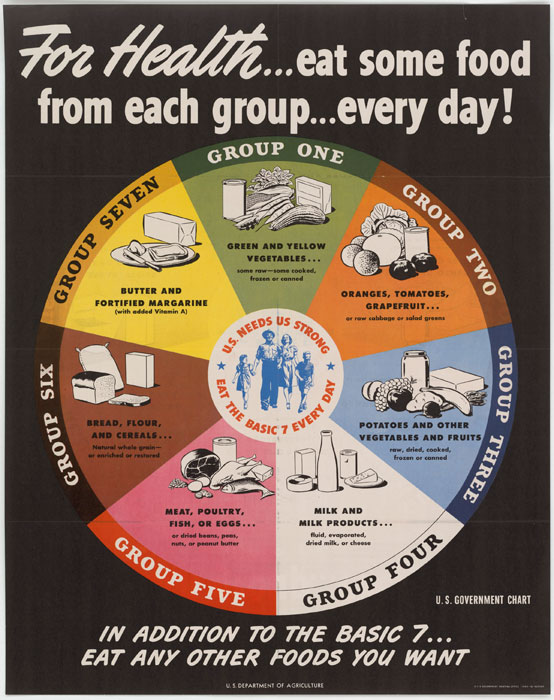
Seven food groups in 1941...luckily, Butter is its own!
New way of visualizing the food groups is 2011
Food and diet is one of the most personal of decisions. What passes our lips, what nourishes our bodies; and what could be more personal than that? But our choices of what we consume are colored by the messages conveyed through the media. While advertising by food companies may be the first thing that comes to mind, the government actually has a considerable role in coloring our perceptions.

One of the most pervasive forms of government intervention in our food systems are nutritional guidelines. Daily recommendations were first published in 1916 with five food groups: meat and dairy, cereals, fruits and vegetables, fats, and sugars. The number and composition of the food groups has changed numerous times over the course of the century. Twelve in the 1930's turned into seven in the 1940's and four in the 1950's. The pyramid we know too well was introduced in 1992, before landing on "My Plate" in 2011.

It's interesting to note the changes in food groups - the loss of a butter category, the consolidation of vegetables. Yet while strides have been made in research and understanding of health and research, the fundamentals of the USDA guidelines has really not changed significantly in all these years. So, what's next for food recommendations, and will these accomplish more in influencing healthy eating decisions by the American public?