Pages

Showing posts with label coffee. Show all posts

Saturday, August 19, 2017

For the Love of Chocolate

-->
Hola devoted readers! I’m writing to you after a little adventure in Colombia recently came to a close. While I voyaged across the great ocean in order to present at the International Congress on Conservation Biology (yes, I did do some work…), I stayed for the biodiversity and agroforestry.
Colombia is a biodiversity hot spot, with endemic species of fauna and flora, as well as a range of alluring ecosystems to explore – from montane rainforests to savannas, beaches, and deserts. Even staying along the Caribbean coast, I found the elevation gradient provided a wealth of possibilities - sandy beaches bordering bathtub-warm water; sticky tropical rainforests, and the cooler montane forests that seem perpetually on the cusp of being shrouded in clouds. While the country is a birder’s paradise (over 1900 speceies), the attraction for me was in the coffee and cacao farms scattered around.
I was won over by Minca, a town about 45 minutes drive outside of Santa Marta, which climbs into the mountains a couple thousand meters above sea level. We stayed for a night on a coffee farm, turned bed-and-breakfast/retreat, tucked into the hills. Then I trekked up the next day to La Candelaria coffee and cacao farm for a bit of a tour from bean to belly. The owner, Eugenio, inherited this 85-year-old farm from his father (and grandfather before that), which spans 10 hectares of coffee, cacao (2 ha), and fruit tree, plus pasture for mules (so about 10 sports fields...). At the moment, he is in the process of converting to organic certification, which follows three main principles:
  • To foster bird habitat on the farm, there are dozens of different types of fruit, including mangos, oranges, and ten types of bananas!
  • No chemical inputs are used, so compost replaces fertilizer, salt water stands in for the fungicide against black pod disease, and frequent harvesting saves cacao pods from pesky birds and squirrels.
  • And while he didn’t provide details, fair and safe labour practices are an element of certification. 
As a small farm, they don’t have the capacity to make and sell fully processed chocolate bars, so I escaped with bags of pure cacao (think unsweetened chocolate bar). You're not going to find this stuff in your local chocolate shop.

But you might find the coffee ... well, you might find Colombian coffee with beans from many farms. Eugenio admitted that most of his sales are to domestic restaurants/cafes and tourists. That's because coffee gets a bit political. The Federacion Nacional de Cafeteros de Colombia controls all coffee exported from the country, requiring permissions if farmers want to ship any of their product overseas. While this is not necessarily a bad thing, as it ensures a standard of quality for coffee and helps to avoid prices fluctuations, it also can make things difficult for a small farmer who has higher marginal costs for the amount of coffee he produces.

This has some implications for the "direct trade" coffee en vogue at the moment. The idea behind this concept is to cut out the middleman between coffee farmers and roasters, so that more of the value is captured by those growing the beans. For coffee connosieurs, it also means roasters have more control over the beans they are getting and the subtle distinctions causes by soil, climate, and farming practices. While it's not without problems, for many it can mean longer-term, more trusting relationships between suppliers and buyers. For now, I'll just be satisfied with my directly traded coffee and cacao in small quantity...

Thursday, August 7, 2014

My Munchable Soapbox: Certifying Gender Equality

Preparing gari - a product of cassava
-->
My research took an unexpected turn this summer – while starting out with the intention to focus on extreme weather events influence farmer’s management decisions, it soon became pretty clear that almost all the weather is just some shade of extreme here. And when farmers say that moderation is best for cocoa, they will provide a month where this happens, not any particular year. Keeping my eye on the climate change adaptation ball, I shifted gears a bit to try getting at how impacts from climate change could affect the household, and specifically how women can and do respond to stresses. Though not a part of the research (yet very much an interest), I thought that certification’s consideration for gender would be an appropriate topic to discuss here.

“Gender” issues are pretty en vogue, at the moment. ISEAL alliance, a network for certification and standard bodies, madethe case for why more gendered attention is needed in certification. But I’m always a bit skeptical about these fashionable issues; I wonder what “considering gender” is actually achieving. The goals of certification range from guaranteeing a “fair price” and combating child labour (which is a whole other issue entirely) to encouraging environmentally sound and long-term sustainable practices.

Coffee has proven a popular case study for those interested in certification. It has everything – organic, fair trade, shade-grown – but the question of whether there is equality in impacts for men and women remains largely unanswered. In Uganda, for example, coffee is the primary export, employing 3.5 million families. Women make up close to 80% of agricultural production and over 50% of commodity crops. Women in the study noted how the gendered division of labour within the system are limiting equal benefits – for example, women are often relegated to working on the farm, but don’t actually make it up further in the supply chain. It also comes down to who deals in the finances.

This all sounds very reminiscent of my conversations with women farmers here in Ghana. For the most part, they work their husband’s cocoa land, and primarily tend to the food crops (maize, cassava, and plantain) that form the first stage of the cocoa cultivation cycle. While what she gains from selling these can go to household expenses, the woman don’t control the bulk of the household income, which seem to go to larger expenses like construction, fertilizer, sprays, and to some extent children’s school fees.

So when we think about the benefits that a certification might provide – price premiums, extension services, market access – those are not necessarily elements that women can readily access. But this is also an opportunity for certification: expressly aim to recognize women’s labour in the value chain, cultivate women leaders, and provide a platform for bring forward women’s issues. I also think that there is scope for considering certification for the crops that women do cultivate themselves, and have more control over the management and the revenue. It’s hard when the big money makers tend to be controlled by the men, but I have met several strong women who know their stuff and are very much standing on their own two feet.

Read More:

Friday, October 11, 2013

Friday Coffee Break: A Global Addiction

 So first off, no, Fridays will not be devoted to coffee. However, I managed to miss International Coffee Day on 29 September (because obviously we need a day for something in order to celebrate and enjoy it...). And while I don't pay quite as much attention to coffee as certain other tropical commodity crops (...chocolate...), it seemed like a good time to insert some coffee tidbits on the blog. 

In case you need a quick refresher, coffee is grown within a narrow latitudinal band around the equator, in approximately 70 countries. The "cherries" of the coffee plant, so the fruits and seeds, are roasted, ground, and brewed into the beverage you likely know and potentially love. Depending on the specific varietal of coffee 'tree', one can produce anywhere from a pound to three of coffee beans per year, though the relationship is negative between quantity and quality. 

As the world's most widely traded agricultural commodity, coffee is both a globally-important economic driver and a globally-significant force for people and the environment. In fact, despite being a non-nutritive food substance (read: it's not really going to provide calories or macro/micronutrients), over 400 billion cups are consumed each year, and the U.S. manages to be the most buzzed by importing about 1/3 of all coffee exports! For how different countries consume this beverage, take a look at this fantastic little infographic on coffee around the world!

Finally, putting on your sustainability-coloured glasses, coffee has not only a large social impact but a sizable ecological and hydrological footprint, as well. One standard 125 ml cup of coffee requires 140 litres of water...let me repeat, LITRES. This embedded water we often refer to as "virtual water," which is insightful when thinking about the costs associated with a product that are not immediately visible. Coffee is also one of the crops most often associated with certifications such as fair trade (which is social and not necessarily environmental) or shade-grown/organic/Rainforest Alliance. Because there is a history of unfair labor practices, deforestation, and pollution associated with the commodity, and a growing threat from climate change to long-term production, such standards are seen as beneficial and increasingly being employed.

Worldwide we may have this addiction to coffee, though in what way and how much is consumed varies drastically regionally and even within segments of societies. But regardless of one's coffee affinity, it is interesting to think that a cup of what is sometimes called 'liquid gold' is so loaded. It is filled not only with a roasted, ground, and brewed tropical berry, but the environmental, social, and economic weights that exist with many of our most coveted commodity crops. And on that note, I better drink my coffee before it gets cold!

Thursday, May 2, 2013

Thirsty Thursday: Because NPR Loves Coffee...

One of the primary reasons that I undertake to live below the line is that day in and day out I am confronted by the issue of small-scale farmers trying to earn a living, feed their families, and not compromise their land and livelihood for future generations. While many of those in developing countries are likely subsistence farmers (meaning they grow to eat not to sell), there are 30 million that grow coffee and cacao for export. So what better commodity to hone in on than coffee (ok, maybe chocolate...)?

Apparently NPR's Morning Edition had the same idea last week. An interview with author Mark Pendergrast, of the new book Uncommon Ground, elucidated the ironic nature of coffee historically as both a convener of revolutionary ideas and the impetus for enslavement. Pendergrast also made the link between the social, economic, and environmental elements of commodity colonialism (is this a term?)..."In Brazil — where slavery was legal until 1888 — coffee plantations would use slash-and-burn agriculture, tearing down rain forests and planting coffee trees that depleted the nutrients in soil. Once the soil had been sapped, growers would move on to another place."

And this confluence of all three legs of the sustainability stool (social, economic, and environmental facets) was the topic of another segment on labels that indicate good behavior on the part of farmers and companies. Zooming in on Costa Rica, where one can find a wealth of coffee certifications, tradeoffs become evident. Cooperatarrazu was highlighted as operating as a collective, and striving towards meeting the standards of many of the certifications discussed. It was also one of the sites I visited last July!

Coffee may be nowhere close to falling within my food budget this week, but it is also not accessible to those who grow the coffee, either. And while it is unlikely that a farmer in rural Costa Rica will be sipping a latte anytime soon, there is headway being made in terms of making the production and sale of the beverage (or rather, the bean) more equitable and responsible. Keep on sipping your coffee, however, make sure to think carefully before pouring.

Also see: Step Aside, Gents. Witness the Rise of Women in Coffee

Photo credit: Neil Palmer (CIAT)

Wednesday, January 30, 2013

My Munchable Soapbox: How Fair is Fair Trade?

If you are reading this, you have likely internalized the mantra that you "vote with your fork" three (probably more) times a day. But those of us who are hell-bent on changing the food system through consumer decisions sometimes find it quite difficult to figure out exactly what we're actually voting for. Labels exist and are proliferating, but more often than not the consumer is left seriously wanting in the information department. And sometimes, what we think we are voting for with a specific label may not be quite what was expected.

A recent paper from the Center for Global Development (CGDev) gets at the questions implicit in this issue - does fair trade work for producers? how fair is fair trade for consumers? Specifically concerned with the coffee market in the US, the report looked at the current state of the fair trade market, and considered the implications of the US break-off from the international Fair Labeling Organizations. In an interview the author also noted that despite the lack of clear, universal benefits from fair trade, it does make markets work better by including some of the costs associated with irresponsible labor and land management practices.

Regardless, it always pays to do your homework. Part of being an ethical and conscious consumer is not blindly following the trendy certification. For now know, that generally speaking, purchasing fair trade will be getting us one step closer to a more just food system.

Wednesday, December 5, 2012

Best of MMM: Dying Breed Brownies

I may have gotten home yesterday, but I am in no fit state to write a blog post. Luckily, there are plenty of past posts on climate change to fill the space. This one from early last year touches on climate impacts on two of the most beloved commodity crops - coffee and cacao. Sound familiar? Well that's because less than a month ago there was more hype about the end of these as we know them. At least you can make tasty, caffeinated brownies to drown your sorrows...
---
We ended last week covering the floods and droughts wrecking havoc on crop production across the world. To build on the trend of climate change-induced extreme weather events, I thought it would be nice to discuss the impacts of a changing climate on a few agricultural products - a commodity crop, a major cereal grain, and your backyard veggie.

While we recently explored coffee's impact on biodiversity and ecosystem function, tonight we'll flip the coin and

look at how these climate shifts will impact coffee. Arabica coffee grows best in sub-tropical and tropical regions of the world, with temperatures moderated between 15-25C and wet/dry seasons clearly defined. Robusta coffee is less sensitive to climatic variation. Flowering and seed production relies on rainfall, so one can imagine that as droughts become more frequent and severe in the rainiest regions of the world, coffee production will begin to suffer. Essentially, whether it's too much or too little, the negative impact holds.

Already we are seeing yield decreases and crop losses due to decreased rainfall in Costa Rice or the flooding Colombia. An article last week at TreeHugger considered the "peak" of high-end coffee (like Arabica), with temperatures and rainfall patterns moving away from favorable growing conditions. Laderch, et al. (2009) completed a study modeling areas that will still be suitable for coffee production in Nicaragua and Veracruz, MX, and how the varieties cultivated may have to shift. They also speculated on possibilities for adaptation in these seriously impacted regions.


Last week, the Seattle Times posted this video on the impact of climate change on Costa Rican coffee farmers, emphasizing the already dire need for adaptation measures and the looming challenges all crops will face. Last Wednesday was a hot day (no pun intended) for coffee, with the New York Times also running a piece on climate change and Colombian coffee. Rust, a fungus capitalizing on warming temperatures in the higher montane altitudes, is of particular concern and has decimated crops. Check out the videos and photo set from the article.

So what did I do in response? Drown my sorrows in a decadent treat using three major tropical commodities - sugar (Whole Foods fair trade cane sugar from Malawi), chocolate (Trader Joe's cocoa powder from Colombia), and coffee (Starbucks Komodo Dragon Blend from Indonesia).

A Dying Breed - Mocha Brownies (serves 9; GF/VG)

1/3 cup vegan white sugar/evaporated cane juice
1/4 cup turbinado sugar
1 tbs molasses
2 tbs ground espresso, brewed in 1/4 cup hot water
1 tbs Kahlua/coffee liqueur (or 1 tsp vanilla extract)
1/4 cup oil
2 tbs fruit puree (like apple butter) or coconut cream

1/4 cup cocoa powder
1/4 cup tapioca starch
1/4 cup millet flour
1/3 cup brown rice flour
1 tsp baking powder
1/2 tsp salt
1/3 cup chocolate chips melted
1/4 cup chocolate chips

1. Whisk together oil, molasses, sugar, apple butter (or whatever you are using) and Khalua. Pour in hot coffee and continue to whisk. It should dissolve all the granule-y sugar. Combine cocoa powder until uniform.
2. Mix in tapioca, millet, and rice flours, along with baking powder and salt. Once all incorporated, fold in melted chocolate and chips.
3. Pour into a greased 8x8 inch pan, baking at 350F for 30 minutes or so, until edges are set. Leave in a little longer if you don't want uber gooey, underdone, yumminess of brownies.

Enjoy your little piece of heaven before Global Weirding turns coffee (and cocoa) production on its head! Commodity crops, such as the cocoa, sugar, and coffee of the world, may only be a small piece of our agricultural puzzle, but they have broad implications for smallholder livelihoods in developing countries. While we will be exploring food stuffs that more directly impact hunger in the ensuing posts, keep in mind that these 'luxury' items (because that is what they should, and will, be) are essential income earners for many tropical dwellers and DO put food on the table.

Wednesday, November 14, 2012

My Munchable Soapbox: An Endangered Beverage (and more...)


Remain calm. Breathe. Your morning routine will be OK.

Well, at least for a while. A new study has predicted that wild Arabica coffee will have gone extinct by the end of the century due to climate change. According to a study in Ethiopia from the UK Royal Botanic Gardens, unfavorable weather conditions will negatively impact coffee output in Africa's largest coffee producing country. Increases in pests and diseases, as well as reductions in seed dispersers like birds, are expected to exacerbate the impacts. Now, it's important to note that this is not the commercial variety found in your coffee mug. However, wild varieties are what allow commercial growers to incorporate more genetic diversity into their production systems, and we know how important biological diversity is for adaptation and weathering shocks.

This is not the first time we've been warned about the pending doom of our favorite morning beverage because of climate change; nor is coffee the only commodity feeling the burn. With the flurry of news around coffee, cocoa almost got brushed under the carpet (or perhaps it was just trying to ride the coffee-induced climate high). Over 70% of the world's cocoa is sourced from West Africa - not necessarily the fine artisan chocolates, but the Hershey's, Mars, and Cadburys of the world. But cacao is a finicky tree, and has a pretty narrow temperature range of compatibility. The short of it is, the temperature in the most important growing regions is becoming to hot, and will exceed thresholds in the next 50 years.

And what can we do? Well, we should definitely be trying to mitigate climate change, reducing greenhouse gas emissions. But our crops will also have to adapt. Companies, like Starbucks, understand that their entire industry is at risk are working both to develop varieties better adapted to new conditions and to build resilience into the system as a whole, restoring the ecosystems. 

Did I say stay calm? I take that back. You're Cuppa Joe may be ok, but we have a lot of work ahead. So take a deep breath, a sip of coffee, and hope we can weather the effects of the greatest environmental challenge this and the coming generations face. (a bit melodramatic? Just ask our ice sheets...)

Learn more:

Saturday, July 7, 2012

Celebrating A Day for Cooperativos


They are pretty small plants, perhaps I would call them woody shrubs, with cranberry-like fruits along the branches. Not surprising considering the perfect mix of cool temperatures, precipiation, and elevation, the hillsides of Costa Rica's Central Valley are covered in the crop. In the Valle de Dota region, which produces what many consider the country's best coffee, the "Goldilocks" set of conditions exist - quality coffee is grown at elevations between 1,200 and 1,500 meters, with rainfall averaging 2,500 mm per year, and temperatures between 65F and 80F - essentially juuust right!

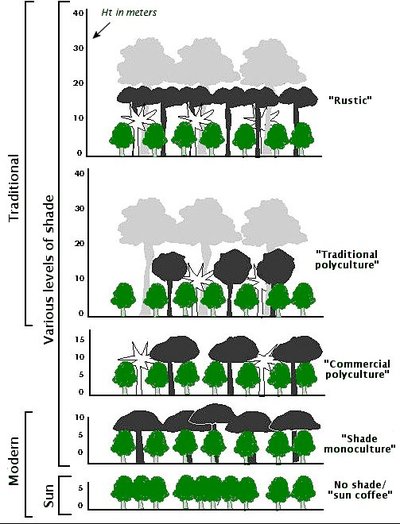
It seems as though your typical coffee farm has a mixture of the coffee plant, a few leguminous (or nitrogen-fixing, e.g. fertilizer) trees, and some banana palms for shade and, well, bananas. First of all, it's important to note, that despite the presence of fertilizer trees, farmers still tend to over-apply nitrogen fertilizer, to the tune of 70% running off the fields! While farmers continue to apply more and more thinking this will increase their yields, there is sadly no correlation with the added nitrogen inputs and yield. Second, and probably more crucial to my own purchasing decisions on coffee, our few days in the Central Valley made me realize the variation inherent in different certifications and designations. I know we have discussed coffee at length on the blog, and shade-grown in particular, but I didn't really comprehend how "shade-grown" can mean so many different things.

Often hailed as the gold standard of sustainability in coffee, shade-grown encompasses everything from monocultures of coffee with a couple of species of fertilizer tree and banana palm interspersed, to several varieties of the caffeinated shrub growing in the understory of a forest. And just because it's shade-grown does not necessarily mean it is chemical free. To combat funghal diseases and insects pesticides, fungicides, and herbicides are applied even in these shade systems. Then we have organic, which only amounts to about 1% of Costa Rica's production, and Fair Trade, which has its own discrepancies. So what's a coffee drinker to do, particularly in a country where coffee is so integral to the economy?

So let's go back to the Valle de Dota and our little coffee adventure. Most of the farmers in the area are not the big guys, but rather smallscale farmers who have combined forces in cooperatives. In light of July 7th, International Day of Cooperatives, the particular cooperativo that J and I visited in San Marcos - CooperaTarrazu - is of note. With about 2,700 members, CooperaTarrazu provides technical, processing, and marketing assistance. Early on in their 50-year history, the co-op realized the importance of improving both methods for their member farmers and the economic returns, to ensure long-term sustainability. This meant changing variety of coffee grown to a more marketable, high-quality bean; reducing chemical fertilizer and pesticide use and waste from processing; and incorporating shade trees. Fair Trade and Rainforest Alliance certifications, C.A.F.E. standards (pdf), and the Pesticide Action Network's approval in concert not only improve sales and export potential, but also have strong explicit social and environmental criteria to ensure better production and proactive management. 

With my bag laden down with bags of coffee (and smelling wonderfully, I might add), I have a new appreciation for the whole value chain of a cuppa. I've said it a million times, but now I feel its weight fully, as a consumer you have A LOT of power influencing how your coffee is grown. So embrace it and support cooperatives and organic+shade-grown producers. Plus, it's just really good coffee!

Hasta la proxima vez!

*once again, the photo is courtesy of J's phone!

Wednesday, July 4, 2012

Of Coffee and Bus Rides


Steep hillsides planted with rows of tree crops or vegetables flash by, as the crowded bus takes the hairpin turns at a solid forty miles per hour. The landscape of the Costa Rican central valley (oxymoronic, right?) is a hodge podge of cash crops like coffee, vegetables, pasture, and the odd forest fragment. But these form the basis for the region's residents' incomes.

It is only midday, but J and I have already been up and about for eight hours. After a couple of packed days at the Centro Agronomico Tropical de Investigacion y Ensenanza (CATIE), we are leaving the region behind to move on to the next phase in out two-week adventure. 

The past two days have been early mornings, catching and banding birds in a couple of types of agrictural lands to see how they move through the landscape. This is important for the birds and other wildlife, in that their habitat is connected and that farmers are not spraying pesticides during mating or nesting seasons. 

We also had the opportunity to explore CATIE's cacao collection and learn about some of the challenges farmers face. Because of the spread of disease, cocoa has become a more minor crop in the country. Breeding new varieties that are resistant to disease, and planting fruit trees for shade and extra income, is beginning to address some of these hardships.

So, in four days, what are my take aways?
  • Rice and beans are cheap, easy to make, and common fare among Ticos. 
  • Bananas (and really all tropical fruit) taste better here. There is no going back! 
Ok, there are definitely more than that. But there are still one and a half weeks left of vacation, so I don't want to tire you out too soon!

Saludos.

Photo is courtesy of J.

Wednesday, June 20, 2012

My Munchable Soapbox: Coffee Kills...

Token lemur photo (Milne-Edward's Sifaka)
...monkeys. Well, at least that is according to a blog post on Scientific American. And, in fact, the monkey in question is specifically the black-handed spider monkey (and not the lemur to the left...), which lives in Central American forest canopies. Why is the blog post author's cuppa joe killing this monkey? Not surprisingly, the destruction of forest for coffee plantations (probably in addition to all the other multitude of drivers of deforestation) is at the heart of the matter.

But besides the coffee bean threat, the article gets at the deeper issue - be it coffee in Costa Rica, oil palm plantations in Indonesia, or mining in Madagascar - global economic demand for commodities drives habitat destruction and ultimately threatens cute, fuzzy, charismatic megafauna. Ok, I'm not advocating for everyone in the world to stop buy 'stuff.' But at its core, this article is actually about the loss of species. The author argues, "this loss of biodiversity may be the single largest environmental change we humans are foisting on our home planet, outpacing even climate change."

So, going back to the coffee example. Standards, such as those employed in certifications like Rainforest Alliance, are presented as the only option currently available for gaining information about the ethics of your coffee. This may have some grain of truth, and Rainforest Alliance does promote both ecosystem health and social wellbeing. But more importantly, it feeds into one of the author's main solutions - you know, just revamp corporations so that they are socially and environmentally responsible. Some companies are starting to do this (such as Starbucks and Nestle) with Business for Social Responsibility, or assessing their impact with an Ecosystem Services Review (pioneered by World Resources Institute and the World Business Council on Sustainable Development).

As I get ready to head off to Costa Rica in a week, for a little vacation/tropical agriculture exploration, I can't help but think about how the coffee industry and eco-tourism can go hand-in-hand in this country. No answers yet (and still working out details of the trip, if you have suggestions or particularly farm contacts), but my hope is upon returning I will have a little more insight and a fresh perspective on our consumption-driven environmental degradation. Now go eat a bar of chocolate and think this over...

Friday, December 2, 2011

Fast Fact Friday: Fair Trade Feuds

While I have not consumed a cup of coffee in over a month now, that doesn't mean I have lost my taste for the beans and the issues that surround them. Fair trade is not a new topic for this blog, even regarding coffee specifically. And I would never argue that the label is a panacea for sustainable and equitable production. However, I had primarily from a farmer's standpoint and not from the farm size angle. NPR recently introduced a podcast about scaling up fair trade to include large producers. Apparently, different certifying bodies have different views on the matter.

What might this mean for coffee consumers and producers? You will just have to listen to find out, I guess!

Friday, November 11, 2011

Fast Fact Friday: Turning up the Heat on Coffee

Coffee beans grow in a very narrow climatic range - too cold and you don't get beans; too hot and you don't get beans. More importantly, the lack of rain and new pests and diseases that coincide with these weather shifts are particularly detrimental to the productivity of coffee plants. One potential action to alleviate some of the stress is planting shade trees.

Read more about the plight of Ugandan coffee on PRI's The World. And buy shade-grown organic, when you can!!!

Wednesday, March 16, 2011

Get Your Caffeine Fix While You Can...

We ended last week covering the floods and droughts wrecking havoc on crop production across the world. To build on the trend of climate change-induced extreme weather events, I thought it would be nice to discuss the impacts of a changing climate on a few agricultural products - a commodity crop, a major cereal grain, and your backyard veggie.

While we recently explored coffee's impact on biodiversity and ecosystem function, tonight we'll flip the coin and
look at how these climate shifts will impact coffee. Arabica coffee grows best in sub-tropical and tropical regions of the world, with temperatures moderated between 15-25C and wet/dry seasons clearly defined. Robusta coffee is less sensitive to climatic variation. Flowering and seed production relies on rainfall, so one can imagine that as droughts become more frequent and severe in the rainiest regions of the world, coffee production will begin to suffer. Essentially, whether it's too much or too little, the negative impact holds.

Already we are seeing yield decreases and crop losses due to decreased rainfall in Costa Rice or the flooding Colombia. An article last week at TreeHugger considered the "peak" of high-end coffee (like Arabica), with temperatures and rainfall patterns moving away from favorable growing conditions. Laderch, et al. (2009) completed a study modeling areas that will still be suitable for coffee production in Nicaragua and Veracruz, MX, and how the varieties cultivated may have to shift. They also speculated on possibilities for adaptation in these seriously impacted regions.

Last week, the Seattle Times posted this video on the impact of climate change on Costa Rican coffee farmers, emphasizing the already dire need for adaptation measures and the looming challenges all crops will face. Last Wednesday was a hot day (no pun intended) for coffee, with the New York Times also running a piece on climate change and Colombian coffee. Rust, a fungus capitalizing on warming temperatures in the higher montane altitudes, is of particular concern and has decimated crops. Check out the videos and photo set from the article.

So what did I do in response? Drown my sorrows in a decadent treat using three major tropical commodities - sugar (Whole Foods fair trade cane sugar from Malawi), chocolate (Trader Joe's cocoa powder from Colombia), and coffee (Starbucks Komodo Dragon Blend from Indonesia).

A Dying Breed - Mocha Brownies
(serves 9; GF/VG)

1/3 cup vegan white sugar/evaporated cane juice
1/4 cup turbinado sugar
1 tbs molasses
2 tbs ground espresso, brewed in 1/4 cup hot water
1 tbs Kahlua/coffee liqueur (or 1 tsp vanilla extract)
1/4 cup oil
2 tbs fruit puree (like apple butter) or coconut cream

1/4 cup cocoa powder
1/4 cup tapioca starch
1/4 cup millet flour
1/3 cup brown rice flour
1 tsp baking powder
1/2 tsp salt
1/3 cup chocolate chips melted
1/4 cup chocolate chips

1. Whisk together oil, molasses, sugar, apple butter (or whatever you are using) and Khalua. Pour in hot coffee and continue to whisk. It should dissolve all the granule-y sugar. Combine cocoa powder until uniform.
2. Mix in tapioca, millet, and rice flours, along with baking powder and salt. Once all incorporated, fold in melted chocolate and chips.
3. Pour into a greased 8x8 inch pan, baking at 350F for 30 minutes or so, until edges are set. Leave in a little longer if you don't want uber gooey, underdone, yumminess of brownies.

Enjoy your little piece of heaven before Global Weirding turns coffee (and cocoa) production on its head! Commodity crops, such as the cocoa, sugar, and coffee of the world, may only be a small piece of our agricultural puzzle, but they have broad implications for smallholder livelihoods in developing countries. While we will be exploring food stuffs that more directly impact hunger in the ensuing posts, keep in mind that these 'luxury' items (because that is what they should, and will, be) are essential income earners for many tropical dwellers and DO put food on the table.

Thursday, February 17, 2011

Your Daily Caffeine Fix

Many of us need a cup of coffee to get our days started (I'm actually more a tea person...), so much to the point that it really has become ingrained in our culture. Everyone knows the Folger's jingle; Starbucks sits on every corner; the default meet-up is grabbing coffee. In fact, 400 million cups of coffee are consumed every day in the United States ... our population is 300 million.

Coffee has made an appearance before, when I blogged about the sustainability of the commodity. I wanted to take this opportunity to highlight A month ago, the Nourishing the Planet blog showcased wild coffee in Ethiopia, the location of origin for this prized bean. In the highland forests of Southern Ethiopia, local people have harvested, roasted, ground, and brewed wild coffee for thousands of years. The post tells the story of a region under threat from deforestation, population growth, and climate change - and the efforts by organizations such as Slow Food International to preserve these rare varieties.

But such a geographically-specific bean is not going to satisfy the crowds clamouring for a Starbucks trenta. At the same time, we can't afford the deforestation and exploitation of low-wage labor associated with coffee production. In response to this, certification schemes and sustainable agriculture projects have been implemented, scaled up, and marketed as a niche product. With any eco-label, the actual impact on the ground is questionable. However, a study in 2007 in Latin America concluded that a combination of organic, fair-trade, and shade-grown certifications yield the broadest set of benefits. Finding such a coffee is not easy, but there are a few out there*...
So, once you've identified a preferred sustainable coffee, you can make some tasty goodies to go along with your morning java.

Jump-Start Cupcakes (8-10 cupcakes gf/vg)

1 cup almond meal
1 cup brown rice flour
1/4 cup tapioca starch
1 tsp xanthan gum
1 tsp baking soda
2 tsp baking powder
1/2 tsp salt
1 cup sugar
2 shots espresso (about 4oz coffee)
1/4 cup oil
1 tsp apple cider vinegar

1. Mix together almond meal, rice flour, tapioca, xanthan gum, baking soda and powder, salt and sugar. Pour in coffee - it is fine if it's still hot. Also add the oil.
2. Combine only until all dry ingredients incorporated. Add the vinegar and mix one last time.
3. Slop into muffin tins. Bake at 350F for 30 minutes, straight. Do Not Open Oven Door!!! I did this and they fell!
4. Remove when they past the clean knife test. All to cool before piping on some chocolate frosting.

I topped these babies with some of Ricki's Chocolate Buttercream! No one has yet been able to guess the key ingredient...

Anywho, you can see that coffee has its sinister side, and even a sweet side. Care to grab a cuppa coffee?

Coffee Shop Reading Material:
* Organic, Fair-Trade, Shade-Grown Coffees: there are a lot of small roasters out there certified in all three. Look for the organic, fair trade (such as TransFair or Fair Trade Federation), and Rainforest Alliance or Smithsonian Bird Friendly labels. Small cooperatives are starting to gain steam in both coffee and cocoa, and are considered more sustainable in some schools of thought.

Wednesday, November 17, 2010

Sta Serra, La Mia Cucina Italiana

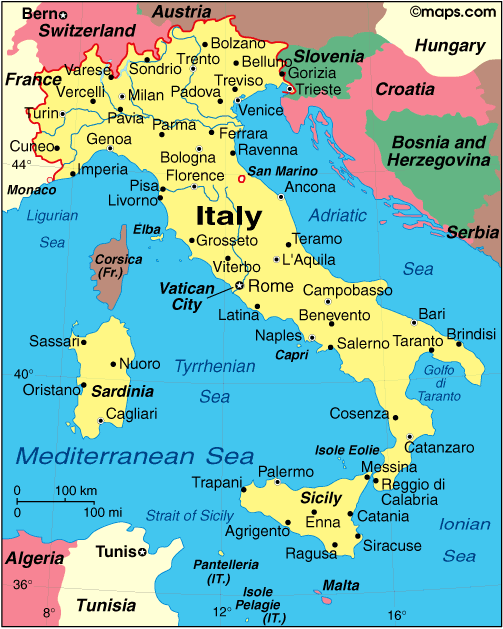
Food-wise, a Mediterranean week is hard to beat. And tonight is no exception, considering we're hitting the shores of Sorrento and the hillsides of Siena. That's right, tonight my kitchen was transported to Italy (well, a few nights ago, but we'll just pretend).
My first concoction comes to us from Tuscany. This central region of Italy is situated on the west coast, housing not only some of the main tourist destinations, but also picturesque hill towns and productive agricultural lands. Known for its wine, olive oil, and bread, there is no better picnicking region! My dish, however, left out wine and bread. Ribollita soup is a classic wintery stew, stock-full of kale and crusty bread. 101 Cookbooks has an alternate version, but the principle is the same. Being kale-less, I used regular (and not "Tuscan") cabbage ... and being bread-less, I used purple potatoes. That said, it was so tasty (forgot to take photos of the finished soup)!
And then I baked! My plan was to make biscotti all'olio d'oliva, nociolle, e limoncello. Sorrento, a coastal town in the south of Italy, is the home of the lemon liqueur called limoncello. The Amalfi Coast is a favourite spot of those on beach holidays. It also has some claims to fame, on the footsteps of Pompeii, a train-ride from Napoli, and decked out in amazing cliff-side beaches. Sadly, I had neither hazelnut flour nor limoncello. So, here is my makeover:

Biscotti di Mandorle e Caffé

150 g All-Purpose Flour
100 g Almond Flour
40 mL olive oil
40 mL vegetable oil
70 mL espresso
30 mL Kahlua (chocolate liqueur or amaretto would also be lovely)
90 g sugar

1. Whisk together oils, espresso, liqueur, and sugar.
2. Fold in flour and almond flour.
3. Form spoonful balls of dough. Place on greased cookie sheet and pat down.
4. Bake at 325F, for 12-15 minutes until slightly brown.

Tuesday, October 5, 2010

Your Morning Cuppa

Photo via prince_tigereye
♪ The best part of waking up, is Folgers in your cup ♪

Many of us grew up hearing this little jingle on the TV, but few (if any) of us considered the extent of the impacts that a cup of Joe has on the environment and people. Coffee is an interesting case study of a plantation crop that has wreaked havoc on ecosystems and local human communities in the tropics for decades, but actually has the potential to be an integral part of diverse and vibrant agro-ecosystems.

Now you've heard me go on about chocolate and how the ethics of consumption depend largely on how your cacao is grown and processed. Coffee presents many of the same challenges and benefits. Acting as the foundation for the livelihoods of 25 million people's, coffee production now covers an area larger than the size of Portugal.

Modern coffee plantations capitalize on the rapid growth and high yields resulting from direct sunlight afforded crops in monocultures, with no canopy of trees. Besides the obvious downsides of habitat loss, these systems also quickly degrade as soil erodes and loses nutrients rapidly. However, traditional production methods capitalize on the nature of this understory shrub or small tree by leaving the forest intact.

A month back, NPR host Guy Raz interviewed UC Berkeley (beat Cal) researcher Shalene Jha about how coffee cultivation can actually promote biological diversity. By maintaining a forest canopy, habitat for migratory birds, protection for essential pollinators, deterrents for pests, and water/soil filtration process are preserved. This in turn, fostering high biodiversity, also supports healthy crops and increases the resilience of such food systems! So scour the shelves of your grocery store for shade-grown coffee or google it and proceed to be overwhelmed. More and more manufacturers are jumping on board...well, maybe not Folger's.

Food for thought: Caffeine is actually the toxic substance meant to ward off seed predators in the wild...similar to nicotine in tobacco plants.

Learn More:
Maps: Coffee-Producing Regions via National Geographic or Conservation International