Pages

Showing posts with label tomato. Show all posts

Friday, August 15, 2014

Frugal Foodie on a Ghana Cedi: Candle-Lit Dinner

Let’s talk about electricity. You probably don’t think about it a whole lot (at least, I didn’t); something that’s easy to take for granted. A quick flip of a switch and voila, a luminescence appears without the slightest effort. But let’s suppose that is not the case. Perhaps 10:00am rolls around and BAM, the socket is dead, your computer has maybe an hour or two of life left, there is that important Skype call at noon, and the power could be out for an hour or ten. At least it’s a nice day, so take a break and go for a walk.

But let’s say it’s 6:30pm, you’ve just begun to put dinner on the stove, and suddenly you are left with little more than the glow of the gas burner. Now that’s a different story, but one that has become all too common here in Ghana. In the States, electric companies are responsible for ensuring adequate power to cover both base loads and peak usage. I can just imagine the outrage, the demands for compensation, the hours upon hours of customer service calls, if regular power outages occurred.

Here, the absence of electricity during certain days or times of day seems almostmandatory, and is very much expected. As many people cook with charcoal, or gas if they have the money, they don’t run into the same problems of non-functional microwaves, electric ovens, or burner coils (though refrigeration can be a problem in some circumstances).

Life without light – without the blaring TV, the ever-present computer – just goes on. It’s kind of nice though; you can sit, writing, listening to the sounds of all life around – the strange chirps and buzzes that only come with the night. Reading, talking, playing games, or actually getting that much-needed sleep rather than spending an extra hour or two on Facebook. There are also downsides to the unpredictability: work can come to a grinding halt (like my literature review progress, yesterday); food that was refrigerated or frozen could spoil; and the streets of the city become a little more hazardous for pedestrians.

Yet, power out or not, we still have access to it regularly; many communities are left without it entirely. In fact, in Ghana 28% of the population (about 7 million people) still has no electricity, and in the whole of Africa 550 million people (that's just under 50%) are without reliable electricity. While I fully believe that in the US model, we rely too heavily on a constant supply of electricity for devices and other stimuli, there are also serious barriers to development that coincide with its complete absence. Think about hospitals. Think about schools. Think about air control towers.

All that said, I quite enjoyed my torch-lit (yes, electric powered by rechargeable batteries…) dinner. It is by far my favourite combination of Ghanaian foods, and really the only dishes I can competently make myself.

Red-Red and Stew of Contumere ne Naadewa (serves 2-3)
6 small spicy peppers
5 cloves garlic, peeled and halved
3 onions, sliced thin
1 cm3 ginger, minced very finely

2.5 cups black-eyed peas, cooked
6-8 small tomatoes, seeded and chopped
2 tbs tomato paste

2 small eggplants, seeded and finely diced
3 cups/6-8 leaves cocoyam leaves or collard greens, shredded

2 tbs vegetable oil + 3-4 tbs red palm oil
Salt to taste
Water as needed

1. Place peppers, onions, and garlic in a bowl of water. Prepare the eggplant, and do the same but salted. Ever 10 minutes, drain the eggplant and refill with water
2. With a mortar and pestle, begin to grind the peppers until the seeds are no longer identifiable. Add half the onions and all the garlic, and continue to grind to a uniform pulp.
3. We’re making two dishes simultaneously, so in two saucepans, heat 1 tbs of vegetable oil and 1 tbs red palm oil over a medium flame. Add half of the pulp to each pan, stir, and then cover. Allow to cook only for 2-3 minutes, and then add half each of the rest of the onions (and maybe a splash of water, if it’s sticking). Now cook for about 5 minutes. 
4. To one pot, add the tomatoes and ginger. Cover and let stew for about 10 minutes to break down the tomatoes. Drain the eggplant one final time, and pour it into the other pot. Stir, add water if needed, and cover, allowing to stew for 10-15 minutes.
5. Thin tomato paste in ¼ cup of water. Add, along with beans, to the tomato pot. Reduce to a simmer and let the flavours meld for a nice 20 minutes. In the other pot, add the greens. You may have to do this in stages, as it will cook down considerably. Also reduce heat and let simmer for 15-20 minutes, until the eggplant is basically falling apart and the greens are very soft. Salt both stews to taste.
6. Fry up some plantain (1 per person is probably fine) and enjoy! Remember, in true form, only eat with your right hand. :)
Don't worry Mom and Day, I'm alive and well!

Monday, October 21, 2013

Frugal Foodie on a British Pound: Smooth as Butter

There are times when I am very thankful for the time difference between my current place of residence and the region of the world where most Munchable readers are situated. This is one of those times. Instead of doing the vast amounts of reading assigned for tomorrow, I am instead sneaking a blog post at an hour decent for folks back home. So what's on the menu this week in starving student* land? 

Butter beans. Phaseolus lunatus. Or, as most of us know them, lima beans (I actually didn't know this until I started researching this post)! Domesticated back at least two millennia in the Andean neighborhood, the lil' lunatus made its way to the Old World aroudn 1500. And it actually depends where in the world you are as to whether butter and lima beans are distinct, and what are their defining characteristics. Adding to the mix of South American origin, and northern European and American consumption, I went ahead and made a pretty classic Italian dish, with a tomato sauce. Hearty, healthy, and cheap!

Fagiolo di Spagna al'Italiano (Italian Butter Beans)
1 cup butter beans, cooked from dry
1/2 medium onion, chopped
1 large clove garlic, minced
1 can chopped tomatoes
2 tsp dry basil
1 tsp olive oil
Salt to taste

1. Heat oil in a deep frying pan on medium heat. Sautee onions and garlic until fragrant and soft.
2. Add entire can of tomatoes, cooked beans, and basil. Allow to simmer, ideally covered, for 20-30 minutes, so that flavors can meld and beans can get really soft (and buttery...hehe).
3. Salt to taste and serve with polenta and a side of winter greens (eat more kale!).

Enjoy more tasty dishes from Wellness Weekend.

*No students were actually starved in the writing of this post.

Monday, June 17, 2013

What's Cooking? La Caponata alla Siciliana


You may have been wondering where I wandered off to the past few weeks (or perhaps not, and are just excited there is a recipe on this page). Well let me tell you, it was nowhere near the hot and humid swamp DC becomes during the summer. I was across the Pond basking under the Sicilian sun. Now, I notice that when I travel and try local cuisine, I often gravitate towards the simple, vegetable melanges that would likely be consumed in humbler homes. Luckily, on the agriculturally-dominant southern Italian island, these are not hard to come by.

Sicily has its own vibe (and cuisine), distinct from mainland Italy, with influences from across the Mediterranean region. Caponata, which is now considered a quintessential Sicilian antipasto (or appetizer/side), likely has roots in Spain and came into being during the early 18th century. Eggplant forms the basis for all traditional varieties of this dish, which is probably a product of Arabic influences and introduced from India. Regardless, this slightly sweet, slightly tart stew (or relish) can be a hearty meal for any vegetarian traipsing around Sicily.

Caponata alla Sicilian (modified from Whole Foods)

2 large eggplants, chopped 
1 medium yellow onion, chopped
1/2 bulb + leaves fresh garlic, minced 
1 large zucchini, cut into cubes
1 cup celery, diced 
14 oz canned Roma tomatoes or fresh chopped 
2 tablespoons capers, rinsed and drained 
1/4 cup golden raisins (optional)
1/4 cup extra-virgin olive oil
1/3 cup red wine vinegar 
2 tbs honey or agave
1/4 teaspoon crushed red chile flakes 
1/4 cup fresh basil, shredded
1/4 teaspoon sea salt + additional for eggplant
1/4 cup lightly toasted pine nuts
 1/2 cup green Sicilian olives, pitted and chopped 

1. Place eggplant in a large bowl and toss liberally with salt. Allow to sit for 30 minutes. Preheat oven to 400°F. Toss chopped eggplant with 2 tablespoons of olive oil in a baking dish. Cook eggplant for about 25 minutes or until flesh starts to melt.
2. While the eggplant is sizzling in the oven, heat rest of oil in a large, deep skillet on medium-high heat. Cook onion for 5 minutes until translucent, and then add in garlic, celery, and zucchini. Take off heat after another 5-10 minutes.
3. Once eggplant is done, add to skillet with tomatoes, cooking another 5 minutes or so. Follow with capers, raisins, vinegar, honey, basil, and chili flakes, keeping on medium heat until everything is tender. Finish with pine nuts and olives and serve warm, or allow to cool and refrigerate overnight. 
4. Serve with crusty bread and a vibrantly green salad!

See more amazingly tasty recipes on Wellness Weekends...I'm back! 


Monday, January 14, 2013

What's Cooking? Nature's Spaghetti

As half Italian, I almost feel like I have a duty to make and consume pasta. Now, I don't really eat pasta very often, and even less frequently spaghetti (don't worry, olive oil and crusty bread is a different story). But it is really a very versatile staple food item, to which you can add just about any vegetable for a fun or interesting meal. So what is a girl to do in this situation? Luckily, I picked up a goodie at the farmers market...enter winter squash.

Cucurbita pepo, the spaghetti squash, is not your typical pumpkin in that once cooked, the flesh becomes stringy and spaghetti-like. In exploring this peculiar veggie a bit further, I discovered that it was developed in Manchuria, China during the 1890's. Introduced in the US in the late 1930's, it didn't find much popularity until World War II, and then not again until the 1960's. (Check out the timeline at the very end of this article). But it would not be the historical element that draws people to spaghetti squash. It can be a nutritious alternative to pasta if you dress it up with marinara, and has a really subtle flavor so that you can have a lot of fun with different ingredient combos. Here's what I did last night:

Spaghetti a la Pomodoro e Cavoletto
1 spaghetti squash, cooked and gutted
3/4 cup sundried tomatoes (I had some preserved from the summer!)
15 Brussels sprouts, quartered
1/4 cup nutritional yeast
1/4 cup olive oil
Salt to taste

1. Roast Brussels sprouts tossed in 1 tbs olive oil and salt to taste in an oven at 375F, for about 15-20 minutes. 
2. Meanwhile, mix sundried tomatoes and the rest of the olive oil. Once sprouts have roasted to tenderness, remove. Sprinkle the scooped out squash with nutritional yeast and then toss with olive oil, sprouts, and tomatoes. Add salt to taste. 
3. ENJOY!

Want more tasty morsels? Check out Wellness Weekends, and below are a few more spaghetti squash recipes:

Monday, August 27, 2012

What's Cooking? Roasted Corn Farrotto

Another month come and gone. It's been a good two weeks since I last wrote (yikes!), which means summer has progressed considerably. We've moved from blueberry season past the height of peaches (which was two weeks early), and now there are corn and tomatoes to spare. After an afternoon canning to my heart's content, I had tomato stock leftover. This delightful risotto, made with barley (you can also use farro), employs the produce available as summer comes to an end.

Roasted Corn Farrotto
1/2 cup white beans, pureed with 1 tsp olive oil
1 ear corn, shaved and roasted
2/3 cup pearled barley, dry
1 1/3 cup vegetable or tomato stock (I used the leftover liquid from making tomato sauce)
Salt to taste
3-4 leaves basil, chopped (optional)

1. Bring stock to a boil. Add barley and cook until just about tender.
2. Combine bean puree and continue to cook another five minutes, until thick.
3. Mix in corn (and basil, if including). Serve!

Squeezing this into Wellness Weekends!

Monday, July 30, 2012

What's...um...Not Cooking? Tomatoes Please

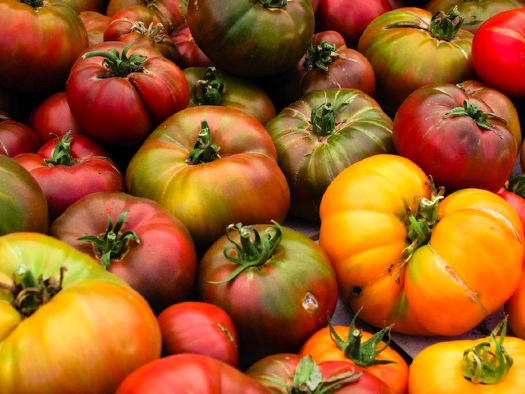
I can't imagine why people shy away from heirloom tomatoes. Ok, so perhaps many of them look a little malformed, or diseased. But to me they are beautiful; each one is unique; each shape has its own story.

More importantly, these ugly tomatoes taste delicious. Recent research has shown that the uniform, red(dish), and firm tomatoes found year-round on grocery shelves are actually genetically inferior in taste! There are also a couple of other factors that could influence the taste of these heritage fruits. Heirlooms tend not to transport well, so they are most often produced locally and picked when ripe!

There is also a greater variety of colors, sizes, and flavors to be found among the heirlooms varieties. In fact, thousands of varieties of tomatoes exist, though we rarely see more than one or two in the produce department. And each one has its own character and charm. I'm currently attempting to grow some Sungold cherry tomatoes, Valencia, and a couple of others, so stay tuned to see how these turn out!

Ugly Tomato Salad 
1 large heirloom tomato, or a couple smaller
1/2 ear sweet corn
3 basil leaves
Sea salt to taste
Dash of good olive oil (optional)

1. Super easy. Slice tomato. Shave off the corn from the cob. Chop the basil. Sprinkle with salt (and maybe oil). Toss. Enjoy!

Check out other summer goodies on Wellness Weekends (barely squeaking in this time!)

Friday, June 22, 2012

Fifty Second Friday: My Last Asparagus

The last, the very last. Yes, that brief spring period where asparagus dominates the menu has come to an end. As temperatures become warmer, these little stalks can think of little else but going to seed. But the time is ripe, as summer produce beings to proliferate. Tomatoes, basil, and zucchini have started to show their lovely faces at market. 

That is something we just have to embrace when eating with the seasons. Sometimes they are just excruciatingly short. Black raspberries only stick around for about three weeks. Green garlic and garlic scapes only last until the bulb has grown up. Strawberries are done (for now), and there will be a flurry of figs in the late summer/early fall. And while this may be difficult to stomach, in a culture where we are accustomed to buying whatever we want, whenever we want, there is a certain beauty in it. The anticipation of the season's first blueberries; the juicy decadence of a perfectly ripened, height-of-summer peach; the crunchy sweetness of the prolific peas (sugar snaps, please).

So in an attempt to pay homage to the outgoing season and the one incoming, I melded everything on top of a baked crust. The aging asparagi met the fresh garlic, at the apex of its life; first of the season summer squash and basil fraternized with last-year's canned tomatoes. It was heavenly.

Spring Meets Summer Pizza Pie
crust
1/4 cup buckwheat flour
1/4 cup millet meal
1/4 cup corn meal
1/4 tsp xanthan gum
1/4 tsp baking soda
1/4 tsp baking powder
1/4 tsp salt
1 tbs olive oil
1 tbs almond milk

1. Combine all ingredients until you can form a ball. If it's really sticky, as some additional flour. Roll out to about 1/4 inch thickness (I made three mini pizzas).
2. Top with tasty veggies (see below). Bake at 375 for 20-25 minutes. Enjoy!

toppings
1 small or 1/2 medium yellow summer squash, thinly slices
4 asparagi chopped
1/2 cup chopped tomatoes
1/4 cup basil pest (I made mine with basil, olive oil, salt, lemon juice, and pepitas)
Sprinkle of nutritional yeast 

Happy second day of Summer!! For more, check out Wellness Weekends

Monday, April 16, 2012

What's Cooking? A Weeknd in the Woods

Some times, with all of the concrete and buildings. the motivation to escape the city limits and venture into less charted territory becomes overwhelming. On this fine weekend in April, I flew the coop. Traipsing along trails in the in the George Washington National Forest, it was great not to think about the things that bog down life - including internet and email (sigh) - and to get some more "tree" time in. 


One of my favorite things about hiking is, what I feel, justified free reign to consume trail mix to my heart's content. With chipmunk-like tendencies, any way, I seem drawn to the mixture of nuts, seeds, dried fruit, and chocolate. But, by the end of a day of hiking, it is often nice to have a cooked meal. Though my outing experience is not extensive, I have become relatively adept at concocting relatively "gourmet" camping dinners. Usually, these rely on quick-cooking dried soups and grains. This time, some couscous, smooshed tomatoes, leftover salad mix, and a seasoning packet (called Poultry Magic, but no fowl play there...) made a really delightful meal.

Cookstove Couscous (serves 3-4)
1 cup dry couscous (or quinoa*)
1 cup water, boiling
1 cup salad mix/greens**
2 tomatoes, coarsely chopped
Seasoning (mix of paprika, onion, garlic, thyme, oregano, and salt)

1. Bring water to boil in a camping stove. Turn off gas and add couscous. Allow to sit for five minutes. 
2. Mix in chopping tomatoes and seasonings. Add greens right before consuming. Voila!

* I added in a quinoa option for a gluten-free, and more nutrient-dense option. Please note, that the preparation is slightly different for this, and will require more time. Add an extra half cup of water, add quinoa while water is boiling and let cook for about 20 minutes. Once the quinoa has cooked, you can add other ingredients. I have made quinoa on camping trips before, so am confident it works!
** Fresh greens not recommended past a day or so without refrigeration (unless it's pretty cold outside).

Check out this recipe and more on Wellness Weekend and Slightly Indulgent Tuesday!

Monday, March 5, 2012

What's Cooking? Running with Beans

Scarlet runner beans are an exquisite example of leguminous beauty. These Oaxacan natives are a unique variety, and have been cultivated for thousands of years. Even in Europe and the United States, the bean has found a place in kitchen gards since the 1600's.

Although one of the few beans that are perennial as opposed to annual, the runner bean does not do well with frosts and cold weather, but prefers mildly warm climes. It is prized for the lovely red flowers produced, and is at times cultivated merely for ornamental purposed. Personally, I would cultivate the bean pods simply for ornamental purposes, as well!

Drunken Runner Beans and Kohlrabi Greens
1/2 cup scarlet runner beans, cooked
Greens from one kohlrabi
1/2 cup diced tomatoes and liquid
2 tbs red wine
1/2 tsp garlic powder
Salt to taste

1. Heat some oil in a skillet over medium. Toss in the greens, chopped with the tomatoes, wine, garlic powder, and salt. Cook until greens just start to wilt.
2. Throw in the beans and cook until liquid is gone. Really, that's it. Serve up and enjoy!

Further Rearding:
Heirloom Beans by Steve Sando and Vanessa Barrington

Tuesday, February 7, 2012

What's Cooking? A Bean of a Different Color

I think I may be experiencing a bit of blogger fatigue. Not a serious case, or anything, and it is luckily not contagious. Perhaps it is because my work life has been revolving around blogs for the past month. Or maybe it's because I am having such a difficult time finding information on the cultural and ecological history of beans!
Black beans, red kidney beans, white cannelinis. These common legumes are only a small sampling of what is available for the eating. But there is a wide world of beans out there. One particular bean I've unearthed is called Anasazi - a slightly sweeter and more easily-digestible native American bean named for the Pueblo Indians. The back story of the bean is still shrouded a bit in mystery, but we do know that they were likely cultivated back thousands of years! We are talking pre-Columbian Americas, here. I will save my musings about the merits of heirloom varieties for another day, but let me just note how exciting it is to have the amazing variety of beans from which we can choose...rather than always falling back on the same old same old...

Here's a dish that celebrates the traditional companion planting - the three sisters: beans, squash, and maize - forming a symbiotic relationship. The maize provides a base on which the beans can climb; the beans fix nitrogen in the soil; the squash leaves block out weeds; and together they provide the complete suite of amino acids!

Anasazi Stew
1/2 jar of chopped tomatoes
1/2 onion, chopped
1/2 medium winter squash (like carnival or acorn; or a large sweet potato) cubed
1/2 cup vegetable stock
1 tsp olive oil
2 tsp cumin
1 tsp paprika
1/4 tsp cayenne
1 cup cooked anasazi beans
1/2 cup frozen (or fresh if in season) corn

1. Saute onion in an oiled skillet until beginning to become translucent. Add cubed squash and stock. Cook until squash fork tender.
2. Pour in the tomatoes and add the spices. Allow to simmer for 10-20 minutes. Toss in the beans and corn. Adjust seasonings; maybe add salt.
3. Serve warm over corn bread :) mmm...

Monday, January 9, 2012

What's Cooking? Lickity Split

Remember how when you were little there were foods you didn't want to see, smell, or even know existed? Like those brussel sprouts your mother would steam and serve, or that unappetizing blog of green jell-o with celery, cranberries and walnuts inside ("shape" as they call it in Britain...). Well, split pea soup is what comes to my mind when I think of foods kids wouldn't want to consume, let alone be seen anywhere near. No no, I did not have a traumatic experience with the green mush as a child. In fact, I do not recall a single time in which my mother served it to us.

I believe my first encounter with the split pea was in high school in the form of Amy's Organic soup, after my vegetarian reformation. Now, years later, I've come to realize the beauty of the legume. It is low in fat, high in protein and fiber, and dirt cheap. Yup, green split peas are probably the cheapest dried bean to get in bulk. They also date back to ancient times, bearing mention in the bible and cropping up in archaeological sites. So if you want an ancient protein to go with your ancient grain, try out split peas!

Split Pea Stew
1/2 cup wheat berries, soaked overnight and cooked
1/2 cup green split peas (soaked overnight - optional)
1/2 onion, chopped
1 medium carrot, chopped
2/3 cup vegetable stock (or just water)
15-16oz jar or can of tomatoes
2 tsp curry powder
1 tsp cumin
1 tsp paprika
1 tsp olive oil
salt to taste

1. Saute onions and oil in a medium-high skillet until beginning to become translucent.
2. Pour in water/stock and bring to a boil. Add split peas and carrots, cooking until peas are almost fork tender.
3. Combine tomatoes, spices, and salt, cooking until excess liquid has boiled away. Serve over wheat berries!

I just barely sneaked this one into Wellness Weekends, though sadly without a photograph!
For a vegetarian twist on the classic split pea soup, check out 101 Cookbooks.

Sunday, August 21, 2011

Heirlooms in the Garden

An heirloom can be defined as "something of special value handed on from one generation to another." Many of us are in possession of an item of this sort, such as a piece of jewelry or dinnerware. The same principle can be applied to seed varieties, pass down over the course of centuries, from generation to generation. And like your grandmother's ring, the seed passed down reflects the conditions under which it was developed (though, you also end up with a greater diversity of crops, while one ring tends to remain a single ring). Heirloom vegetables and fruits harken back to a day prior to the industrialized methods of farming that reward uniformity, and if any of you have seen those ugly heirloom tomatoes, you know what I mean!

I can't seem to stop writing about peaches and tomatoes, can I? Perhaps that is because they are so flavorful and wonderful at the moment. Perhaps that is due to the large quantities of the two fruits I have been consuming. Either way, it is always nice to incorporate in a new flavor or two to change things up.

Well, A Couple Cooks recently posted a delicious recipe for an heirloom tomato and peach salad! Very summery - refreshing and nourishing. The photo gracing the blog emphasizes how the deep red of the tomatoes contrasts nicely with the vibrant yellow flesh of the peaches and makes the green of the mint pop (and the couple themselves make a pair of beautiful bloggers!)

Though a really simple and quick recipe, I made a few changes to suit my mood and herbs on-hand:

1 heirloom tomato
1 large peach
3-4 leaves basil
dash of white balsamic vinegar
pinch of fleur de sel or sea salt
Five days more to Portland!

Sunday, August 14, 2011

A Belated National Can-It-Forward Day

My kitchen has been getting a lot of use on Sunday afternoons. After we pack up at the farmers market at around 1:30pm, I stuff my bike basket full of overly-ripe produce items and race up the hill to my apartment. Then, I proceed to spend the entire afternoon processing the bulk of seconds peaches and tomatoes acquired at the aforementioned market. Whew.

Well, yesterday happened to be National Can-It-Forward Day! While I have to admit that my usual summer canning activities did not differ, I thought I would take a moment to extol the benefits of canning. Canning as we know it really only dates back to mid-19th century, but the premise behind it and other older food preservation methods are the same: make the months of bountiful harvest last during times when plants won't grow. Why do I can? When you see the tables overflowing with tomatoes and peaches at the market, it is a hard to suppress the urge to bottle it up! And honestly, when one's favorite fruits come out in droves too great to consume in one sitting, there really is no other option. And thus we come to the Sunday canning adventures.

Slicing and freezing peaches was my go-to up until this point. Last year I had a good five or six gallon freezer bags of peach slices to tide me over through (half) the winter. However, because of limited freezer space, I have jumped into the marvelous world of canning fruit. Peaches packed in a light, vanilla bean infused, sugar syrup. Yum. Crossing my fingers that they are a success. Learn more about preserving stone fruit here. As for the tomatoes, you can read about my exploits with those last year. I have that canning venture down pat!

Sunday, August 7, 2011

Taste of Summer

Washington DC supposedly empties as August rolls around. People go on vacation, escape the oppressive humidity of the swamp that houses our Nation's Capital (...I don't think it's so bad...). As such, one would assume that the city turns to a ghost town. But you wouldn't think that after seeing the packed stalls at the farmers market this morning. Perhaps this was the last hurrah before people skip town. Perhaps it was in celebration of National Farmers Market Week! Even so, I think that the crowds today were a testament to the fact that farmers markets in the summer are festive, alluring, and downright breath-taking.

August is perhaps what I consider to be the epitome of summer, at least in terms of food. Today marked the first Sunday farmers market of August 2011, and you could tell immediately that summer is in full swing. While the berries are winding down (unlike in the Pacific Northwest), stone fruit abound. Hot weather vegetables include zucchinis, eggplants, and tomatoes (really these are also all fruit...) start to claim real estate.
Considering the prevalence of these last fruits of the earth, it seems only reasonable that one should take this into consideration when preparing meals for the coming week (and believe me, the peaches have already been accounted for...). So here I offer you a very simple, very easy, and very delicious summer stew that takes advantage of the height of summer produce. It's scalable, storable, and takes virtually no effort.

Slow-roasted ratatouille
1 medium Italian eggplant
1 large yellow summer squash
1 large or 2 medium tomatoes
2 cloves garlic
1 sprig of fresh oregano
1 stem of fresh basil
salt to taste
olive oil to coat the bottom of the pan

1. Slice eggplant into rounds (about 1/4" thick). halve, and then place in bowl and salt. Allow to sit thirty minutes. Meanwhile, slice up squash into rounds, slice tomatoes and garlic.
2. Coat bottom of a pyrex casserole with olive oil or spray. Layer eggplant, zucchini, some garlic, and tomatoes. Salt. Place basil and oregano here. Continue with a second layer of eggplant, zucchini, garlic and tomatoes.
3. Cover casserole with lid (or foil) and bake at 325F for an hour, or until everything is really soft and the garlic literally melts in your mouth.
4. I like to add red lentils or split peas. Can serve with crusty bread or polenta. Would also be tasty adding fresh corn from the cob or caramelized onions. ENJOY!

Ricki's holding a weekly roundup of recipes. Check out other healthy summer eats at Diet, Desserts and Dogs!

Thursday, July 28, 2011

Dare to Bake: Sweet Eat and Summer Bounty

Jana of Cherry Tea Cakes was our July Daring Bakers’ host and she challenged us to make Fresh Frasiers inspired by recipes written by Elisabeth M. Prueitt and Chad Robertson in the beautiful cookbook Tartine.

Let's just say I took a few liberties with this month's Daring Bakers' challenge. I really did intend to make the cake and some vegan pastry creme, but the hot weather and lack of portability of said dessert (so I could take it to work) ultimately found me scrambling on the 27th to throw something together. While I enjoyed consuming the results of my labors, neither one was the "fraisier" we were challenged to make.

Instead, I took advantage of the fact that I had been bequeather a large sum of tomatoes that had been bequeathed to me at the market on Sunday. Now, many of you know that the tomatoes you find in a grocery store are good for little more than flavorless additions to a sandwich. They pale in comparison to a vine-ripened, fresh-picked fruit. A month ago, NPR's Terry Gross interviewed food writer Barry Estabrook about his new book, Tomatoland. Estabrook takes the reader on a journey through the evolution of the tomato to the modern industrialized crop bred for durability on the grocery shelves.

Without incentive to maintain flavor, farmers and breeders have essentially focused in on the appearance, transportability, and storability of the tomato. That does not make for good eatin'. But my tomatoes were ripe and bursting with tomato-y goodness. What did I do with them? I made a baked polenta and zucchini-tofu Napolean with roasted tomato and garlic sauce! mmm...

Tomato Sauce
5 large tomatoes, diced
2 large cloves garlic, sliced
drizzle of olive oil
sprinklin' of salt
dash of red wine
tossed in a bit of basil

...and placed in a covered pan at 350F for 45-60 minutes until soft and melty!

Zucchini Tofu
1 package of mori-nu firm tofu
2 zucchini sauteed with some salt and garlic powder
2 tbs nutritional yeast
sprinkle of salt and either basil or oregano

...pop in a food processor and go at it until smooth.

Assembly
some disks of polenta (can use the tubed stuff or make your own)
ramekins, greased

...layer polenta, tofu, polenta and then place in oven for about 25 minutes. Top with tomatoes!

And for dessert, no baking for me. Top and bottom made of ground almonds, dates, cocoa powder, and a little agave. The inside, pictured frozen, is a chocolate mousse made with silken tofu, melted chocolate, cocoa powder, and some stevia to sweeten. Low GI, packed with protein, and does not involve an oven!

That is all folks. Next time I promise to have a better DB post! Look out for some more chocolate and summer produce on its way.

Monday, April 25, 2011

A Dinner on the Brink of Destruction

About two weeks ago, I regaled you with the story of the Vanishing of the Bees. As if to prove this was an issue that merited my attention, another article came across my radar in March's issue of National Geographic Magazine. Through its usual array of breathtaking images, the magazine reminds us that recent declines and threats to pollinators (including bees, birds, bats, and small mammals) rock the foundation of many of our fruit and nut crops. Last time I wrote about possible causes for colony collapse disorder (CCD), particularly systematic pesticides, parasites, or a combination, but apparently the debate goes on.

Pollination 101
We're not going to dwell on the blame game of what is killing off the bees. Instead, I thought we could explore the magic that is pollination (in a very unscientific way). Plants produce pollen, contain half of a genetic makeup (essentially the equivalent to sperm). Because our leafy friends a rooted to the ground, they can't reproduce as animals. So, they rely on elements like wind or critters like insects and birds to transfer pollen from one flower to another. A pollen grain will then fertilize the ovary of its new host flower, which over time develops a seed (fetal plant?) and a fleshy exterior. This juicy fruit is your apple, peach, or plum and the seed is your almond, walnut, or cashew.

Some plants are generalist, while others seem to have been carefully designed to perfectly match a specific moth, etc. Now note, not every flower becomes a fruit; some flowers are only that, but they do need to pollen to produce seeds. Almonds, grown throughout California, are one of those crops mentioned in the article that are pollinated exclusively by honey bees. However, there are many other plant-based food items that rely on pollinators to produce fruits. Zucchini and squashes, tomatoes, and asparagus fall under this category.

The Meal
Well, I made a very precarious dish (in terms of pollinators, at least) this evening. For this month's SOS Kitchen Challenge, I barely squeaked by. Asparagus only surfaced about a week ago at the farmers market in DC, so haven't had too much time to play with it. And since I have been eating raw this week, it was not on the time of my veggie list. Then tonight, I decided to make a colorful meal of...
Zucchini Linguini Primavera alla Asparagi
1 zucchini, julienned or spiralized
1 tomato, diced
1/2 cup mushrooms, chopped
1/4 cup asparagus tops
1 tbs olive oil
1 tsp dried basil
1 tsp dried oregano
Salt to taste

1. Toss all ingredients together and let "marinate" for about 30 minutes. Once again, it's that easy. Consume!

Hopefully, my fresh veggie (and fruit) "pasta" doesn't represent a dying breed. The NGM article wasn't too uplifting, ending on a note of imminent doom and loss (goodbye chocolate). But Claire Kremen, researcher at UC Berkeley, offers up some solutions. Many of these require a shift in our approach to agriculture - limiting pesticides, diversifying crops and surrounding vegetation, and cultivating more bee/wildlife-friendly habitat. Not another technological bandaid, staving off the larger collapse of a system, but a restructuring of the system as a whole. Now, that's something worth cultivating.

Wednesday, September 29, 2010

Produce of the Week: Tomatoes!

Photo by Tara Maxey

The last of summer drifts away as the leaves begin to turn and flutter to the ground. But even as the weather turns (and let me tell you, the weather has definitely turned from warm and sunny to chilly and rainy), tomatoes are still around to brighten the day...for another couple of weeks.

Native to South and Central America, the tomato made its way from Montezuma's garden to Cortez's Spain (and subsequently the rest of Europe) in the early 16th century. The Italians embraced these beauties most heartily and were the first to actually cultivate the plants outside of the Americas. As a fruit from the Nightshade family, the tomato was thought to be poisonous by many, but it finally caught on in the rest of Europe and jumped over to North America in the early 18th century.

I find it fascinating that a crop that presently epitomizes a region, such as tomatoes in Italy or potatoes in Ireland, originated from a land across an ocean. Tomato breeding has led to a smaller scope of domestic diversity than the initial range of the wild plant, yet there are still more varieties (especially with the resurgence of heirloom tomatoes) than most people can handle. Take a look at this article on the impacts of tomato domestication and explore a snippet of tomato biodiversity.

As with many of the crops we have explored, tomatoes have an interesting and complex history of travel and domestication. But tomatoes are also incredibly versatile; there are just so many ways you can cook with them! Dice 'em, roast 'em, stew 'em, dry 'em, can 'em...this time of year, though, my thoughts turn to ways of preserving summer for the coming winter.

I attempted my first canning enterprise this past week. I'll get back to you in a few months as to whether they we properly canned (or whether I fell victim to botulism...). Try out this recipe for Roasted Tomato Sauce and read this sound advice before canning. I also might branch out and make tomato jam or oven-dried with my next batch of tomatoes...

Other fun recipes for end-of-summer tomatoes:
The Italian in me goes straight for bruschetta, crispy bread and drizzles of olio.
Panzanella for end-of-summer festivities
Classic and easy rustic tomato salad (basil may be getting harder to come by this time of year)
Moroccan tomato soup (dice your own tomatoes!) is perfect as fall sets in.
If you are in the mood for Indian, cauliflower tomato curry might be up your alley.
Seriously, tomatoes over polenta is fantastic and flexible (just leave out the cheese)
And Bitman blogged about season's last tomato sauce, so hop on board before it's too late!

Enjoy your season's end bounty. Stay tuned for some exciting posts in the coming week (conservation, blog action day, and one-year birthday)! Over and out!

Wednesday, April 21, 2010

Produce of the Week: Basilico

You might be thinking - "basil isn't in season, especially not in the great (but often chilly and grey) Pacific Northwest." Well, you can think that all you want, but that is not going to change the fact that there is a basil plant (actually five) growing in my backyard at this very moment. If that is not local and seasonal, I am not sure what is.

While appearing in Asian varieties such as Thai and Lemon basils, this tender herb is most well-known for its starring role in many Italian dishes. It is high in antioxidants, possesses antibacterial properties, and traditionally has been used to treat maladies related to stress and asthma. And of course, there are the many culinary traditions to which basil adds flavor and color.

Basil is my go-to herb. Usually I resort to the dried variety: it's available year-round, it packs a punch with more concentrated flavor, and can be steeped in stews and sauces. Oh, but fresh basil is heavenly!
Classic Pesto Genovese (with carrot linguine)

1 large bunch of basil
2-3 medium cloves of basil
couple of tbs of pine nuts
salt to taste
olive oil to create desired consistency

1. Food process all ingredients until smooth-ish. That's it!
2. My mother has this fantastic method of freezing pesto in ice cube trays to use for later. You just grab one or two little 'uns, heat it up with a tad bit of olive oil, and then coat your favorite pasta! Note: traditional pesto has a hard cheese like parmesan, but don't freeze it like this!

Carrot Linguine

1. Use a peeler to strip a few large carrots clean to the ribs.
2. Dump the carrot strands in a skillet with a bit of oil and water until starting to get tender.
3. Toss with the pesto or a roasted tomato marinara...mmm...

My Favorite Basil Recipes:
  • I love Ratatouille, the classic Provencal courgette et tomate dish can be light and baked, stewy, or in the Smitten Kitchen, a lovely tart! My stint on the Italian farm was filled with pomodori, zucchini, e basilico - the perfect ratatouille, the perfect August repast.
  • In the heat of summer, toast up some crusty italian bread drizzled in olive oil and layer a slice of garden-fresh tomato and a leaf of basil for delicious Caprese salad.
  • Good marinara requires basil, either fresh added at the end or dried allowed to simmer (and there are plenty of good gnocchi recipes without eggs).
  • Of course, a good white bean soup is always a nice addition to a meal (Fat Free Vegan Blog has many delightful recipes with basil!)
And if you plan on retaining your own basil plants, keep in mind that they repel many pesky insects and aid in the growth (and flavor development) of tomatoes - who would've guessed?