Pages

Showing posts with label Munchable Soapbox. Show all posts

Tuesday, October 11, 2016

Fasting for the Anthropocene

Around this time every year, millions of Jewish people shun food, from sundown to sundown. We don't eat or drink for those 24 hours in order to bring attention away from our physical beings and focus instead on repenting for the year's transgressions and seeking forgiveness from those we've wronged. Religious or not, I think we can all agree that a time for introspection and self-reflection is important. But while we fast from food on this day, there are other fasts we could undertake that are arguably more impactful, larger scale, and longer-lived.
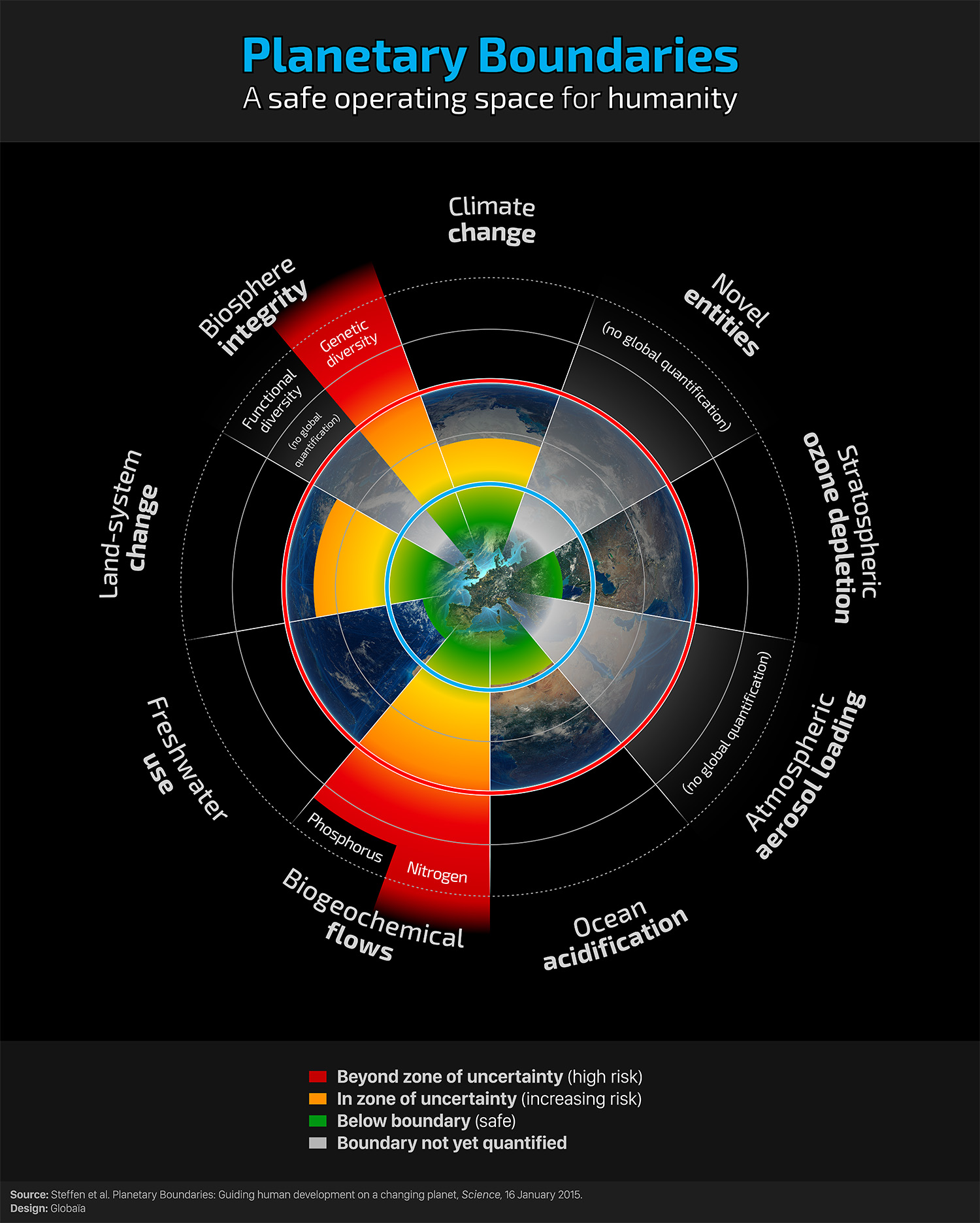
http://www.stockholmresilience.org/research/planetary-boundaries.htmlIn 2009, some scientists got together and said, you know, Earth probably has some limits in terms of safe operating space for humans (...we are a bit anthropoocentric). These 'Planetary Boundaries' consisted of biological and physical aspects of the Earth, such as freshwater, biological diversity, and  atmospheric composition, which underpin its ability to support most life. Within the past couple of years, scientists have broadly agreed that several of these boundaries have been surpassed. We can largely thank widespread agriculture for two of the big ones - loss of genetic diversity and changes in nitrogen and phosphorous cycling -  however, we have a much less complete understanding of things like invasive species and ocean acidification.

Right, so what does that have to do with Yom Kippur? Well, let's just say we have created a problem that could benefit from a bit of fasting. One of the major drivers of reaching and exceeding the planetary limits is the human population's level of consumption. We like 'stuff' and go through heaps of it: Americans trash 11 million tons of clothing annually (and buy 5 times as much as in 1980); Aussies exchange or upgrade their mobiles every 18 months; Brits put 3 billion disposable cups in the rubbish every year. Such consumption patterns can affect land and water systems both directly - through extraction of resources like timber, metals, and oil, to feed demand for this 'stuff' - and indirectly - by throwing away the used and unwanted (...even when there is no away) and polluting with this waste. They also have embedded impacts related to production, ranging from water and energy use to human rights infractions and labour conditions.
IMG_2800
Now is maybe a good time to note that the need to reduce humanity's level of consumption is not a new idea. Meadows & co addressed this issue back in their 1972 Limits to Growth, though the sheer quantity and ephemerality of consumables today would probably have been difficult to fathom back then. So recognizing the problem is not the tricky part - perhaps a 'fast' is a bit extreme, but humanity definitely needs to go on a bit of a diet. Yet coming up with feasible, effective, and equitable solutions is by no means easy, and is rife with challenges of feasibility and ethicality.  

One school of thought finds fault in the very nature of our growth driven economy, arguing the impossibility of a 'Green Growth' model that sees only an upward trajectory, contingent on consumption as a primary measure of success. Ultimately, we may just we have to choose: we either keep buying in to the system in order to grow our economy or live more simply to ensure our future existence. Sounds bleak. While this may seem austere, the principles are very practical and social. Proponents of the degrowth model support reaching for 'sufficiency' not simply 'efficiency'. This means repurposing existing infrastructure, buying second-hand, growing a "sharing economy", cultivating edible yards, and re-considering what makes us happy (I'm also partial to the tiny house phenomenon...). Nothing short of a revolution, that will ultimately involve changing the way our communities are designed and the laws and regulations in place. But many of these principles are already in practice at a small scale, and as individuals we can continue to take baby steps, and make more mindful choices as consumers. 

For those observing, have a safe, meaningful, and perhaps thought-provoking fast. For all of us, year-round, let's collectively move toward fasting from the unnecessary, the disposable, and the wasteful.

Friday, May 22, 2015

Can Biodiversity and Development Ever Get Along?

It’s the 14th celebration of the International Day of Biological Diversity, with the theme of sustainable development. I feel like these ‘days’ often focus on the developing world, the hotspots of biodiversity in the tropics, how we can ensure that ‘nature’ remains intact as incomes grows and standards of living improve. But the past week has caused me to think much more about biodiversity and America’s not-so-sustainable development.
Wheat fields of central Montana
As you know from my last post, I spent the better part of Saturday through Tuesday on cross-country trains. For miles on Monday afternoon we passed immense monoculture of wheat. The park service docents who hopped onboard at the border of Montana pointed out the occasional pronghorn or fox that dotted the landscape (though I was hard-pressed to see where they might make their permanent residence). Yet this vast swath of grain at one point was prairie grassland, an often underappreciated and misunderstood biome. It was home to bighorn sheep, wolves, grizzly bears, and elk up until the early 20th century. According to The Nature Conservancy, over the last 25 years 25 million acres of grassland has been lost and conversion to cropland stands as its greatest threat. As one docent informed, even up until the drought (AKA Dust Bowl) in the 1920/30’s, homesteaders maintained a relatively diverse holding of different wheat varieties, hay and fodder fields (for their draft animals, of course), and home gardens. After water scarcity downsized the pool of farmers, the State’s wheat market consolidated to a ‘family-owned’ corporate system that now dominates most agricultural production in the US.
http://www.iinet.com/~shs/logging.html
Early 20th c. logging around Lake Sammamish
So there’s your agricultural example of unsustainable and anti-biodiversity development. But the harder hitting case for me rests much closer to home, and involves Washington ecosystems, including its forests, which house a sizable array of plants and animals. Just a little background – I grew up in a suburban plateau outside Seattle, on the cusp of rural Puget Sound and surrounded by floodplain farmland. The road running from Redmond to Issaquah (through the not yet founded city of Sammamish) looked like a page out of national park brochure when we first moved to the area 27 years ago (though the irony is the area was heavily logged in the late 19th century…). It has changed at a frightening pace in my lifetime; however that didn’t make the vision of rapid development from my bus window yesterday any less heart-rending. What were hillsides of evergreen ecosystems not more than five or ten years ago, have been reduced to an assortment of townhouses, big box franchises, and roads. This mode and rapidity of development embodies a lifestyle reliant on fossil fuels and focused on consumption, while insensitive to the long-standing culture and character of the area.
So while I applaud the United Nations’ attempts to tie together awareness on biodiversity and sustainable development, I mourn a lost opportunity to look more broadly at the challenges inherent in development. We need to really think long and hard about the tradeoffs between our current consumption patterns (particularly in the ‘developed’ world) and diversity - whether that's in ecosystems, flora and fauna and crop varieties, or even the types of transnational enterprises that seem to coincide with the process of development. 
Photo credits: (top) me! (bottom) Sammamish Heritage Society.

Friday, December 19, 2014

Confessions of a Fair Trade Skeptic: Some Holiday Cheer

PB; Mocha; Atzec Chocolate; Spiced Pumpkin; Straweberry
Every year around this festive winter period I throw some tasty things together, enrobe it in chocolate, and call it a truffle. It has become sort of a tradition for me, with my sister's 21st birthday being the inaugural affair. This year was particularly exciting because the Cooperative (it's a member-owned grocery chain like the name implies...for those of you not in the UK) started making their Fair Trade dark chocolate without dairy! So, I loaded up on the ethical confection, ready to melt, mix, and mold into a suite of bonbons.

Wait, hold your horses! You might be thinking - What about that post she wrote on 'How Fair is Fair Trade?' And what about that disparaging piece on Fair Trade and Chocolate? Well, that's exactly the point. Unfortunately, in most cases we don't have evidence that ethical certifications, including Fair Trade, deliver on their mission statements. In some cases, we actually know they may be counter-productive or have untinended impacts on people excluded from participating. Furthermore, it is difficult if not impossible, to demonstrate any sort of causality, to tease apart what is the on-the-ground outcome of a certification versus government policy versus a development project.**

Sitting on the consumer end of the supply chain, we have even less information at our fingertips, and must essentially trust in a company with advertised good intentions. I might even go so far as to suggest we have insignificantly, if any, more information about a labeled product's realities than any other product off a grocery shelf. Yet, when I see that little blue and green ying-yang (especially if the price is not markedly more than uncertified...), it's as though the choice has already been made. Of course I will buy the product boasting a shiny label, the beacon of social responsibility.

Why, when after over 3 decades there is still so much uncertainty about impact, do I put my precious pennies into something I don't entirely trust? In part, I think it is a resigned reaction of the "it's better than nothing" variety. We have so little information about the backstory of anything purchased in a grocery store, that it is easy to latch onto something even marginally more tangible, such as an ethical label. On the other hand, the number of different certifications and associated labels has ballooned in the past decade, and can be rather overwhelming and difficult to wade through. For most people, diving into what's behind the sticker is an additional, more difficult, time-instensive, and therefore undesirable step. Berkeley's Journalism School held a contest a few years back for a rethink, a redesign of food labels. A similar concept could apply to the ethical labeling genre.

But this brings us back to issue at hand. While the US is worse than its European counterparts, overall sound regulation on what is required by food labels (and others) is sorely lacking. However, even with stronger requirements, there is still a lack of impact assessment mentioned earlier. Networks like ISEAL Alliance and the Ethical Trade Initiative are trying to drive better accountability within supply chains. As consumers, we actually have a lot of power. Ask questions in stores; write letters or emails to companies; find certifiers on social media and join their discussions!

Further Reading:

** If you want references, I've got 'em! I'm writing a paper at the moment on impact assessment and consumer perceptions around Fair Trade, which I will hopefully be able to share in the first quarter of 2015.

Thursday, December 4, 2014

Fifteen Years and 'It's Complicated'

The questions come up a lot. It is a main topic of conversation after meeting someone for the first time. 'How long have you been a vegetarian?' in a tone of mild interest. This is generally followed shortly thereafter by some variant of 'why'.

I don't mind the questions. In fact, they make me constantly revisit and reflect on my dietary decisions. Thanksgiving - the holiday for which 45 million turkeys are destined to sate one country's appetite - achieves the same end. My earliest vegetarian memory dates back fifteen years to my middle-school self celebrating the first meat-free Thanksgiving - a day I now mark as 'the beginning'. Yet it dawned on me last week, as I gathered with friends over a meatless meal, that in the intervening years the rationale for abstaining from meat and subsequently other animal products has become increasingly nuanced and complex. It makes the explanations in conversation trickier, while also making everyday choices more difficult.

So why am I a vegetarian (or rather, vegan at this point), and what makes it so complicated?

http://www.ornot2b.com/index.php?comic=Vegetarian+Whales1. If you care about climate change, then you should care about what you eat. Generally speaking, eating no animal products has a lower carbon footprint. Livestock release 15% of the global greenhouse gas emissions, with beef and dairy cows contributing the most (hence vegan, and not just vegetarian). There is strong evidence that reducing meat consumption, especially in developed countries and the big emerging economies, will be necessary in order to have any meaningful impact on our warming planet. If you think about it, it makes sense. In an herbivorous diet, you are simply eating the product of photosynthesis - the conversion of photons (sunlight) into sugars - whereas animal products require intermediaries (the animals...) to convert plant material to calories with associated lost energy along the way.

But, like I said, it's complicated. There are all types of vegans and vegetarians, and if your plant-based diet happens to consists primarily of processed soy (read: tofu), oils (like canola, etc.), and hothouse tomatoes in the winter, not to mention lots of frozen vegetables, you are still running up a pretty hefty carbon bill. This calculator will give you a sense of what's big.

2. Not all places or contexts are the same. It's incredibly important to be respectful of other cultures and ways of living, especially as a stranger in a strange land. When I say that I've followed a vegan diet on-and-off for six years, it is for the very reason that some places my rationale for herbivory just doesn't hold up and insisting upon it could be just downright rude. Particularly in developing countries, in many cases consuming animal products and not just staple grains signifies a special occasion or is a gesture of respect, gratitude, or hospitality. Over the summer, many of the households I visited in Ghana prepared stew for us (usually a groundnut or green), and to refuse would be the pinacle of offensive behaviour. One woman in particular would offer up two perfectly oblong chicken's eggs whenever we came through the community - despite being ill and barely able to provide for her three children.

Sure, it is one thing to dictate my own grocery purchases, and align my diet with a certain notion of what I perceive as sustainable and ethical. But coming from a place of priviledge, having the luxury to choose not to eat certain things, I think it wholly unfair to transpose that value system on others when I am a guest in their home (be it house or country). I'm not saying throw in the towel and go carnivore if you happen to find yourself in a remote corner of South America, but be conscious of local customs and propriety and the potential implications of saying 'no' in certain contexts.If the thought of sometimes just not knowing is terrifying, perhaps sticking to these 'safer' countries is a better bet.

3. Ok, ok, enough with the soapbox. But really, at the end of the day, it's about what you care about, your values, your objectives. Figuring out how to make that worldview of eating align with the complex realities of our modern world and food system is difficult at best. Though I would like to consume foods that are healthy for me and the planet, and that come out positive for both 'the environment' and for people in the supply chain, a black-and-white binary decision is often just not possible. I think we all live with those little (and some perhaps not so...) incongruities in our every day choices and underlying values.

While I don't eat meat, nearly every other week I sell it. One of the farms I work for raises pastured sheep and pigs, which they subsequently bring disassembled to the farmers market. The vast majority of people are not going to turn veg overnight or at all, but those same people can choose to eat meat fewer times per week and buy it from producers that treat animals well and as part of a larger system. Which brings me to the second point here, that domesticated animals and crops co-evolved and the interactions play an important role in closed-loop systems. Sadly, I'm not naive enough to think we will revert to these idyllic (and idealized) systems with chickens running around eating pesty insects and fertilizing vegetable row crops. But it is a direction we should probably veer toward, away from the energy and input intensive, and frankly vulnerable, agricultural production systems that dominate today.

Finally, if ethics are your thing, simply cutting meat from your diet still leaves a wealth of issues to confront. Most recently, there has been quite a stir about demand for quinoa, a favourite veggie 'grain', from western nations and the implications for traditional Bolivian farmers. But think about the child labour scandals, the exploitation and lack of fair wages in many commodity crops systems, the deforestation in the Amazon spurred not just by cattle ranching but also soy and sugarcane, and similar destruction in Indonesia for oil palm plantations. We can each try to live as closely to our principles as possible, but it is vital not to get too caught up in striving for an impossible goal and miss all the joys in food.

So, it is important to note that not all vegans and vegetarians are so for the same reason (though many would consider my "flexivegan" ways as misrepresentation). On this 'vegiversary', if we go back a decade and a half, the reasons would be vastly different (and something along the lines of "I like animals..."). That's the trouble with labels; they restrict us to a 2D plane when we in fact need a 3D, textured landscape.

Read More:
Livestock - Climate Change's Forgotten Sector - Chaltham House
Importance of food-demand management for climate mitigation - Nature Climate Change
The Carbon Footprint of 5 Diets Compared
What's Wrong with What We Eat - Mark Bittman Ted Talk
The Future of Food - National Geographic

Thursday, October 16, 2014

BAD Inequality: EnGendering a Resilient Future

Anti Faustina, wearing her teacher hat
I've been reading a lot about women lately - books on development paradigms; papers on gender dimensions in agriculture; twitter chats on women farmers. It is all for my thesis, so I'm delving a bit into the archives and seeing how the discourse has changed over the last 30 or 40 years. Perhaps not so surprisingly, a lot of what is in those papers, books, and the like, seems to stand the test of time (which is not really a good thing...). Themes around education, household labour, rights and resouce surface time after time. When it comes down to it, we're talking about inequality.

Before we get too deep, why am I writing about this? Well, today is an interesting day. For one, it happens to be Blog Action Day (or B.A.D), an effort in its eighth year to unite around a globally important issue - this time 'inequality' - and, well, communicate about it! Coincidentally, it is also the 35th World Food Day, which is focused on the sustainability of family farming. And if you just couldn't get enough, yesterday marked the eighth observance of International Day of Rural Women. Three different topics, but they actually have pretty strong ties.

Now that we've gotten all that out of the way, let's go back to today's blog action topic. The dictionary definition of inequality brings up charged issues like social disparity and injustice, as well as rather neutral things like uneveness and variableness. Gender issues in agriculture and rural development have largely been framed as a social disparity concern - most recently coined the 'gender gap'. The statistics paint a pretty bleak picture of rural women in developing countries (who are primarily family farmers). Across the board, women have a much lower literacy rate and enrolment in schools. It is not common for women to inherit land, and what they do have is smaller in size than their male counterparts. Demands on time is a particularly facinating topic, because much of what a female farmer does is not compensated housework (though, this comparison of men and women in the Zimbabwe's wet season is pretty telling...).

Anti Aso, our spritely veg farmer
Did I mention that I spent the better part of this summer speaking to women farmers in Ghana? Well, I was asking these wonderful ladies about how they've dealt with past environmental shocks, what most influences the "success" of a year, and how future climate change (in not so many words) could impact their lives. The literature depicts much of the same story we've already heard, with the addition of a mild plot twist starring climate change as the villain. However, one of the things I was really struck by was the many ways in which these women are already so resilient in the face of change. Many have started side businesses for multiple income sources. Many acknowledged adjusting the crops, timing, and location in response to variability of weather within a year. And a few after my own heart were passionate about building the health of their soil, limiting the amount of chemicals, and maintaining the long-term health of her family and the land.

In concluding this post for Blog Action Day on inequality, I have to note that this entire post (and several others) was dedicated to discussing women. In doing so, though, I have created another inequality. Men often get side-lined from the gender dialogue, and perhaps that is fair. But I would like to leave you with a thought; 'gender' is about the ways in which both men and women engage in a system, their roles, their challenges. At the end of the day, we are all human, all have a role to play. I wonder how much further we entrench the division between men and women by discussing it as such. That said, we have made gains by certain metrics, and there is great optimism, if we can find the most meaninful ways to join forces - to ensure a just and liveable world, that will continue for generations to come.

Read Previous B.A.D. Posts
BAD 2011: At What Cost?
BAD 2010: Water

Saturday, October 4, 2014

Give it a Rest: A Day of Atonement

Today, Jews across the globe abstain from consuming either food or drink, reflecting on the past year of transgressions. Yom Kippur, literally the 'Day of Atonement', began last night at sunset and will conclude today at the same time. While initiating this period of self-analysis last night, I was quite surprised to hear 'climate change' and 'sustainability' creep into the sermon. Why was environmentalism creeping into this little collective of Oxford Jewry? 

The answer? Shmita.

Now, before you close the tab and write off My Munchable for Shmita is not what it sounds like it potentially means. Just like many religions provide the seventh day of the week as a sabbath, a day of rest, Jewish tradition likes to provide the seventh year as one of 'release' for the land. Historically, in society's agrarian age, this year would one in which farmers leave their lands fallow (and debts are forgiven, and a few other nitty gritty little details). Whatever grew naturally (kinda like One Straw Revolution...) could be harvested freely by the poor, and the rest left for the wild animals. Now, I've written about this connection between holidays and land management before - the ties with long-term sustainability and social safeguards for those marginalized and in poverty.

But think about it for a moment. Religions often either helped to explain nature phenomenon that we could not understand, or put in place rules that ensured resources would not run out. Setting a year aside for fallow lets the soil replenish nutrients and restore structure, so that the land does not become too exhausted and degraded. This isn't relegated to the Jewish faith; many cultures have taboos in place that regulate the amount of water taken at certain times of year, or days when venturing onto the farm or into the forest is forbidden. 

The problem, though, is that modern society does not encourage or appreciate these very practical pauses. In order to get around the whole not being able to farm dilemma, rabbis have created one of the many famous loopholes (see a previous Passover rant): you are a farmer who needs to make a living, so you sell your farm to a non-Jew for the year of shmita. Problem solved. Yet this commoditization just misses the whole point of good land stewardship! And in modern society this is not just an agricultural issue. We consume non-stop - energy, water, computer time, bad tv shows - with no thought that in the long-haul, this just can't last.

In his sermon, the rabbi last night challenged all of us to take a shmita year. Not from farming, as I would guess very few in the room farmed for a living. But rather, unplug a bit, take a break from all the external stimuli and constant distractions, and enjoy what 'Mother Earth' actually has to offer. This advice may seem painfully simple. That said, an appreciation for the natural world is in itself a step towards a sustainable future.

Want to understand shmita more? Read this nifty handbook from Hazon! It is pretty fantastic, laying out contemporary alternative farming tactics (and ways to live generally) to meet the shmita principles every day and not every seven years. To all those observing, may you have a meaningful fast.