Pages

Showing posts with label livestock. Show all posts

Thursday, April 21, 2016

Eating for the Planet

“By eating meat we share the responsibility of climate change, the destruction of our forests, and the poisoning of our air and water. The simple act of becoming a vegetarian will make a difference in the health of our planet.”
Thich Nhat Hanh, The World We Have: A Buddhist Approach to Peace and Ecology

https://flic.kr/p/Gbc8FeAbstaining from eating animal products has long been the domain of animal rights activists, hippies, and tree-huggers (at least in Western cultures). In academic circles, ethicists and philosophers have mused for decades about the moral implications of consuming meat, but not so much the scientists. Yet, these days it seems like studies connecting diet, health, and climate change are all the rage, building up an evidence base of why a meat-free diet is a key strategy for the planet and us.

A few University of Oxford researchers published a paper this year in the Proceedings of the National Academy of Science (for those who don't know, is a well-regarded and widely-read publication), which shows on a global scale that the less meat consumed, the greater the greenhouse gas emissions reductions and the more health benefits. It was a win-win-win scenario: food-related emissions would decrease by more than 60%, fewer people would die 'prematurely', and the world would save up to $31 trillion otherwise lost to healthcare, environmental restoration, and missed work hours ... we just (all 7.4 billion of us) have to shift to an entirely vegetarian diet. No biggie.

A Nature Communications piece (a more main-stream 'pop-science' journal), which came out about a month ago, suggested that only plant-based diets are compatible with wide-spread re-forestation. This is both due to the sheer quantity of meat people consume (read: alot) and what we feed livestock (largely soy and maize). So vast swaths of forests are destroyed to grow grain to feed to animals. Let's just say it's not very efficient.

Finally, this month a group of researchers at the World Resources Institute (awesome think tank based in DC) pubished the 11th in a series of the "Creating a Sustainable Food Future" brief series. They provide some nifty graphics comparing the environmental impacts of different protein sources, and then go on to model some scenarios of different diets (both for the world and the US). The takeaway? Animal protein uses a lot of resources, and the average American eats more than his fair share. If you're curious about how feasible they thinking shifting the American diet away from meat is, there are even more colourful pie charts that detail how.
https://flic.kr/p/FfMKggYou're probably thinking, 'Ok ok, enough already, get off your vegan high-horse'. But, let me just say that I'm under no illusions that the world is going to give up meat tomorrow. Nor do I honestly believe everyone should (and if you want to know my thoughts, peruse this earlier post and this one). In fact, after traveling around Southeast Asia for a month, I feel even less convinced that people would willingly give up meat, fish, dairy, and eggs. It was actually a bit surprising, as I thought predominantly Buddhist countries would at least limit consumption (apparently that's not how it works...). Fish sauce was nearly impossible to avoid anywhere but explicitly vegetarian restaurants, and other animal proteins dominated the main courses.

At the same time, the proportion of meat to grain was usually pretty small. People are still living on very little, and meat is expensive. Following periods of food scarcity in the not-so-distant past, effort went into planting hectares of rice fields rather than prepare pasture. Sure, water buffalo graze on hillsides, and pigs and chickens roam rural villages, but it's not on the same scale as most industrialized nations (and increasingly China...yup, that's also a favourite of academics). So while I agree that diets around the world have been moving in an unsustainable and unhealthy direction for quite a while, it is important to remember in these broad global studies that the more local contexts matter a lot. The WRI report does mention poverty implications, and there are definitely people out there looking at regionally-specific 'sustainable diets'. But it is still a good thing to keep in mind when reading these broad-brush studies.

Well that's all for now. Happy Earth Day! With the theme of Trees for the Earth, it seems only right to focus on a driver of deforestation, no?

"My own view is that being a vegetarian or vegan is not an end in itself, but a means towards reducing both human and animal suffering and leaving a habitable planet to future generations."
Peter Singer
Some lovely plant-based pulses!
Most people in the region still eat a predominantly rice-based diet


Saturday, April 18, 2015

Visions of Sheep


It's been nearly a month since my last post, so I thought the obvious solution was to focus on photos. Well OK, this musing has actually been written for a couple of weeks now, since returning from a five-day trek in England's Lake District. It might seem a bit odd to see me writing about herd animals on the blog, but this time of year it is hard to venture anywhere in the UK without confronting an army of rambunctious lambikins*. The topic is an important one regardless of one's dietary tendancies, in terms of people's lives and incomes, as well as ideals of natural beauty. In a country with a pastoral tradition at least two millennia old, and a landscape that now suits the venture to a T, it's no surprise that of the 67,000 holdings most herds are on the smaller size (under 500 animals). There were nearly 23,000,000 sheep and lambs in the United Kingdom in 2013. Just for a sense of scale, the UK's human population is 64,100,000 (not quite the 20:1 ratio of New Zealand, but still...).
 
During the last week in March, I went to hang out on the farm, and of course play with all the lambs now running around. It was a beautiful site, but having sworn off meat over 15 years ago, the knowledge that these young'uns had half a year left and at most two made the day bittersweet. That is until I noticed the deep empathy the farmers had with their animals - the comments about different sheep's personalities (and praise for their good mothering), the attachment and sorrow when a mother falls ill or succumbs, the tenderness when bottle-feeding an abandoned lamb. Of course this is not the case for all farmers, especially as the size of farm or the intensity of production increases (remember that livestock research centre...?). Yet it is also an injustice to demonize an entire industry when there is in fact no cookie-cutter scenario.

Sure, it doesn't make killing young animals any easier to swallow, but from a socio-ecological perspective, it is also important to recognize and respect how much this way of life has become part of the landscape in certain regions of the world. Having recently returned from traipsing through northern England's Lake District, this is clear. The hilly, some would even say mountainous, terrain lends itself poorly to grain production or horticulture. What woodland exists is either plantation or remnant from the large-scale deforestation five centuries ago. So across the region (ok, let's be honest, across the whole country!), sheep abound. From valley floors to highland meadows. While only 6% of the 41,000 inhabitants of the Lake District are in farming, this is considerably higher than the national average of less than 1%. Without the grazing currently underway, the character and aesthetic of the landscape would also fundamentally change. Maybe change wouldn't be a bad thing, but right now it embodies this iconic image of pastoral England that holds a certain significance to a great number of people. 

*You might recall this reference from childhood...
Mountain sheep in the early morning light!
The Show-Down: Man vs. Sheep (I'm pretty sure sheep won)

Wednesday, October 1, 2014

The Healthy Diet World - My Munchable Soapbox

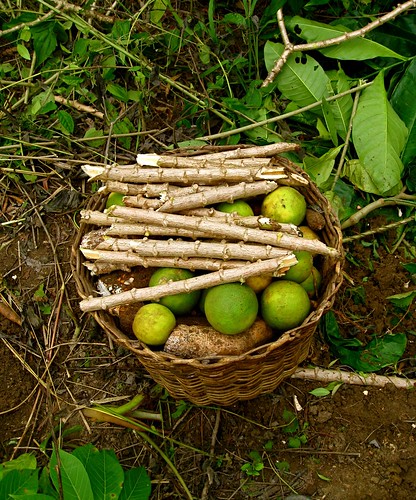
The harvest in Ghana: oranges and cassava
It's October 1st, 2014. The year is rapidly winding down, which leaves little but the prospects for our future to consider. There's a good bunch of people - researchers, politicians, starry-eyed nonprofiteers - who are concerned because that future is one in which our same little planet must feed 8-10 billion people. Factoring changing dietary preferences and the degradation of land, not to mention insufficient increases in agricultural productivity, this concern does not seem unfounded. 

Since I think about agriculture and food a lot (OK, maybe all the time), it was exciting to see the proposal of a solution not focused on yield or production. A group of researchers published an interesting article in Nature focused on changing demand as a means to reduce the impacts of food on climate change. They set about modeling future food needs, the land able to support crops and animals, and a bunch of variables that influence the conversion of what goes in to what makes it to the dinner table.**

Ultimately, they wanted to determine the extent to which "sustainable intensification" (basically getting more from the same land/chemical additions, with a smaller environmental footprint) and shifting future demand could contibute to feeding Earth's 2050 human population.  The first conclusion? Producing animal products - meat and dairy - is terribly inneficient in terms of how much energy from biomass goes in versus usable calories that come out, and that amound of land needed! 

The harvest in Prague: cream puff and tartlets
Food loss and waste was also raised as a significant consideration (with reference to other studies currently estimating anywhere from one quarter to half of what is produced is lost). But, it matters when the waste happens. If you throw out a hamburger, there are more embedded calories than say a bowl of lentils. 

So, taking dietary preferences and food loss/waste as the main parameters, the authors ran a few different scenarios to see where we might end up. My favourite - the "Healthy Diet" - reduces consumption of energy-rich products like sugars and saturated fats (goodbye cream puffs...). If people start wanting more of the most inefficient foods, the whole system becomes "larger" and "less efficient". Therefore, it makes sense that a scenario, in which less of these things are consumed, would lead to less agricultural expansion and fewer greenhouse gas emissions. 

Now, I don't know how feasible this world of herbivorous eco-people is (not that this is what they propose), but they justifiably argue the need for demand-side action and not just agronomic research. Oh, by the way, happy World Vegetarian Day!

...And, for my nerdiest of readers, here is a pretty nifty figure from the paper, which you can gaze at until you are cross-eyed.
http://www.nature.com/nclimate/journal/v4/n10/full/nclimate2353.html?WT.ec_id=NCLIMATE-201410

** Note, they admit to probably underestimating the importance of subsistence agriculture, and completely omitting forest and aquatic resources (which are really important in many parts of the world). Also, adapting to the consequences of a changing climate doesn't really factor into their analysis; we only get a sense for the environmental impact of agriculture not how well certain types of food prediction will fare under more variable or extreme weather. Fodder for another study?

Wednesday, October 9, 2013

My Munchable Soapbox: Living Under a Rock

As the title of today's post suggests, I must have been living holed up in a cave or under a rock the past few weeks. A few critically important days came and went:

1. September 13th was International Chocolate Day, so proclaimed by the National Confectioners Association. It's like a Hallmark holiday, only tastier. Celebrated by consuming some chocolate with a soul, per usual.

2. The U.S. Government shutdown last Monday evening. OK, maybe I didn't miss this one, and maybe it's not directly food related. However, it is worth noting the absurd childishness of our government, the expansive economic repercussions this might have (even for those of us living abroad...damn exchange rate), and makes me more inclined to pretend I don't speak English. "Mi dispiace, ma non parlo inglese..." But in all seriousness, there are a few key points on how this affects food and the environment: 1) National Park Service is furloughed, which means the parks close as does their management; 2) while food stamps and subsidized school lunches remain unaffected, the support program for pregnant women, new mothers, and children (hovering at around 9 million) up to five will receive no more funding; 3) the Food and Drug Administration (AKA FDA) has halted most of its food inspection; and 4) and finally, lack of data on crop production from USDA could impact the normal international trade procedures and crop price development, ultimately impacting food prices around the world (yay for a globalized economy)!

3. The 1st of October was World Vegetarian Day! Maybe you tried meatless Tuesday, or just read about this vegetarian restaurant that's over a century old. And while I try to bash people over the head with vegetarianism, there has been a lot of work recently demonstrating that even abstaining from meat once a week, or forgoing that hamburger once a week, can significantly decrease greenhouse gas emissions and consequently climate change forcing. This awesome infographic from the Environmental Working Group circulated a few years back, and is very compelling...

4. Finally, National Kale Day was last Wednesday. I love kale (reminder to self to add to shopping list...). It is delicious, versatile, and healthy. There can never be too much love for leafy greens. So, in case you missed it, feel free to celebrate...every day.

Friday, December 14, 2012

Best of MMM: Musing on Meat

In going back through blog posts from years past, it seems that I have the most to say about a few select topics: chocolate, seasonal produce, and meat. A perhaps unhealthy obsession with a certain confection explains the first; my weekend side job could account for the second; but the third is a little funny for a vegan. My take? Since I don't ascribe to the stereotypical animal rights bucket of vegans, my musings on meat are an attempt to provide evidence for my own dietary decision to avoid it. Last meat post of the year; feel free to comment...
---
Photo credit: Neil Palmer/CIAT
This is my last Vegan MoFo Soapbox, and I have yet to broach the topic of meat-eating! We have previously discussed my own journey and reasons for following a plant-based diet here, here, and here. Though on the whole I don't dwell excessively on the lack of meat in my diet, and more on the other components, since we are drawing towards the end of the month, I thought we could devote today to exploring the issue.

According to a study last year, livestock occupies a quarter of the Earth's surface and one third of the arable land grows animal feed. The team of researchers from the UN Food and Agriculture Organization (FAO), Swiss College of Agriculture, World Bank, Stanford University, and the International Livestock Research Institute predicted a possible double of production by 2050. If we think about the current far-reaching impacts from animal waste, deforestation and land degradation, methane and nitrous oxide emissions, etc. all associated with livestock production, it is hard to imagine a world with even more!

A World Watch Institute report released in 2005, Happier Meals, documented the impacts of factory farming, and touts organic and local animal agriculture, and increasing the number of vegetarian meals eaten in a week! Most distinctly, the report discusses the inefficiencies of converting feed, water, and fossil energy into edible calories. A more recent publication by the Institute echos the message of this earlier work. A Vital Signs (based on FAO data) on the increase in meat production describes the serious environmental impacts - deforestation and greenhouse gas emissions - associated with the twenty percent increase in the last decade.

But at the same time, the report also notes that 70 percent of the 800 million in abject poverty (living on less than $1/day) rely on livestock for their livelihoods. In Zimbabwe, cattle's role in turning the soil has reversed the path of desertification that was threatening crops and food security. Manure is an important nutrient provider; chickens serve as pest control by eating bugs off crops; and goats, well, can clear weeds...

Ok, so perhaps you thought when I started this blog entry about the eating of animals, that it would be vegan-centric, touting the benefits of an herbivorous lifestyle. I have to say that for my part, I believe in the benefits of such a diet for health and the environment. But I think the issue of livestock-raising and meat-eating merit more critical scrutiny and informed discussion. This is particularly true in cases outside of industrialized countries, where animal protein is a luxury not a norm (or an excess!), and where that may be the difference between starving and feeding a family.

I welcome and encourage comments, in hopes of inciting perhaps a little more discussion than usual on the benefits and shortcomings of a diet inclusive of meat, dairy, and eggs.

Monday, December 3, 2012

Best of MMM: A Veggie Considers Meat

It would be a little uncharacteristic of me to spend an entire week at a meeting on climate change and not even bring up the topic. So, on my last day in Doha, and during the one full day devoted to agriculture and rural development, I am posting on agriculture's major contribution to climate change - Livestock. This post is from last year, but as far as I know, animal-based agriculture still contributes around 18% of total greenhouse gas emissions.
---
Photo credit: Neil Palm/CIAT
No, I am not considering EATING meat, but the press coverage livestock has experienced lately in the foodie and agriculture world merits some attention. This industry has often held a central role in sustainability discussions, as well as those focused on rural development and food security. In the past couple of weeks, several articles (and articles on those articles) have emerged addressing the part livestock plays in climate change, land degradation, and world food system.

First, let’s establish a bit of background on the livestock industry. According the UN Food and Agriculture Organization (FAO), livestock contributes 40% to global agricultural production and is the base of sustenance (both financially and nutritionally) for close to one billion people. While it also supplies 15% of daily energy consumption and 25% of dietary protein, the industry itself experiences many market distortions fueled by poor policies that ultimately cause a disproportionately greater environmental impact than economic/human benefit. Animal-based agriculture has two faces: it is both an integral part of an agro-ecosystem’s waste and nutrient cycle, as well as a performer in the great climate change and land degradation saga. I’m going to leave out regional differences and the whole discussion on development and changing dietary preferences, but the FAO’s State of Food and Agriculture Report provides plenty of statistics and analysis to give you a good grasp of the topic.

Now that you have some context for our discussion, we can get to the meat of the issue (yes, pun intended). My biggest beef (again? groan!) with the world’s meat obsession is the discrepancy between large industrial production and small-scale traditional farming methods. Apparently, I am not the only one (of course not!). The recent deluge of articles centers around this dichotomy. Noted livestock naysayer and Guardian columnist, George Monbiot, has changed his tune from “veganism is the answer” to “it’s all about how you do it.” Monbiot argues that, “Cattle are excellent converters of grass but terrible converters of concentrated feed [like corn and soy]. The feed would have been much better used to make pork… And pigs should only be eating grain when there's a surplus -- the rest of the time they should be eating from the endless human food-waste stream.” How old-school. Can you imagine a system where the wastes of one process feed the production of another good? That sounds almost…efficient.

While animal agriculture is a major driver of deforestation, particularly in South America, and a competitor with humans for grain, it also can play an integral part in a climate and human friendly agroscape. A study by the International Livestock Research Institute (ILRI) demonstrated that raising cattle on pasture, supplementing this diet with crop residues, and restoring degraded lands will make serious inroads into curbing greenhouse gas emissions associated with livestock production. As it is, most of the climate change contribution of livestock results from deforestation and land degradation (and the extent attributed to the animals is another hot point of debate). Researcher, Philip Thornton, also puts this forward as opportunity to level out the burden placedon developing nations by establishing a carbon market for these services.

So, if I have not exhausted your attention span, there is much more information available on this hot topic, and some related domestic policy issues. Here are a few more articles for your perusal:
FDA's Proposed Regulations for Antibiotic Use in Animals and the Failure of Food Safety Legislation.
A Report on Livestock's Environmental and Social Impact to get your hands on (go Cardinal!)
World Resource Institute explains The Role of Livestock in Poverty Alleviation

On a whole livestock production is an issue on the gray scale (approach with a critical eye and an open mind). While I am not advocating that everyone now consume copious amounts of meat, if you do eat meat be conscious of the source and methods of production. Consider your choices and make educated decisions.