Pages

Showing posts with label Vegan MoFo. Show all posts

Wednesday, September 4, 2013

My Munchable Soapbox: Emergency Chocolate

Emergency chocolate bar vs. Special stuff
As you must have realized by now, I am quite the chocoholic. The distinctions between cacao from a range of countries, varying percentages, and differences in processing are astounding. When you want to really savor the flavors and subtle variations in taste, there are the artisan chocolate bars. Often these are discriminating in terms of quality of cacao, ecological soundness of production practices, and fairness of labor laws. While in New York a couple of weekends back, I picked up two single-origin bars from Madagascar - one from Mast Brothers and the other Raaka. Both these companies have an ethical bent.

But this post (which will have to be cut short) is not about the feel-good stuff. It's about Emergency Chocolate. This is the chocolate that hangs out at the bottom of your bag; it's the bar that resides in your desk drawer or car glove compartment; it is that rectangle of wonderfulness that is there when you most need it. Whereas consumption of the Mast Brothers and Raakas of the world is carefully orchestrated and savored, like an aged balsamic or an expensive bottle of wine (and let me tell you, these are not cheap bars), Emergency Chocolate is a cheaper, good but not mind-boggling slab of cocoa, sugar, and vanilla. 

Emergency Chocolate is critically important for my well-being, yet it also is a social and environment heavy-weight. Sacrificing quality and values for cost is not a new phenomenon, and short of eating less and paying more per bar, the challenge of an emergency is a serious one. Now, I don't normally argue along the lines of paying less for high-cost commodity crops, but when when a conscious chocoholic (who has begun a rapid decent into student debt...) is in a bind, there are still some good options that won't bounce a check or sink you into an ethical depression.

Whole Foods dark chocolate bars clock in at around $3 or slightly less, and also include community support projects or follow organic practices. You can find Theo Chocolate in stores for $4 or less, and they aim to source directly, fairly, and in an environmentally sustainable manner. Salazon is another favorite (although dangerously addictive) that is organic, Rainforest Alliance certified, and founded from a backpacking trip...so what could be bad? You're not going to pay $1 for a 3oz bar, but you also won't drop upwards of $12 for haute couture chocolat!

Perhaps, though, chocolate at our beck-and-call is just not appropriate - as it has never been up until now. If you have thoughts on this dilemma, feel free to let me know.

Tuesday, September 3, 2013

What's Cooking? Small Potatoes, New Beginnings

Dear readers, you may be wondering where I have been lately; why My Munchable Musings (henceforth MMM) has been so acutely neglected. A blog is an interesting beast, and can be many different things depend on the user and the audience. But while a personal blog may educate or entertain, it ultimately serves the needs of its writer. MMM was born out of necessity to maintain an underemployed recent graduate's sanity; it followed me all the way from the "Best" Coast to our Nation's Capital; and it has since endured moves within the city, travel abroad, disappointments and triumphs, farmers market produce and a hefty serving of baked goods. As MMM approaches its fourth year online, it seems to be time for change once again - this time, we'll close out our fourth year together across The Pond.

This week begins the epic Vegan Month of Food (Vegan MoFo), in which I have participated since 2010. Essentially, bloggers are challenged with posting five days per week, ranging from complex thematic pieces to an instagram shot of lunch. The first year I toyed with weekly themes; during year two I started a version of the thematic days that I still follow; and last year's month paled in comparison to prior years. And while this year I have no lofty plans or aspirations, it should be an interesting ride amid a Vegan Month of Food (and Travel)...more to come tomorrow.

For now, let us turn our attention to the important matter - new potatoes. To me the trusty spud is a bit of a miracle. You plant one of these South American natives - one a little past its prime, with eyes starting to form - in fertile ground; cover it with lots of compost over and over as it grows; watch as the flowers bloom and then begin to die off. Three or four months later you can carefully dig through the earth in search of the little tots that proliferated underground. Around this time of year, new potatoes with thin skins, like a gentle casing of tissue paper, grace the market stalls and offer possibilities of delicate side dishes for eager market-goers. Only to put icing on the cake, a cherry on your sundae - they're purple.

Purple Pan Potatoes
4 small-medium new purple potatoes, small cubes
1/2 onion, chopped
3 cloves garlic, finely minced
2 big handfuls spinach leaves (or kale), coarsely shredded
1/2 tbs grapeseed oil
1 tbs nutritional yeast
1 tsp paprika (smoked if you're feeling adventurous) 
Sea salt, to taste

1. Heat oil in a skillet over medium heat. Add onions and saute until starting to turn translucent, then toss in all that lovely garlic. Lower heat and continue to cook another few minutes.
2. In go the taters, covering the skillet with a top to retain moisture and steam them to tenderness. Give it perhaps tens minutes, stirring or unsticking every now and again. 
3. When they are fork-tender, add in the spinach and cover again for a couple of minutes to let the leaves wilt. Add nooch, paprika, and salt. Serve hot as an accompaniment to some pan-fried tempeh or some nice beans. 

Potatoes, while they seem so unassuming, so humble and commonplace, have been the lifeline for people in ages past (and probably in some places today). And the amazing thing is that every potato (like a clove of garlic or a kernel of popping corn) has the potential to yield a whole new crop. Here's to new beginnings...

Monday, October 29, 2012

What's Cooking? Halloween Edition


Many of you have been hearing about or experiencing the storm making its way around the Northeastern Seaboard. To be honest, I'm mainly worried about losing power and all of my lovely vegetables spoiling. But one in particular will overcome this challenge and stand in the face of an imminent threat. That hardy crop is none other than the winter squash, the sugar pie pumpkin!

So as I was market yesterday, during the oh-so-dreary calm before the storm, all I could contemplate was how much I longed for a cozy chair, a warm cup of team, and a comforting baked good. Ok, that's not entirely true, but I was extremely excited to start using some of the abundant winter squashed. And being so close to Halloween, it just had to be a pumpkin.

Dark and Stormy Night Pumpkin Muffins (yield 12 muffins)
1 medium sugar pie pumpkin, roasted, scooped out and pureed
1 cup apple cider
1 cup sugar
1 tbs molasses
1/3 cup vegetable oil
1/3 cup olive oil

1 tbs cinnamon
1 tsp all-spice
1/2 tsp ginger
1 tsp salt
1 tbs baking powder
1 1/2 cups whole wheat flour
1 cup rolled oats
1/2 cups pepitas/pumpkin seeds
1/2 cup chocolate chips (optional)

Coconut Cream Whip
2/3 cup coconut cream
1/2 cup sugar
1/4 cup arrowroot powder 
1 tsp vanilla extract

1. Mix pumpkin puree, cider, sugar, molasses, and oils until smooth. Add in spices.
2. Combine dry ingredients until just coming together. Spoon into muffin cups. Bake at 350F for about 30 minutes, until a knife comes out cleanly.
3. Meanwhile, place sugar and arrowroot in the blender and whiz until a powder. With a hand mixer (or powerfully with fork and arm), whip up coconut cream, sugar, and vanilla until fluffy. 
4. When muffins are done, let them COOL COMPLETELY! Coconut whip will melt otherwise. Then you can add some whip to the top, and enjoy!

Two more days of Vegan MoFo (and October 2012), yikes!

Thursday, October 25, 2012

Fifty Second Friday: Cocktail Kiwi Pie

Happy belated Food Day! Yes, the U.S. National Food Day is officially on October 24th. I won't go into the detail, and if you really want to know about the event here in DC, check out my blog post for work. Essentially, though, this celebration is attempting to providing a coalescing point for all of the disjointed "food movement" activities so that it can more water in terms of shifting a food system. Different aspects of a new food system are important to various people - emphasis on health, or no pesticides, or less meat - but one of the rapidly growing subsets of foodies (not in a negative sense, but just those concerned with food and agriculture) is the local and seasonal cohort.

As I am a big proponent of locality and seasonality, you can imagine how ecstatic I was to find kiwis growing within easy distance of my home-base farmers market! Now these are not your typical grocery store kiwi, the Actinidia deliciosa, but rather the hardy kiwi (A. arugata). Also know as the baby kiwi, kiwi berry, or cocktail kiwi (oooh, now that's an idea!), the arugata is capable of surviving temperatures well below freezing. While the grape-sized fruits rival its better know cousin for flavor, this rapid-growing vine has become an invasive weed in parts of the northeastern United States.

Still, I was super excited them at the market on Sunday. However, after eating a good handful of them, I had plenty more and not an idea of what to do with them. After toying with a few ideas, in typical Rachel fashion I turned to the pie. And of course, being only one person, I opted for a mini tart pan. So this recipe is optimal for 2 people.

Cocktail Kiwi Pie (vg, gf)
crust
1/3-1/2 cup buckwheat flour
1/3 cup almond meal
2 tbs arrowroot or tapioca starch
1 tbs agave nectar
1 tbs tahini
1 tbs coconut oil
1-2 tbs almond milk

1. Combine all crust ingredients. Adjust proportions of flour and milk to obtain a not-so-sticky dough ball. Press into small tart pan.
2. Place into a preheating 350F oven while you mix the filling.

filling
1/2 medium ripe banana
10 baby cocktail kiwis, very ripe
1 tbs arrowroot

1. Skin kiwis (they should be ripe enough to just squirt out the insides). Mash with a form or hand blender along with banana and arrowroot.
2. Fill partially baked shell. Place in oven for about 20 minutes until crust starts to brown. Remove and let cool. Then refrigerate at least an hour, but preferably overnight. Serve cold!

Check out more fun recipes on Wellness Weekends!

Sunday, October 21, 2012

What's Cooking? Iron Chef Sesame


It's pretty incredible, but October is three-quarters of the way complete. That also means another Vegan Month of Food is nearing an end. Last weekend was really fun with vegan Chopped, so I thought I would this weekend's Iron Chef MoFo! It's pretty simple - use the two key ingredients in the creation of a new recipe. So what's on the burner this week? Potatoes (sweet potatoes included) and Sesame!

This is very indicative of the turn of the seasons. We're moving into potato time. Spuds are this amazing diverse group of starchy tuber vegetable - critically important to the food security of populations around the world (but the Andean region in particular). Propagated through runners, you can literally plant a sprouting potato in a large pile of fertile soil and have a mound of potatoes in a matter of months (ok, perhaps a bit more complicated).

In fact, there is an entire research center devoted to potatoes! First domesticated 8,000 years ago, approximately 3,000 varieties of potatoes exist. This genetic diversity has significance even for modern-day crises - from the great Irish potato famine (this links to a great explanation of the dangers of monoculture) in the 19th century to the present massive loss of potato diversity. All that said, what did I actually make? While potatoes originated in South America, this challenge draws in the Far East.
 
Sweet Sesame Shepherd's Pie
1 small sweet potato
1 tbs tahini
1 tsp agave
1/2 tsp miso paste

3 mushrooms, chopped
1/3 cup diced green beans
1/2 cup beet greens, shredded
1/2 tbs toasted sesame oil
Couple shakes garlic powder

2 tbs soy sauce
Enough boiling water to cover soy curls
2/3 cup dry soy curls (from Butler)

Toasted sesame seeds for garnish (optional)

1. Soak soy curls in soy sauce and boiling water. Meanwhile, heat up sesame oil in a skillet over medium-high heat. Start to cook green beans and mushrooms.
2. After ten minutes of soaking, pour the entire mix into the pan and continue to cook. 
3. Meanwhile, microwave your baby sweet potato (pierce a few times by a fork) for 3-4 minutes, until soft. Peel and then mash with said fork along with tahini (which is sesame paste!), agave, and miso. Set aside.
4. Add garlic powder and greens to the pan. Cook down the greens and then pour into a small casserole dish. Top with sweet potato mash and broil for five minutes or so. Serve!

Sunday, October 14, 2012

What's Cooking? MoFo Chopped!

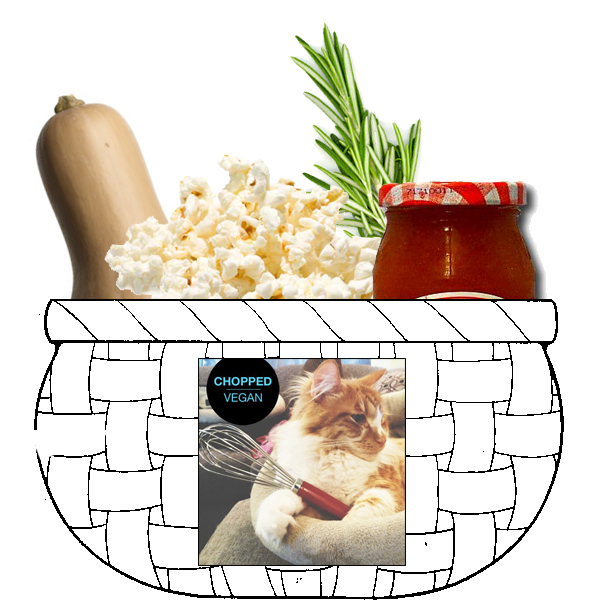
Sunday evening is not my usual blog posting time. But this week's Chopped/Vegan Brunch Round was too tempting to pass up (and tomorrow is the deadline and Blog Action Day). This game is fun. We're given a meal and four ingredients, and then set free to design a dish. Judged on perceived taste and presentation (drat, I wish I had some natural light for my photo), the dish may also include other ingredients. Ok, drum roll please...the secret ingredients are: butternut squash, popcorn, rosemary, and apricot jam!

So here goes, Complete Brunch, gluten-free vegan style (serves two).
Making brunch for dinner means terrible indoor lighting
 Poppin' Johnny Cakes
1/2 cup cornmeal
1/3 cup lite coconut milk
1/4 tsp baking soda
1/3 tsp baking powder
1/4 tsp salt
1 tsp rosemary, fresh, chopped finely
1 tbs apricot jam (or the wonderful apricot rosemary jam the farmer I work for sells)
2 tsp olive oil
2 tsp lemon juice
1/3 cup air-popped corn

1. In a food processor,  combine all ingredients except lemon juice and popcorn. Taste to ensure desired sweetness has been achieved.
2. Add juice and corn, and pulse five or so times.
3. Heat a little oil or non-dairy spread in a skillet over medium-high heat. Spoon batter into four circles in the pan. Cook until edges look set, then flip and press. Continue to cook until other side browns. Remove from skillet and plate, maybe top with some more jam (rosemary infused or otherwise).

Butternut Hash
1/2 medium butternut squash, grated
1 cup beet greens or chard, chopped
1/4 onion, diced
Salt to taste

1. Heat some olive oil in a skillet. Add onions and cook until starting to become translucent.
2. Add butternut squash and continue to cook for another 10-15 minutes with a lid covering to keep in moisture. 
3. Throw in greens and cook until wilted and squash is soft. Salt to taste and plate.

Tofu Scramblers
1/4 onion chopped
6 oz firm tofu
5 baby bella mushrooms
1 tbs white wine (optional)
1 clove garlic, minced
1 bell pepper, diced
1 tsp turmeric
1 tbs nutritional yeast
1/4 tsp thyme
1/4 tsp oregano
Salt to taste

1. Heat olive oil in a skillet on medium high. Cook onions until starting to become translucent, then add mushrooms, garlic, (and wine). Cook another five minutes or so.
2. Meanwhile, mash tofu, turmeric, thyme, oregano, nootch, and salt in a bowl. Add to the skillet along with peppers. Fry up until liquid has evaporated

Friday, October 12, 2012

Fifty Second Friday: Punkin Puddin

Awesome photo of a Carnival Squash from VeganYumYum Blog
Ok, fifty seconds, go! Every year, around this time, I come back to my 'Ode to Winter Squash'. Why? Because nothing says Fall like pumpkins, and nothing helps me survive a cold, gloomy winter better than the sweetness of a roasted winter squash. My first squash purchase of the year was a Carnival squash. And after a bit of a roast, it become a quite delectable, protein-rich treat.
Pumpkin Spice Pudding (sort of)
1 winter squash, diced and roasted until tender
1/2 cup red lentils
2/3 cup water
1/3 cup coconut milk
1 tbs agave nectar
10 drops stevia (or another tbs agave)
1 tsp cinnamon
1 tsp vanilla

1. Boil water and coconut with lentils. Cook until lentils are starting to soften.
2. Mash roasted squash with a fork. Add to lentils and continue to cook.
3. Once the red lentils begin to meld together, add sweetener, vanilla, and cinnamon. Cook until a nice mush. 
4. Serve warm, perhaps with a scoop of some vanilla soy ice cream...

See more tempting treats on Wellness Weekends.

Monday, October 8, 2012

What's Cooking? Portable Pies

I've spent the past week playing on the west coast. Oh, it's been marvelous - lots of good food, very little good cooking. However, I thought I would take this opportunity to bring back one of my favorite posts on 'Portable Pies' that I wrote nearly two years ago. Why? Well, yesterday as I was leaving San Francisco I grabbed dinner for the airport at none other than a little shop called Peasant Pies...specializing in, you guessed it, hand pies!
By now most of you know how much I love pie! Yet rarely does one find a store that actually sells vegan versions of these tasty tarts. This shop sold not one, but three different savory portable pies (oh, the west coast). I purchased the Moroccan lentil and spicy black bean and tofu pies to munch on at the airport before my red-eye last night. Let me tell you, these were wonderful. Flavorful filling, the sturdy dough of a typical portable pie, and very filling. It was the perfect comfort food before a long flight, and something I definitely plan on recreating.

Happy second week of Vegan Month of Food!

Friday, September 28, 2012

Fifty Second Friday: Heads Up!


Happy third-to-last day of September! This month just flew by. And if you recall from last year, October happens to be the Vegan Month of Food (AKA Vegan MoFo). It starts on Monday. Yikes. Really snuck up on me this year...and as such have no plan! However, I do have the running series, so I thought a quick refresher was in order:
  • Mondays: What's Cooking? - there is always some great produce waiting for it's chance in the spotlight (remember Produce of the Week?). Or, I'm cooking up an old favorite with a new twist. Regardless, there will be a recipe and a (hopefully) somewhat decent photograph. 
  • Tuesdays: Food News - there is always something going on in the vast planet related to food. I'll pick out some interesting news bits and provide a little food for thought.
  • Wednesdays: My Munchable Soapbox - I may have a few opinions about food-related issues, whether they are social, political, cultural, or environmental. While not preachy, this is the day to get some facts and perspective on more heated topics on food and agriculture.
  • Thursdays: Thirst Thursday -Washington, DC has a happy hour obsession, particularly on Thursday evenings. I don't...although every so often it's nice. Instead, this day usually focuses on something related to water, which is so critical to producing food and just generally in daily life.
  • Fridays: Fifty Second Friday - yeah, that sums it up. Quick tidbit. Maybe an image or video or recipe. Ideally takes me fifty seconds to post ;)~

Monday, October 31, 2011

CookBOOk Mondays: Trick or Treat?

Ok, that was bad. It is the day of Halloween, but honestly I could have come up with a better play on words! Plus, there is no trick, just soup... Today is the last day of the Vegan Month of Food, even though I feel like October only just began. That said, I have enjoyed the structure of this month so much that I think I will retain certain elements (posting 3-4 times a week to preserve my sanity!). At the bottom of this post is the link to a short survey for you to provide input on your interest in blog content. It will help me gauge what you want to read, as I give My Munchable Musings a bit of a makeover.

Ok, now that those nuts and bolts are out of the way, today is a cookbook double-wammy! The first is a new acquisition from Paperback Swap about which I am exceedingly happy. And the second is a favorite macrobiotic dessert cookbook.

Moosewood Restaurant Low-Fat Favorites is not an exploration in vegan cuisine, but it does have some lovely hearty dishes that served my growing desire for winter comfort foods. This weekend I whipped up a modified batch of Basque White Bean Soup - but I really want to make Callaloo and Golden Split Pea Soup in the near future.

Luscious Legume and Greens Soup
2 cups chopped onions
2 garlic cloves, minced
1 tbs olive oil
1 tbs ground fennel (omitted)
1 tsp dried thyme
1 cup coarsely chopped kale (substituted for cabbage)
4 celery stalks, sliced (omitted)
1 carnival squash, peeled, seeded, and cubed (substituted for butternut squash)
3/4 cup minced red bell peppers
1 cups diced tomatoes (my addition)
6 cups vegetable stock
2 cups mixed black-eyed and green split peas (subbed for white beans)
salt and pepper to taste

1. In a soup pot, sautee onions and garlic in oil until onions start to caramelize. Add kale and celery (optional) until tender. Then add the squash, peppers (optional), and tomatoes. Pour in stock and bring to a boil.
2. Add herbs and cook for 5 - 10 minutes more, until squash cooked. Stir in legumes and season to taste.

Today's fall baked good recipe is an adaptation of a really fabulous Kabocha Pound Cake recipe. I actually came across Love, Eric while in Florence, which is funny considering the cookbook was published in California! Because of my excess of apples during this time of year, I altered the recipe to utilize this fruit.

Honey Crisp Pound Cake
1/3 cup safflower (or other mild) oil
1/2 cup organic apple sauce
2 tbs ground flax (substituted for 2 oz firm tofu)
3/4 cup apple cider (or sub a 1/2 cup soy milk)
1/2 cup turbinado sugar + 1/4 cup agave (substituted for maple syrup)
1 1/2 cup white whole wheat flour
1/2 tbs baking powder
1 pinch baking soda
1 pinch sea salt
1 1/2 cup diced honey crisp apples

1. Whisk oil, apple sauce, flax, cider, and sugars until smooth. Let sit for five minutes.
2. Mix in dry ingredients until just combined. Add apple.
3. Bake in a greased loaf pan for 25-35 minutes at 350F.


Both of the recipes feel very homey and comforting. I hope you enjoy and get a chance to check out these two wonderful cookbooks. Happy Halloween!

Please help me make My Munchable Musings better by taking this short survey.

Thursday, October 27, 2011

Thirty Second Thursdays: Dare to Bake a Povitica

Turning from farm animals to floury hands, let us focus in on a baked good! The Daring Baker’s October 2011 challenge was Povitica, hosted by Jenni of The Gingered Whisk. Povitica is a traditional Eastern European Dessert Bread that is as lovely to look at as it is to eat! While the original recipe was far from vegan, I made a few minor changes for the bread to fit the bill.


A Pearfect Povitica (Makes one loaf)
To activate the Yeast:
1 tsp Sugar
2 tbs Warm Water
1½ tsp Active Dry Yeast

Dough:
½ cup Soy or Almond Milk
3 tbs Sugar
¾ tsp Salt
1 Egg Replacer or Flax Egg
1 tbs Coconut Oil, melted
2 cups All-Purpose Flour or White Whole Wheat, measure first then sift

Topping:
2 tbs Cold STRONG Coffee (I used instant hazelnut)
1½ tsp Granulated Sugar
Oil

Quarter Batch Filling Ingredients (enough filling for one loaf)
1¾ cups finely chopped English Walnuts
2/3 cup homemade Pear Butter (1/4 cup apple cider + 2 large pears chopped + 1 tbs agave)
1/3 cup Almond Milk
¼ tsp Cinnamon
1/4 tsp Granulated Ginger

Follow instructions on original recipe for a not-too-sweet bread. It's a great accompaniment for morning tea or coffee.

Wednesday, October 26, 2011

My Munchable Soapbox: Musing on Meat

This is my last Vegan MoFo Soapbox, and I have yet to broach the topic of meat-eating! We have previously discussed my own journey and reasons for following a plant-based diet here, here, and here. Though on the whole I don't dwell excessively on the lack of meat in my diet, and more on the other components, since we are drawing towards the end of the month, I thought we could devote today to exploring the issue.

According to a study last year, livestock occupies a quarter of the Earth's surface and one third of the arable land grows animal feed. The team of researchers from the UN Food and Agriculture Organization (FAO), Swiss College of Agriculture, World Bank, Stanford University, and the International Livestock Research Institute predicted a possible double of production by 2050. If we think about the current far-reaching impacts from animal waste, deforestation and land degradation, methane and nitrous oxide emissions, etc. all associated with livestock production, it is hard to imagine a world with even more!

A World Watch Institute report released in 2005, Happier Meals, documented the impacts of factory farming, and touts organic and local animal agriculture, and increasing the number of vegetarian meals eaten in a week! Most distinctly, the report discusses the inefficiencies of converting feed, water, and fossil energy into edible calories. A more recent publication by the Institute echos the message of this earlier work. A Vital Signs (based on FAO data) on the increase in meat production describes the serious environmental impacts - deforestation and greenhouse gas emissions - associated with the twenty percent increase in the last decade.

But at the same time, the report also notes that 70 percent of the 800 million in abject poverty (living on less than $1/day) rely on livestock for their livelihoods. In Zimbabwe, cattle's role in turning the soil has reversed the path of desertification that was threatening crops and food security. Manure is an important nutrient provider; chickens serve as pest control by eating bugs off crops; and goats, well, can clear weeds...

Ok, so perhaps you thought when I started this blog entry about the eating of animals, that it would be vegan-centric, touting the benefits of an herbivorous lifestyle. I have to say that for my part, I believe in the benefits of such a diet for health and the environment. But I think the issue of livestock-raising and meat-eating merit more critical scrutiny and informed discussion. This is particularly true in cases outside of industrialized countries, where animal protein is a luxury not a norm (or an excess!), and where that may be the difference between starving and feeding a family.

I welcome and encourage comments, in hopes of inciting perhaps a little more discussion than usual on the benefits and shortcomings of a diet inclusive of meat, dairy, and eggs.

Tuesday, October 25, 2011

Off the Grocery Shelves: Okra

Okra has only recently entered my repertoire, kicking off the Vegan Month of Food! But because of my new-found attachment to this vegetable, I thought it would be interesting to explore a bit further. The red okra at the community farm spurred my interest in this topic. Okra is not something one would regularly find in a supermarket produce section, not even necessarily a Whole Foods. But this pod has classically been used in Southern cooking and can be happened upon in ethnic markets.

The plant stems from the ancient region now known as Ethiopia, Eritrea, and Sudan. In fact, the preparation in a "meal" batter as generally used in Southern cuisine hails from this Northern African center of origin.

Okra, too, has its share of exciting varieties. From the Red Burgundy's crimson pods to the Cow Horn that can reach eight feet high! Well, reaping the benefits of some pretty tall okra at the farm, on Sunday we prepped some fun okra fritters (non-vegan). These were so enticing that I decided to dig up a few a recipes to try out in the coming week:
Down to a week left of Vegan MoFo!!

Monday, October 24, 2011

Cookbook Mondays: In Celebration of Food Day

Today is Food Day. Now, do not confuse this with World Food Day, which took place last weekend. The U.S. version was founded by two congress people, seeking to rally public advocacy around reforming the domestic food system. Six basic principles make up the agenda:
  1. Reduce diet-related disease by promoting safe, healthy foods
  2. Support sustainable farms and limit subsidies to big agribusiness
  3. Expand access to food and alleviate hunger
  4. Protect the environment and animals by reforming factory farms
  5. Promote healthy by curbing junk food marketing to kids
  6. Support fair conditions for food and farm workers
That is a hefty set of goals, but I encourage all of you to sign the petition on the website to garner as much support! In the meantime, it seemed like a good time to break out a cookbook I had acquired and not yet consulted: A Cook's Book of Vegetabales: Peas, Beans, Greens. This is an out-of-print Aussie cookbook focused on just what its title insinuates.

So I made this lovely dinner (and week's lunches) and forgot to take a photo (not very photogenic food, anyhow)! So, instead you get some old photos of an eggplant, and my contributions to Wellness Weekends on Diet, Dessert 'n' Dogs (both adapted from the aforementioned cookbook). I think this roundup1 is well-suited for Food Day, in so much as it promotes healthy meals and avoids the need to rely on factory farms by being completely animal-product-free!

Creamy Sweet Potato Polenta
1 orange sweet potato, washed and aerated with a fork
t tsp coconut oil
1/4 cup soy or almond milk
1 tsp salt
1/2 tsp cinnamon
1 cup polenta
3 cups water

1. Microwave potato for 3-4 minutes, until soft but not dried-out.
2. Meanwhile, heat 3 cups of water to boiling, adding polenta at the beginning. Continue to stir and add liquid as necessary, until loses its coarse, grainy texture. Add cinnamon, salt and milk.
3. Mush potato and oil together until smooth. Add to polenta with a fork, and combine until even.
4. Serve warm.

Eggplant and Lentil Salad
1 medium eggplant, diced into 1/4 inch cubes
2 tbs olive oil (I tried a smoky one!)
1/2 small onion, finely diced
1/4 tsp ground cumin
2 cloves garlic, minced
1/2 cup red lentils
1 cup vegetable stock
1 tbs red wine vinegar (optional)
1 tbs olive oil (good stuff, optional)

1. Place eggplant in a bowl with salt. Allow to sit for 30 minutes.
2. Heat 1tbs olive oil over medium heat. Add onions and cook for 2 minutes. Add eggplant and cumin. Cook for another 5-10 minutes, until onions are translucent and eggplant soft.
3. Remove mix back to a bowl. Heat second tablespoon of olive oil over medium heat.
4. Add garlic and brown for a minute or two. Then pour in vegetable stock and bring to a boil.
5. Cook lentils until soft and liquid is gone. Return eggplant to pan and cook for another five minutes.
6. Toss in vinegar and good quality olive, if so desired, before serving up.

Friday, October 21, 2011

Fast Fact Fridays: No, No, We Won't GMO!

You probably ate something today that was genetically engineered (GE). 95% of sugar beets, 91% of soybeans, and 85% of canola and corn are genetically modified. The bigger issue, whether you agree with GMOs or not, is that there is just no information about what products contain them.
  • 48% of GMO cropland is planted in the U.S.
  • 31 countries, plus the 27 European Union member nations, have labeling laws/regulations for GE crops and food products. The U.S. (except Alaska!) has nothing.
  • Over 80% of Americans support GE labeling.
Last Sunday, the Right to Know March landed at the White House to show our government that the American public wants...no, needs...information to make decisions about what we purchase and what we consume!

Thursday, October 20, 2011

Thirty Second Thursdays: A Caffeine Jolt

My friend is amidst qualifying exams for her PhD work in mechanical engineering. This means months and months of studying for three thirty minute technical oral exams at a white board; in other words: months of long hours and late nights. So, in her final weeks, I sent off a batch of these tasty (caffeinated) cookies!

Jumpin' Java Chip Cookies
1 1/2 cups whole wheat flour
1 cup sugar
1/4 cup instant hazelnut coffee (or plain + 1 tsp hazelnut extract)
1/3 cup oil
1/4 cup hot water
1 tsp vanilla
1 tbs ground flax
1 tsp salt
3/4 tsp baking soda
1/2 cup chocolate chips

1. Whisk together sugar, oil hot water, and instant coffee until coffee is completely dissolved. Add vanilla and flax, allowing to rest for a minute or two.
2, Sift flour, salt, and baking soda over wet ingredients. Mix only until combined then fold in chocolate chips.
3. Spoon tablespoons of dough onto a lined/greased cookie sheet. Bake at 350F for 15-20 minutes, until starting to brown and set, but still pretty soft to the touch. They will harden as they cool. 

"Dangerously delicious...satisfyingly crunchy" -RZP

Wednesday, October 19, 2011

My Munchable Soapbox: Frankenfood or Hunger Hero

This week, let's focus on genetically modified organisms, or more commonly referred to as GMOs. Why? Well, this past Sunday, a march that began in New York on the first of the month ended with a rally in front of the White House. The Right to Know March focused on the lack of information around GMOs in our food supply and the American public's desire to know what we eat.

That is a fair concern, considering how many of the products on grocery shelves contain GMO ingredients. We've had big stories about round-up ready crops created superweeds and controversy over patent law cropping up in farmers' fields! Genetically engineered (GE) crops are quite a polarizing topic of conversation, particularly in countries in the European Union and other regions where labeling is required and many products banned entirely. However, I think the topic of GE crops is even more fascinating in the context of rural development and food security.

I have struggled with the concept that genetic engineering can play a crucial role in creating drought-tolerant crop varieties, improve nutritional content ("Golden Rice" is the classic example - enhanced with vitamin A to combat blindness), and feed a growing population. A couple of years ago the New York Times Room for Debate column took on this issue, with both sides of the spectrum weighing in. While the pros cited biotechnology as the way to combat climate change impacts and boost yields, harping on those who would write off these scientific feats, it seems as though very little evidence has shown the outstanding benefits resulting from GMOs. Raj Patel brings up the critical point that at present we produce enough food to feed the planet, but lack of access to these calories from poverty and poor infrastructure is ultimately at the root of hunger.

So after all this reading and musing, what are my thoughts on the topic? For me personally, the issue of GMOs is a no-brainer. I don't want to eat them. While there probably is more hype and hysteria than is merited, the fact remains that we are playing with something we don't fully understand.

As for feeding the world, I don't believe we need to go there. From an ecological perspective, engineering traits into our crops is not the same as boosting the natural systems that confers properties of adaptability and resilience. Building soil healthy, harboring pollinators, and ensuring the function of surrounding ecosystems is essential to a whole system with adaptive capacity. On the development side of things, many of the proposed GMO crops, as did the rice and wheat of the Green Revolution, require more inputs, more water, more seeds (since they often can't reproduce on their own)...for a poor African farmer, who knows if these added expenses and inability to save seed outweigh whatever engineered benefits they convey.

So, that was perhaps a bit longer and more rambling than intended, but hopefully it shed some light on the range of issues associated with genetically modified foodstuffs. I did not march on Sunday, but I do think that knowledge is power and we do need to increase awareness around the ubiquity of GMOs, both domestically and in our humanitarian aid and international development work!

Tuesday, October 18, 2011

Off the Grocery Shelves: Eating Your Greens

Kale is one of those vegetables that is experiencing a resurgence of interest among eaters in this country. A staple winter crop of yesteryears, few of the varieties once cultivated still make their way onto the dinner plate. Even at the farmers market, pickings are a mere shadow of what they could be: lacinato/dinosaur kale, Red Russian, and curly. With origins in Italy and the Mediterranean, this older sibling of cabbage has been a part of a human diet for 2,000 years. In fact, the hardy winter green played a critical role in the survival of the Scottish Highlanders!

Browsing the Cornell University Vegetable Variety Database, I came across 49 distinct varieties that made the phytophile in me almost giddy! A few different types of Siberian, the Lily White, Even'Star, and Pentland Brig, not to mention some Asian transplants like Ryokuho and Suiho. So now I am waiting with bated breath for kale for sale to diversify. In the meantime, I'll stick with some delightful Lacinato.

In fact, on Sunday, we made caramelized pears and kale with the kids at the community farm. My hopes weren't high considering we were cooking some green leafy substance. However, I was pleasantly surprised by how receptive and even enthusiastic the kids were about eating this slightly sweet superfood combo. Guess that just goes to show every veggie is worth half a chance!

Monday, October 17, 2011

Cookbook Mondays: A Taste of Veganopolis

Once upon a time there was a fantastic vegan restaurant in Downtown Portland. I know, not all that unheard of. But, this was the lunch spot my mother, sister, and I frequented every year around New Years. We'd usually split a tempeh sandwich or salad with seitan chicken. At one point, we sampled the mac 'n' cheeze with peas, only to miss all the days they served that delectable dish from that point forward. And then one year it was gone. The cafe up and moved to Chicago. Well, I don't know how well it fared out in the Windy City, but I do know we sorely missed it in Portland. Luckily, I finally came across The Veganopolis Cookbook and now can make cheezy macaroni to my heart's content!

Ok, so maybe not. Instead, this weekend I cooked up an exotic soup and some down-home greens!

Curried Roasted Cauliflower Soup with Green Peas (adapted for a large single serving)
1 1/2 cup cauliflower florets
1 tbs garam masala
1/4 tsp salt (more to taste)
1 1/2 tbs olive oil
1/2 cup soy or almond milk
1 1/2 tbs white spelt flour
1/2 cup peas

1. Massage 1/2 tbs olive oil, salt, and garam masala into cauliflower. Spread on baking pan and roast at 450F for 30-45 minutes until well-browned.
2. Meanwhile, heat rest of oil and flour in a saucepan over medium-high heat, whisking until color begins to darken. Add milk and stir until the mixture thickens. Turn off heat until cauliflower finishes.
3. Once roasted, add cauliflower to saucepan and puree until smooth. Return to heat to reach a simmer and add peas. Cook until peas are tender. Taste and adjust seasonings as desired. Serve!

Cajun Slow-Cooked Greens (I also halved this recipe)
2 tbs olive oil
1/2 cup finely diced celery
1/2 cup finely diced onions
1/2 cup finely diced sweet peppers
1 tbs garlic powder
1 tbs onion powder (omitted)
2 tsp ground white pepper (omitted)
2 tsp ground black pepper (omitted - ok, I don't like pepper. So sue me)
1/2 tsp cayenne pepper
1 tsp ground nutmeg
2 bunches of collards (or mustard greens), chopped
1 cup tomato stock (liquid from roasted tomatoes, or vegetable stock)
salt to taste
seasoned rice vinegar, to taste (omitted)

1. Heat onlive oil over medium heat in a skillet. Add celery, onions, and peppers. With dry spices, sautee until onions are soft and translucent.
2. Add chopped greens. Cook everything at least 30 minutes.
3. Add salt and vinegar to taste. Easy peasy!

Friday, October 14, 2011

Fast Fact Fridays: A Cacao Catastrophe

Most of the world's cocoa is grown in Ghana or the Ivory Coast. These areas, sadly, are slated to be impacted considerably by climate changes. A study by the International Center for Tropical Agriculture (CIAT) predicts that by 2030, we will see a significant decrease in cacao production. Now I don't know about you, but that leaves a bitter taste in my mouth!