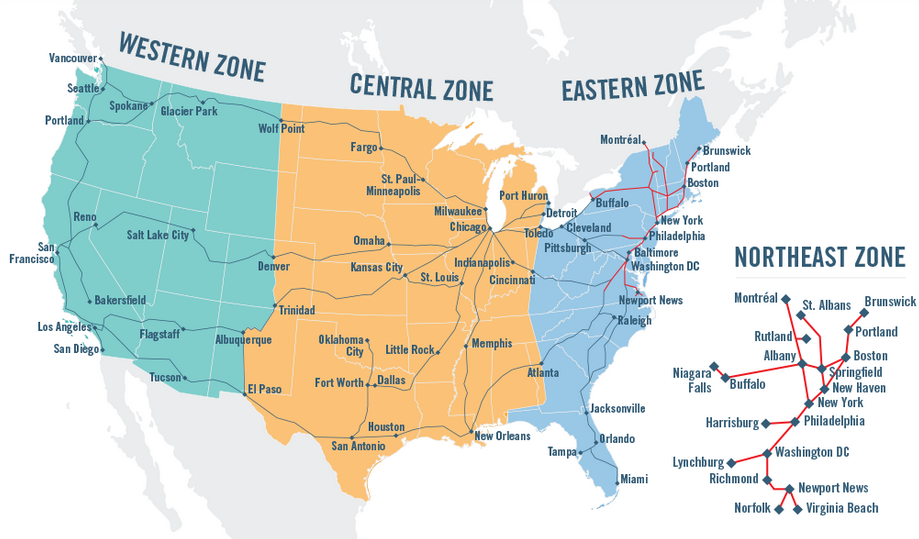
Maps of the US seem to be all over the media recently, a little patchwork quilt of reds and blues - a repeated reminder of the divisions between urban and rural, between coastal and central, between ethnic groups or income levels. But it’s one thing to see the maps of the country’s political inclinations, and quite another to get one’s head around the sheer vastness of these here United States.
 |
| Union Station in Washington, DC |
I’ve written this from a train. This visit home, I decided to cut out the air travel and catch a few locomotives. Now, this isn’t an earth-shattering decision on my part. My move back home after college was by train. And I had crossed the country twice before, traveling from Washington, DC to Seattle. However, this was my first trip linking together so many rail rides – committing to a full loop (sorry southeastern US…), a “Grand Tour”, shall we say. It meant factoring in a solid 8.5 days in-transit. Inevitably, that makes you stop and think about how big the country is, how different each place is, and how many people call each home.
Just a quick history lesson – while the US wasn’t the first to pioneer railroads, it replicated and expanded upon the technology to an unparalleled extent. During the mid- to late-19th century, trains were the ultimate movers of people and products – capable of covering great distances quickly and relatively efficiently – but they were much more than that. As the name of the route from Seattle to Chicago – The Empire Builder – suggests, trains were also means of asserting national sovereignty and uniting geographically disparate regions. Railways served this purpose in countries like Italy and India, connecting a collection of autonomous city-states. In the US, railways helped assert the notion of manifest destiny and supported rebuilding in the post-Civil War reconstruction period. Between 1855-1871, the US government operated a land grant program for new rail companies to expand west (eventually totaling 730,000 sq km), encouraging settlement and development. Notably, the first transcontinental railroad was completed in 1869 by the Central Pacific and Union Pacific Railroad companies (note the link to my alma-mater…), running from San Francisco to New York City. Fortunes were made and lost in the rail business, and economies rose and fell.
With the expansion of motor vehicle and airplane use in the mid-20th century, trains became the less preferred method of moving people. Today, they still significantly contribute to US freight transport, most noticeably for heavier cargo traveling long distances. For instance, rail makes up 15% of US-North America transboundary freight transport (by value, second after trucks). But passenger rail has lagged behind other developed nations. While not surprising given how the country’s transportation network developed, the missed opportunity for the US to lead in rail innovation still saddens me.
 |
| Heading north in Central Oregon |
Tears aside, there is much to be said from my Grand Tour. It took me across over 7,500 miles of the United States, including a southwestern route I had never been on before. Although I had vowed to use the time for an uninterrupted writing retreat, much of the daylight hours found me distracted by the landscape flying past. Here’s a brief overview:
Leg #1: Los Angeles to Oakland (12 hours)
My first time on this stretch of the Coast Starlight, I was surprised by how popular this route was, not to mention the number of vocal first-time train travelers. Filled with beautiful coastal views complemented by the rolling Central Valley scenery, the routes from LA are notorious for delays, not least because freight is king.
Leg #2: Oakland to Seattle (21 hours; 1,377 miles from LA)
During the winter, you lose all the northern California landscape to the night, but wake up to Oregon’s high desert with the dawn light. This remains my favourite route, perhaps because it invokes those comforting feelings of coming home. It’s also a pretty vibrant leg, with many passengers getting on and off for the shorter trips between San Francisco and Portland (or somewhere in between) and Portland to Seattle.
 |
| Skirting Glacier National Park as day breaks |
Leg #3: Seattle to Chicago (45 hours; 2,206 miles)
This ride would be amazing in the summer, with some of the most impressive alpine window-watching! The tracks start along the Seattle waterfront, with views of the Pacific for the first hour or so. East-bound you miss the journey across the Cascade Mountains this time of year, but you catch the majestic peaks of Glacier National Park as the sun comes up. Looking at a map, it is also particularly interesting to see how the tracks skirt several Native American reservations, including: Colville, Blackfeet, Flathead, and Fort Belknap. It is a subtle reminder of the region’s tearful history.
While Montana takes an entire day to cross, the majority of which is comprised of sparsely populated prairie (there are less than 7 people per square mile in the state). North Dakota flew by under the cover of night. As the second day broke on Minnesota, we had a reminder of heightened border security, when a patrolman came onboard to ask passengers’ nationalities. Not to sound like a broken record, but people really do use the train! This seemed to be mostly short-hauls, and I expect the train is more convenient for some more rural areas, where major airports are hours drives away. The demographics leaned slightly older, some of whom I overheard discussing their dislike of flying and prefer to avoid the hassle of airports if they have time. Ehem, #32goingon70
 |
| Along the Mississippi is apparently the best place to spot eagles… |
Leg #4: Chicago to New York City (20 hours; 959 miles)
Chicago is the hub that nearly all cross-country routes go through, and this time proved trains to be oddly reliable: with some snowstorms hitting the northeast and flight/bus cancellations, the trip was packed with people who had opted for the train.
Leg #5: New York City to Washington, DC (3 ½ hours; 226 miles)
Much better than the bus. Period.
Leg #6: Washington, DC to Chicago (18 hours; 764 miles)
Passing through Chicago again, with a few hours to catch up with a friend (or family).
Leg #7: Chicago to Los Angeles (43 hours; 2,256 miles)
As my first time on the Southwest Chief, this leg of the journey was fascinating and quite a contrast from the northern routes. Deserts, canyons, and glimpses of the Rockies – after that first night, it soon became clear we were not in Kansas anymore (which we crossed while sleeping). There were also little reminder of the strong industrial ties to railways – passing offshoots to mines and cars full of coal, destined for ports or other parts of the country.
 |
| Coal cars in Colorado |
After spending over 160 hours on trains in the span of five weeks, I made it back to beginning, to leave you with a few final thoughts on taking the slow travel option. 1) This was definitely a lesson in Geography, a refresher in neighboring States and overland distances, while tracking that little blue dot inch along my phone’s map. 2) I’m continually surprised at how quickly the time flies. While three days seems like a long time to get from point A to point B, in the scheme of things it isn’t. And when you travel this way, everything tends to feel just a little bit less urgent. 3) Opting for the train has to be more than low-carbon travel. In Europe, there is really no comparison: the default electric high-speed rail produces about a tenth (or less) of the greenhouse gas emissions of flying. However, this is ‘murica! Amtrak trains emit about ~0.45lb CO2/passenger mile (the NE corridor is at 0.37lb CO2 because it runs on electricity rather than diesel), which is comparable or slightly higher than a non-stop long-distance flight (though taking a coach is by far the greenest, though perhaps less enjoyable, option). While sometimes it is the more carbon-friendly option, there are also plenty of other reasons to go via rail (did you see that mountain?).
On that note, anyone interested in a combined rails and trails trip? Until then…