Pages

Showing posts with label academic. Show all posts

Friday, April 27, 2018

How Just, and Just How?

 It’s a long-standing ambition, for society to reach some sort of just and equitable ideal. What that means in practice differs, depending on the time, place, and people involved. But it does seem that meeting basic human rights and needs and the notion of ‘fairness’ are prevalent across discussions of social justice and equity. Things like poverty and hunger connect pretty clearly to equity. For conservation, however, it’s a bit fuzzier. In theory, conservation is driven by values around making the world a better place. Yet we also have to ask ourselves - who gets to decide how conservation happens, where, and who benefits or suffers. 

A few other researchers and I recently thought we’d try to get a better sense of how research in conservation has so far approached equity - especially how it’s defined, measured, and evaluated in studies. We sifted through a mound of papers, synthesizing information from the 138 that considered how social equity and conservation fit together. Besides a general upward trends in the amount of research explicitly on this topic (and alphabet soup present as SDGs, REDD, and CBD have become prominent), there are also some trends in what and how.

Equity is 3D. According to people who spend a whole lot of time thinking about equity, we should consider not only the distribution of costs and benefits, but also the procedure of making things happen (e.g. who gets to make decisions) and the recognition for rights, types of knowledge, cultural factors, and the like. The conservation literature has often defaulted to analysing distributional equity, adopting a stance of equity as egalitarian or fair allocation of costs and benefits and capitalizing on concrete and easy-to-measure things … like money. And what is considered ‘equitable’ may be a bit fuzzy or obscured, but making it very clear is essential for keep tabs and evaluating progress.

While the limited view of equity adopted by conservation and insufficient definition are important things to recognise, there are other lessons we can take away from the state of our current equity and conservation research. If we backup and consider why researchers study conservation and equity in the first place, we often see a utilitarian perspective, this romantic notion that social equity and conservation success go hand-in-hand. However, there may in fact be trade-offs between social equity and conservation (or even between those different dimensions of equity). In both research and practice we need to be more critical of our underlying motivations and examine more closely the knock-on effects of any given action.

Like a lot of the research in conservation, there are also some discrepancies between who is carrying out the research and where conservation is taking place. For example, very little research is happening on conservation and equity in Europe or North America, but much of the research is coming from institutes in those regions. This makes it a bit hard to tell how much studies reflect the researchers’ own notions of equity or what is relevant to the local context.

I guess the burning question is still, is conservation equitable? Well, it’s complicated (and inconclusive). We found that studies reported negative or mixed outcomes - so conservation less frequently resulted in positive equity results. But all those elements above (and many more) will influence these endpoints.

If you found this all super-intriguing, you can get even more detail from our review paper in Environmental Research Letters! AND, while we’re on the topic of social equity … During Live Below the Line this May, I’m raising funds again for this awesome foundation that works to end poverty and empower youth. Definitely fighting injustice!

Friedman, R.S., Law, E.A., Bennett, N.J., Ives, C.D., Thorn, J.P.R., & Wilson, K.A. 2018. How just and just how? A systematic review of social equity in conservation research. Environmental Research Letters, 13(5). Doi: 10.1088/1748-9326/aabcde 

Monday, February 26, 2018

Weathering Change: Women Farm Cocoa, Too

You have probably read an article or two (or more) about how climate change is going to be the end of chocolate. Compounded by potential losses of our other favourite indulgences - coffee and wine - this is nothing short of tragic. But what these articles don't really discuss is what happens to the farmers who grow these valuable export crops. Studies documenting how climate change affects rural people generally point out that they're likely to lose income, and that women are particularly at risk of experiencing negative effects. But not everything is about money, and not all women are in the same boat. The coarse resolution at which poverty and gender are often treated means we may get a skewed picture of who is actually vulnerable to climate change and for what reasons.

Back in 2014, I was working on surviving my MPhil degree, and reveling in the joys of fieldwork. From June to September, I was in the Central Region of Ghana, chatting with women in cocoa farming communities about their lives, their work, and the stresses they face. The idea was to get a sense from past experiences of "weather events" - the usual droughts and floods, mostly - in order to get an idea of how climate change could alter the lives of these farmers in the future. While the dissertation may have long since been done and dusted, one piece has lingered in the shadows. After 2.5 years since its first draft, some of the insights from this project finally made it through the peer-review process to see the light of day!

Yes, Kakum looks like a seahorse. Credit: Alex Morel
It's a bit off-point from the usual ecology fare (or maybe that's not so usual these days...). The idea of our little study was to get a better sense of who among cocoa farmers is vulnerable to climate change and how. While by no means the definitive works, the paper describes how women involved in producing cacao are vulnerable in different ways. Because I've been told it's acceptable to celebrate your first first-authored paper, I'm unabashedly taking this time to share the highlights.

First off, why cacao? Besides the logical reason of its being the precursor to chocolate, cacao is an interesting case in a changing climate. A bit of a "Goldilocks" crop - it is best suit to a limited area around the globe - it needs certain amounts of rain, a tight temperature range, and both these things at the right times. So shifts in climate may have severe consequences for cacao crops. One finding from the study was that women who own cacao farms may become more exposed to adverse weather conditions - merely because the crop is particularly finicky - in comparison to those women who don't and grow a range of vegetables and starchy staples that have different optimal growing conditions.
But that's where the relative benefits of not owning cacao seem to end. Farmers are very much like investors - they diversify their portfolios of activities to reduce their sensitivities to any single unfortunate event. Cacao can be a highly profitable cash crop, and the women I spoke with who managed their own cacao had more disposable income and independence to take up a variety of income streams. They could spread their nest eggs across many baskets. Independence was not just about finances, though. The confidence and sense of empowerment that came along with owning cacao differed considerably from the pessimism and hopelessness expressed by many of the women who did not. Someone must have said that "success is a state of mind", and while tangible resources do help, having a proactive attitude can make all the difference in responding and adapting to challenges, not the least of which is climate change.

Couldn't have managed without Auntie Fausti,
who looked out for us while Homaho!
Last of all, while not explicitly part of the analysis, I did notice a strong tendency for women with cacao to point out the importance of ecological stewardship. Perhaps because it is harder for women generally to obtain fertilisers and pesticides used in cacao production; perhaps because many also cultivate the veg that they then feed to their families (and who wouldn't want to feed their kids safe and nutritious food?); or perhaps it's because many have inherited land after farming all their lives and building up knowledge of ecology over time, rather than receiving agricultural extension training focused on technology and inputs (also largely unavailable for women). Perhaps that is a question for another research project!

Unfortunately, none of this solves our chocolate predicament. But hopefully it's a step toward more nuanced ideas for helping farmers face the current and pending climate changes.

Read the full paper, if you're feeling ambitious...
Vulnerability of Ghanaian women cocoa farmers to climate change: A typology. Climate and Development. doi: 10.1080/17565529.2018.1442806

Related Posts:
So much thanks to my co-authors- Mark and Emily, Rebecca for constructive comments on the paper and support in the field, and all of the ECOLIMITS team for letting me tag onto the project. This would not have been at all possible without the amazing interpretation skills of Anne, the local know-how and tech support of Mike and Prosper, and of course all the women who gave their time (and often food and hospitality) in opening up about their lives and contributing to this project. I'm forever grateful, and hope one day this can help in some small way. Medaase!

Tuesday, February 20, 2018

Four Stages of Interview Success

Camp! Ranomafana National Park, Madagascar, 2007
Fieldwork is often the bread-and-butter of many researchers' work. This ritual of going 'out' to collect 'data' forms the core of how both natural and social scientists build their understandings of the world. I fell into field ecology my second year at university, doing fun things like counting the number and size of trees in a certain area, or seeing how many different types of bugs we could catch in pitfall traps set at regular intervals. The methods were pretty much the same if we went to the rainforest in southern Mexico, a deciduous forest in northern New York, or across the globe to the temperate humid forests in eastern Australia. Expeditions could require a fair amount of logistical magic - between wrangling gear (like massive measuring tapes for transects or containers for sample collection) and obtaining appropriate permits (particularly if in a foreign country or accessing protected areas). Something will inevitably go wrong - inclement weather, malfunctioning equipment, lost luggage - and it can get lonely. But it can also be peaceful, contemplative, and rejuvenating (...anyone need a field assistant?).

I don't think we made it to the village... Central Ghana, 2014
But this 'fieldwork' has changed a fair bit for me since the last excursion in ecology just over a decade ago, as more of the natural gets replaced by social. Yet, particularly in a school of biological sciences, I get the feeling that social science methods are underestimated in terms of their complexity and questioned for their legitimacy and robustness. In becoming more familiar with the social sciences over the last few years, though, I'm coming to terms with their own methodological challenges not too dissimilar from carrying out an ecology fieldtrip. Yesterday, while trying to sort out a few remaining interviews for a study here in Indonesia, we were discussing all the behind-the-scenes activity involved in the final 45-90 minute interview. For your benefit, I've detailed the four stages of "interview success" below:

First Success! Obtain contact information for the target interviewee, either directly, or through circuitous process of snowballing. For example, you know someone, who knows someone, who used to work at the organisation the right person might still be affiliated with.

Second Success! Make contact with target interviewee, and proceed with a long series of WhatsApp messages, often missing vowels or half the word. Then, you realize that your explanation in bahasa Indonesia implied you are implementing a “project” and not “studying” something on the topic of interest, and you spend the next exchange of messages explaining that you’re doing something else entirely, and you really just want to talk to them and hope it eventually makes a difference in the world.

Third Success! Set a time, date, and location for the interview. Change said time, date, and location because of heavy rains and flooding. Then realize the location is actually perfectly situated for acoustic augmentation of motorbikes revving, which is all a dictaphone or mobile actually picks up. 

Fourth Success! Actually meet target interviewee, conduct congenial interview, shake hands (maybe taken token photo), and part ways. This does eventually happen. 

Bonus Success! Interpret your notes scribbled during the interview and somehow manage to fit them into a framework you thought was applicable to the "study system". Proceed with analysis and writing up, ultimately trying to make some sense of the messy world we live in.

A recent paper reviewing the use of interviews in conservation research provides some useful insights into good practices when choosing interviews as a methodology.

Saturday, December 31, 2016

The Best of Times, The Worst of Times

I think all of us can agree that 2016 had a bit of a rough run. It was politically charged; it was tragic and sorrowful; it was also beautiful in many ways; and I hope it will open the door to some much needed healing in the year to come. Holding with tradition for the eighth year running, I put together a bit of a recap of the past year seen through the eyes of My Munchable Musings.

This year seemed particularly replete with environmental and social grievances, as if the Anthropocene - the age of Homo sapiens - had finally come into its own. Despite international efforts to overcome poverty and injustice, we are still battling inequalities reminiscent of bygone eras. This was my fifth year Living Below the Line, contemplating the trade-offs the food insecure face in terms of costs, calories, and nutrition. Perhaps a product of my own news filters - thanks selection bias and algorithms for reinforcing our bubbles - but there also seemed to be considerable coverage of human-induced environmental problems and social justice issues. Imminent climate change catastrophes made late headlines, victims of environmental exploitation made small waves, and the world watched rather silently (or preoccupied) loss of human rights and dignity. Thanks Twitter for making the world's atrocities so much more accessible (and Storify for allowing me to rehash it all).

Going back through my actual blog posts from the year, however, there seemed to be much more to celebrate. In true Munchable fashion, we took a bit of a tour through through the beauty of biodiversity and food, at the intersection where art and agriculture collide. About halfway through the year, a challenge to compile a week of photos depicting beauty in nature made its way around the interwebs. A lunchtime conversation spurred a post on the amazing tuber diversity. And of course I could not go a full year without pontificating on the joys inherent in the art of bread-baking. These may seem like small potatoes, but to me they seem more like beacons of hope amidst stormy weather.
  
Finally, this year saw many developments here at command central. At the end of January, I left the damp of England after 2.5 years and moved to Australia in order to continue the over-education process. On the two month journey between the two Commonwealth countries, I made a second transcontinental rail trip to see immediate family in the US, followed by a first foray into Southeast Asia (including some history lessons and another train trip). Starting the PhD has helped me finally come to terms with my identity NOT as an ecologist, but as intentionally straddling disciplines (good luck with that...).

Mid-way through the year, I did some stock-taking as a 30th birthday exercise. Almost as a physical reminder of this aging, I proceeded to tear my ACL and menisci (...lesson to all that gymnastics takes hours of training, particularly when you are no longer 17). To ensure the year ended on a high note, I scheduled in my first surgery and overnight stay at a hospital the week before Christmas. I suppose out of necessity, the new year will be one of recovery, and not just for me, but hopefully more broadly from all the cruelty, divisiveness, and hatred that has taken place recently. Here's to a more enlightened 2017.

Read Years Passed

Thursday, July 7, 2016

Do We Need a Bigger Box?

Humans are social creatures. We like to feel as if we belong, have a common bond and value set as our peers. And we often do so by putting ourselves in boxes. There are liberals and conservatives. We have national identities, racial identities, religious identities, even dietary identities. In academia, we love it. He's an historian; she's a mathematician; they are economists; we are biologists. It makes it easier. We know how to talk to one another, use the same vocabulary, approach questions in the same way, have the same colleagues and network connections. It's comforting to know what something is; when I see an apple, it's nice to know that it's an apple (and not a grapple...that's just wrong).

But that's not really how the world works. And while we as people may try to fit ourselves into those nice little boxes, as much as we try we just can't address complex, real-world problems that way. The field of conservation biology grapples (not the fruit...) with this challenge on a regular basis, as by its very nature is tasked with addressing complex, real-world problem. So it is observing how this plays out, while participating in the Society for Conservation Biology Oceania conference this week. If you simply looked at the programme or the delegate list, you would see an astounding diversity topics from hard-core ecology to spatial planning to economics. But if you dug a little deeper, started having conversations, or just listened to today's plenary, a dynamic emerges that - while not unexpected - is indicative of the larger shortcomings of tertiary (and perhaps even earlier) aceademic training.

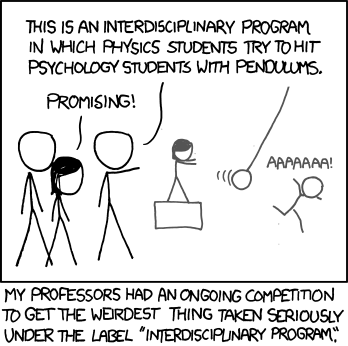
Today's really fantastic plenary speaker (no seriously, I sat rapt through his "not-very-deep history of conservation"), Mark Burgman set a challenge to the "card-carrying social scientists" at the conference and more broadly engaged in conservation to step up their game in terms of the means and methods of getting people to care about conservation, which the ecologists presently lack. But there was a bit of an us versus them cloud descending on the room, which reflects how natural and social scientists are trained to define problems, analyse data, and develop solutions. And therein lies the challenge, in my humble opinion: we approach conservation in an interdisciplinary fashion, bringing together the ecologists and the economists, the anthropologists and astrophysicists (hey, they're good at maths and modeling!) and expect to fluidly join expertise to answer burning questions. But what we are actually missing are the transdisciplinarians who have the background to be able to translate and mediate across different disciplinarian methods, yes, but also ingrained ways of seeing the world (and to give credit where it's due, this was a mutual point in a conversation yesterday post-conference). 

So this brings me back to identity, because all this thinking has perhaps clarified my own struggle with disciplinary identity and explained (...or rationalised?) my seemingly meandering academic training to date. When asked 'what is your background', I often resort to identifying as a lapsed ecologist. But to be honest, I'm not and never have been. Sure, Earth Systems - Biosphere majors spent a fair amount of time studying ecology (the 'fuzzy' natural science), yet also took classes in economics, anthropology, and even the odd course in history or psychology. The differences emerge in part because of the questions we try to answer: ecologists seek to understand the interactions between plants, animals, and abiotic factors, whereas Earth Systemsers ask how we can use knowledge of ecosysems, as well as the socio-economic contexts in which they are situated, to solve pressing environmental problems. But I would argue it goes even further to keeping an open-mind, not diminishing or invalidating a discipline's approaches (most likely because we don't understand the underlying theory and reasoning), and embracing the wealth of methodologies and existing knowledge at our fingertips when we work together.

DSC_7750
I'm not arguing for the end of specialists or disciplines, but we do need to put more weight in training people across disciplines to translate and mediate. Going back to blog posts from ten years ago (which were admittedly a bit mundane and poorly written) the references to this type of undergraduate training were there, although perhaps not fully appreciated at the time. It's increasingly important that training across disciplines be encouraged, while at the same time, those who gravitate towards a particular field of study also must work to be at eye-level with other disciplines (i.e be more accepting and not scoff at the credibility and reliability of each other's practices). If this conference is any indication, it's still a long road, but at least we've begun!

Read More: