Pages

Wednesday, September 29, 2010

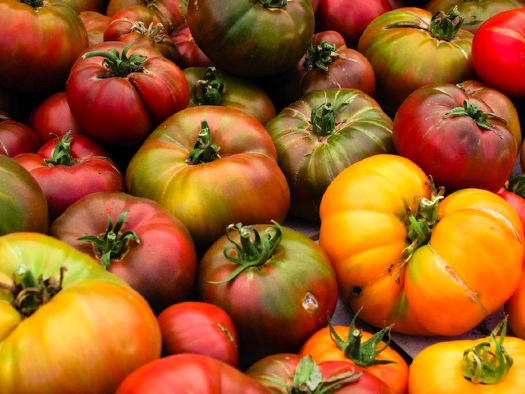
Produce of the Week: Tomatoes!

Photo by Tara Maxey

The last of summer drifts away as the leaves begin to turn and flutter to the ground. But even as the weather turns (and let me tell you, the weather has definitely turned from warm and sunny to chilly and rainy), tomatoes are still around to brighten the day...for another couple of weeks.

Native to South and Central America, the tomato made its way from Montezuma's garden to Cortez's Spain (and subsequently the rest of Europe) in the early 16th century. The Italians embraced these beauties most heartily and were the first to actually cultivate the plants outside of the Americas. As a fruit from the Nightshade family, the tomato was thought to be poisonous by many, but it finally caught on in the rest of Europe and jumped over to North America in the early 18th century.

I find it fascinating that a crop that presently epitomizes a region, such as tomatoes in Italy or potatoes in Ireland, originated from a land across an ocean. Tomato breeding has led to a smaller scope of domestic diversity than the initial range of the wild plant, yet there are still more varieties (especially with the resurgence of heirloom tomatoes) than most people can handle. Take a look at this article on the impacts of tomato domestication and explore a snippet of tomato biodiversity.

As with many of the crops we have explored, tomatoes have an interesting and complex history of travel and domestication. But tomatoes are also incredibly versatile; there are just so many ways you can cook with them! Dice 'em, roast 'em, stew 'em, dry 'em, can 'em...this time of year, though, my thoughts turn to ways of preserving summer for the coming winter.

I attempted my first canning enterprise this past week. I'll get back to you in a few months as to whether they we properly canned (or whether I fell victim to botulism...). Try out this recipe for Roasted Tomato Sauce and read this sound advice before canning. I also might branch out and make tomato jam or oven-dried with my next batch of tomatoes...

Other fun recipes for end-of-summer tomatoes:
The Italian in me goes straight for bruschetta, crispy bread and drizzles of olio.
Panzanella for end-of-summer festivities
Classic and easy rustic tomato salad (basil may be getting harder to come by this time of year)
Moroccan tomato soup (dice your own tomatoes!) is perfect as fall sets in.
If you are in the mood for Indian, cauliflower tomato curry might be up your alley.
Seriously, tomatoes over polenta is fantastic and flexible (just leave out the cheese)
And Bitman blogged about season's last tomato sauce, so hop on board before it's too late!

Enjoy your season's end bounty. Stay tuned for some exciting posts in the coming week (conservation, blog action day, and one-year birthday)! Over and out!

Tuesday, September 21, 2010

Produce of the Week: An Apple a Day

image courtesy of Telegraph UK

Happy Autumnal Equinox! If any fruit epitomizes the autumn season, the apple would be it. And there is such a spectrum: from sweet to tart and tangy, crunchy to soft (and often mealy). Apples have an interesting history and a distinctly American character. Which is why this fruit is making a second appearance on Produce of the Week.

But apples are not American in origin. One of the achievements to emerge from the fertile crescent, this fruit made its first appearance in Kazahkstan at the birth of agriculture around 10,000 years ago! In the earliest of human civilizations, from Chinese to Egyptian to Indus, apples played a role as sustenance and luxury. The importance of apples should not be undermined, or written off as the common lunchbox fruit of today.

Apples pervade history and literature: as the impetus of Adam and Eve's fall in the Garden of Eden; the fruit of love and temptation throughout Greek mythology; cameo appearance in the Odyssey. Their reputation spans the spectrum, from virtuous to corrupt, health food to dessert. A world traveler, the apple has diversified into over 7,500 varieties worldwide. The fruit itself carries the genetic material for vastly different offspring; grown from seed, such apples are good for little more than hard cider (thank you Johnny Appleseed)! The gamut of apples today stems from long-term breeding and grafting practices of orchardists.

If ever asked about my favorite use for an apple, I would have to respond that nothing surpasses the joys of biting into a crisp and juicy piece of raw fruit. However, a close second would have to be a tasty apple crumble pie! If you don't want to go to the hassle (whatever, pies are easy) of making a full-fledged pie, try this individual-sized dessert I whipped up for this month's SOS Challenge.

Crispy Apple Bake (a healthful twist on an apple crisp)

1 medium gala, honey crisp, ambrosia, or other sweet and crisp apple

1/4 cup unsweetened almond milk

1/4 cup oat bran

1/4 cup rolled oats

1/2 tsp cinnamon

2 packets of sun crystals or powdered stevia to taste (the former is part real cane sugar, which caramelizes to provide a nice crispness)

1. Cut apple in half and remove seeds/core. Place on top of foil in a pan or baking sheet.

2. Combine all filling ingredients. Stuff into the apple halves.

3. Wrap in the foil. Bake on 400F for 20 minutes. Uncover. Bake for another 5-10 minutes, until apples are soft and oats are crisp.

4. Eat warm, as is or with some soy ice cream! (photo is actually of my apple crumble pie, but same idea, just no bottom crust!)

What else can you do with an apple? Possibilities are endless ... but my blog post isn't. So here are a few to try out:

Heidi's Broccoli Crunch or Curried Apple Cous Cous (this sounds familiar...)

Smitten Kitchen's Cabbage, Apple, and Walnut salad (minus the blue cheese and creme fraiche)

Just-a-tad-early-for-Thanksgiving Apple Stuffing

Baked Squash and Apples (sub olive oil for butter)

And don't forget kids, "an apple a day keeps the doctor away"... so enjoy the wealth and variety of fruit this fall!

Sunday, September 19, 2010

A Veggie Considers Meat

No, I am not considering EATING meat, but the press coverage livestock has experienced lately in the foodie and agriculture world merits some attention. This industry has often held a central role in sustainability discussions, as well as those focused on rural development and food security. In the past couple of weeks, several articles (and articles on those articles) have emerged addressing the part livestock plays in climate change, land degradation, and world food system.

First, let’s establish a bit of background on the livestock industry. According the UN Food and Agriculture Organization (FAO), livestock contributes 40% to global agricultural production and is the base of sustenance (both financially and nutritionally) for close to one billion people. While it also supplies 15% of daily energy consumption and 25% of dietary protein, the industry itself experiences many market distortions fueled by poor policies that ultimately cause a disproportionately greater environmental impact than economic/human benefit. Animal-based agriculture has two faces: it is both an integral part of an agro-ecosystem’s waste and nutrient cycle, as well as a performer in the great climate change and land degradation saga. I’m going to leave out regional differences and the whole discussion on development and changing dietary preferences, but the FAO’s State of Food and Agriculture Report provides plenty of statistics and analysis to give you a good grasp of the topic.

Now that you have some context for our discussion, we can get to the meat of the issue (yes, pun intended). My biggest beef (again? groan!) with the world’s meat obsession is the discrepancy between large industrial production and small-scale traditional farming methods. Apparently, I am not the only one (of course not!). The recent deluge of articles centers around this dichotomy. Noted livestock naysayer and Guardian columnist, George Monbiot, has changed his tune from “veganism is the answer” to “it’s all about how you do it.” Monbiot argues that, “Cattle are excellent converters of grass but terrible converters of concentrated feed [like corn and soy]. The feed would have been much better used to make pork… And pigs should only be eating grain when there's a surplus -- the rest of the time they should be eating from the endless human food-waste stream.” How old-school. Can you imagine a system where the wastes of one process feed the production of another good? That sounds almost…efficient.

While animal agriculture is a major driver of deforestation, particularly in South America, and a competitor with humans for grain, it also can play an integral part in a climate and human friendly agroscape. A study by the International Livestock Research Institute (ILRI) demonstrated that raising cattle on pasture, supplementing this diet with crop residues, and restoring degraded lands will make serious inroads into curbing greenhouse gas emissions associated with livestock production. As it is, most of the climate change contribution of livestock results from deforestation and land degradation (and the extent attributed to the animals is another hot point of debate). Researcher, Philip Thornton, also puts this forward as opportunity to level out the burden placedon developing nations by establishing a carbon market for these services.

So, if I have not exhausted your attention span, there is much more information available on this hot topic, and some related domestic policy issues. Here are a few more articles for your perusal:

Grist's Take on Monbiot

FDA's Proposed Regulations for Antibiotic Use in Animals and the Failure of Food Safety Legislation.

A Report on Livestock's Environmental and Social Impact to get your hands on (go Cardinal!)

World Resource Institute explains The Role of Livestock in Poverty Alleviation

On a whole livestock production is an issue on the gray scale (approach with a critical eye and an open mind). While I am not advocating that everyone now consume copious amounts of meat, if you do eat meat be conscious of the source and methods of production. Consider your choices and make educated decisions. Cheers!

Tuesday, September 14, 2010

Produce of the Week and the End of Summer

I honestly don't know where August went. Maybe to the invisible DC-housing monsters that haunt me on a daily basis? As such, I will plead lack of baking paraphernalia, cookware, and well, time, as my excuse for not posting or completing last month's Daring Baker's Challenge (which I will do someday). Despite still not having settled into a place of my own, I have managed to freeze away four gallon bags of sliced peaches. If anything, this was a successful hoarding of summer's bounty.

But peaches are not our produce of the week. Pattypan squash are a variety of summer squash (as is the traditional zucchini). Native to the Americas, squash has been consumed by humans for at least 7000 years. All falling under the same species, squash have a long history as part of Native Americans' diets - along with beans and corn. If you have ever been to a farmers market in late summer, you have probably witnessed the immense varieties. Squashes tend to be quite promiscuous, their flowers being openly pollinated by bees.

Most of the dishes I make with zucchini stem from the Italian tradition. Granted, Italy's warmer temperatures and sunny skies lend themselves better to growing zucchini than most other European countries. But there is so much more to do with zukes than sautee them with some tomatoes!

Ok, here is what I uncovered (and have yet to try):
Heidi of 101 cookbooks has a slew of recipes - most of them are very un-vegan, but I liked the sound of the Vegetable Cianfotta, the Spinach and Zucchini Soup, and a Chickpea StirFry.

NY Times made my day with a Summar Farro Salad and a Zucchini Panzanella Salad.

I also really like zucchini taking an Indian twist. So, Honey and Spice's Curry recipe caught my attention. You can also just sautee up some zucchini with mustard seeds, curry powder, and onions.

Finally, Sweet Beet and Green Bean has an awesome recipe for a gluten-free, vegan zucchini pizza! Or, you can check out my concoction I brought to work:

Scrumptious Zucchini Bread

1 large patty-pan squash (about 3 cups grated)
1 1/3 -1/2 cup turbinado sugar
2 tsp cinnamon
1 tbs starch
1 1/3 cup flour
½ cup corn meal
¼ cup oil
½ cup almond milk
2 tsps baking powder
½ tsp salt
(optional) heaping handfuls of chocolate chips

1. Whisk together sugar, oil, and milk. Incorporate zucchini fluff.
2. Add in all dry ingredients and mix until just combined.
3. Throw in some chocolate chips, if you want.
4. Split between two loaf pans (or 4 small) that are oiled and floured. Bake at 350F for 35-45 minutes, until a knife comes out clean. It will be moist, but that's what is so wonderful!

Next post (hopefully soon): The Meat of the Issue, followed by some apples.

Saturday, September 4, 2010

A Hodge-Podge of Foodie Fodder

Remember when I used to post an entry several times a week, with photographs and commentary? Well, that was before I moved to DC and searching for housing and a job turned my life upside down! But just because I'm not posting obsessively, does not signify the absence of food issues from my life. In fact, a few recent articles struck an internal chord.

First off, the case for organics. There has been some serious debate over the extent of health and environmental benefits of organic produce. Sure, using no synthetic chemicals has its upsides, and the state of the soil largely dictates the quality of the produce. But there are organic pesticide and herbicide alternatives that have consequences for the environment, and the supposed nutritional leg-up of organics is questionable.

A recent study at Washington State University, a well-respected institution in the agricultural realm, supports the points favoring organic superiority. While the study only tackled strawberries, it did so in a comprehensive manner, considering nutritional quality, health of the fruit, flavor, and even genetic diversity (as an insurance measure against climate change). And, seeing as California's use of a known carcinogen in strawberry production was such a hot topic a couple of months back, these results actually have direct and immediate application.

Switching gears to more of a social issue...Being on a pretty tight budget this past month has put a crimp on my organic acquisitions (though, all of my produce is farmers market sourced), but the latest developments in the grocery world may alter my other purchases. Trader Joe's (along with Whole Foods) is my shop for nuts, chocolate chips, peanut butter, and other random things I eat. Exposure of farm-worker's rights transgressions, from poor working conditions to allegations of slavery, has left TJ's shoppers with a sour taste. And while I would not dream of purchasing the tomatoes that seem to be at the center of the dispute, the failure of TJ's in the social responsibility realm could very well be a deal-breaker. I'd be interested to find out what factors enter into your choice of grocery stores, and whether something like this would severely impact your shopping!

Well, if all this ethical musing is getting you down, take comfort in the end-of-season peaches. In my attempt to attract people to my hall-way at work, I have started baking random treats. However, my transient and unsettled state in life (oh, the elusive affordable DC housing...) has left my baking in a state of disrepair. Never fear! My attempt at some interesting cookie-like pastry yielded this week's:

Just Peachy Muffin Drops - when life gets you down, peaches are there to make things better!

1/3 cup oil (maybe a little less)
1/2 cup peach sauce - like applesauce + a little sugar (use homemade...and not TJ's)
1/3 cup golden raisins or dried cranberries
2/3 cup turbinado sugar
1 1/3 cup flour
1/2 cup fine-ground cornmeal
1 tsp salt
2 tsp baking powder
1 tsp ground cardamom
1 tsp ground cinnamon

1. Combine oil, sugar, and peach sauce with a whisk until well-mixed.
2. Slowly incorporate dry ingredients, but don't over-develop the gluten.
3. Add the raisins. Drop spoonfulls on a greased baking sheet or into muffin tins.
4. Bake on 350F for 20-30 minutes until golden. Let cool...if you can, but serve relatively warm with soycream or cold with tea.

Perhaps not the most outstanding creation I have developed, these cookies-turned-muffin tops are pretty sweet and go really well with morning tea! Likened to a light scone, they are best made with peach sauce from those fruit smashed on your bike ride home (can personally vouch for the improved taste from the marred fruit).

I apologize for the lack of photographs, but promise to deliver on this week's produce of the week (TBD). Cheers!