Pages

Monday, June 28, 2010

Produce of the Week: Kohlrabi


It's not a turnip; it's not a rutabaga; it's not a cabbage. But this lil' brassica falls into the same genus and is actually the same species as broccoli, kale, and brussel sprouts! Kohlrabi cultivars originated in Europe prior to the 16th century, although its early history remains a bit of a mystery. The name itself means "cabbage turnip" in German, an appropriate description. It looks somewhat like a turnip, with a similar texture and a milder, slightly sweet flavor. Probably my new favorite salad veggie, the root is very versatile raw, roasted, or sauteed.

Despite its humble beginnings in Europe, kohlrabi experiences its greatest popularity in Kashmir (in which it arrived during the 16th century). It still enjoys its own niche following in the United States, and as an easy-to-grow, cool-climate crop, it is no wonder I find it regularly present now at the farmers market. High in dietary fiber, vitamins A and C, and Potassium this is one superfood!

But does one do with Kohlrabi? Honestly, my favorite use by far is thinly slicing this beauty and adding it to a nice green salad! Sautéing or roasting is also an option, and I've been told that using a mandolin to VERY thinly slice it and adding a little salt and olive oil is the way to go!

Other fun and exciting uses for kohlrabi:
And someday I'll come up with a crazy kohlrabi cake...
Kohlrabi Monster!!! Ok, they're not that scary...
Other Resources:
http://www.vegparadise.com/highestperch24.html
http://aggie-horticulture.tamu.edu/archives/parsons/publications/vegetabletravelers/kohlrabi.html

Sunday, June 27, 2010

Dare to Bake: Chocolate "Pavlova"


Pavlova, an Australian/New Zealand dessert traditionally consisting of a meringue base with whipped cream and berries. My first and only experience with a pavlova happened during my quarter studying abroad in Australia. While I absolutely loved traipsing through rain forests, searching for turtles on the beach, and wandering around new cities, I found that the cuisine fell a little short of my expectations. As a vegetarian who didn't eat cheese, the barbecue and other meaty delights were off the list. So, small as I am, I probably lost a good five to ten pounds over that three-month period! Some of the few things I found to eat, though, were desserts (this was before vegan tendencies). Almost every night for dessert in the Daintree Rainforest we were served pavlova. Many of my peers found the meringue and fruit combination not quite to their taste, but I really enjoyed the sugary cookie with berries and kiwi!


But as far as vegan desserts go, meringue falls on the more impossible side of the spectrum. Egg whites have this amazing leavening capacity and subtle flavor that make them hard to replace. But there comes the point when you have to try! My motivation - this month's daring baker's challenge.


The June 2010 Daring Bakers’ challenge was hosted by Dawn of Doable and Delicious. Dawn challenged the Daring Bakers’ to make Chocolate Pavlovas and Chocolate Mascarpone Mousse. The challenge recipe is based on a recipe from the book Chocolate Epiphany by Francois Payard.


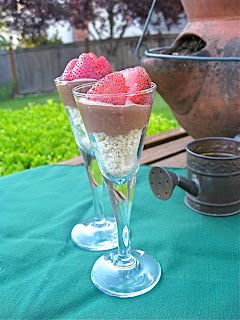
Using a vegan meringue recipe from AP269 and my own favorite chocolate "cream" recipe, I attempted this month's challenge. Ok, so this is probably the last vegan meringue I make, but I quite enjoyed the chocolate and strawberry combination!

Vegan Meringue

2 1/2 cups tapioca starch - divided


1/2 cup glutinous rice flour

1/2 cup sugar


1 1/2 tsp baking powder


1/2 cup thick coconut milk

Maybe add a tsp of cream of tartar

1. All ingredients should be really cold (store in the refrigerator overnight).


2. Mix half of the tapioca starch with the rice flour, sugar and baking powder.


3. Add coconut milk and stir.


4. Knead well and let rest for 30 minutes.


5. Add remaining tapioca starch and knead well. The dough should have the consistency of shortcrust. You won't be able to pipe it, but you could use cookie cutters to make the pavlova bases.


6. Bake in preheated oven at 150°C/ 300°F for about 15-20 minutes.

They are a bit chalky in texture and taste a bit too much like rice. But, what can you expect when veganizing the unveganizable?


Chocolate "Mascarpone Cream"


14 oz silken lite tofu

1/2 cup coconut or almond milk

1/2 - 2/3 cup semi-sweet chocolate chips or chopped dark chocolate

1/4 cup cocoa powder

1/2 - 2/3 cup flour

1 tsp vanilla extract


1. Heat milk over medium heat. Melt chocolate chips in the milk.

2. In the meantime, food process tofu until smooth. Add sugar, cocoa powder, and vanilla.

3. When chocolate is melted add to the food processor and blend until uniform color. Make sure to taste it for desired sweetness.

4. Refrigerate until ready to use.


To Assemble, layer meringue, chocolate cream, and sliced strawberries. Enjoy!

Or, I guess you could just make mini tarts with the tasty chocolate mousse and strawberries...

Tuesday, June 22, 2010

Produce of the Week: Bietola


I bet that one got your attention! On the farm in Italy, I could easily walk out back and grab a few large leaves of bietola for a stir-fry, soup, or salad. While ours were merely green-leafed, whitish stalks, the varieties come in a spectrum of colors. The “Bright Lights” I brought home last week sure lived up to their rainbow reputation.According to a 40-year-old Italian-English dictionary, bietola translated as beetroot.

While the same species as your basic beet – Beta vulgaris – bietola is the variety bred for leaves rather than roots – chard. Recognized during Greek civilization in the Mediterranean Basin, chard didn’t migrate to North America until the 19th century. As many vegetables, it was traditionally applied to medicinal uses, particularly in the beetroot form. Containing plenty of vitamins A and C, it is no surprise that this leafy green provides a nice health boost!

A week ago, one of the many time-sensitive duties on the farm was transplanting young rainbow chard plants. If you have never gotten your hands dirty, tenderly moving a plant to newly tilled soil, then you are missing out. It is altogether gratifying seeing the row progress from bare soil to rows of tiny leaves to the bouquets into which chard transforms.

Well, after traveling home with a hefty bunch of these multi-colored stems, I had my work cut out for me coming up with creative uses for my bounty. As you will see below, there are endless possibilities for your chard:

Bright Lights Chard Quiche

Crust

½ cup cornmeal

¼ cup white whole wheat flour

1 tbs olive oil

2-3 tbs water

Filling

8 oz tofu

2 tbs nutritional yeast

1 tsp garlic powder

4 large chard leaves

salt to taste

1 tbs garlic scapes

1. Combine crust ingredients until the sand-textured mixture sticks together. Press into two 4” tart pans.

2. Heat some olive oil or spray a skillet. Sautee chopped garlic scapes. Add chard and cook until soft.

3. In a food processor, blend tofu until relatively smooth. Add garlic powder, nutritional yeast, salt, and sautee until chard in roughly chopped.

4. Pour filling into crusts. Bake at 350F until starting to brown and setting on top. Usually 30-45 minutes. Allow to cool!

For a beautiful non-vegan but gluten-free tart recipe, check this one out.

Chard gnocchi made an appearance on my plate tonight – essentially mix mashed potatoes, chard, salt, nutritional yeast, and flour (besan + AP would be good) until a not-so-sticky dough forms. Make little logs, mark with a fork, and then place in boiling water until they float. Drain and then pan fry in olive oil and salt or a nice marinara!

You could always go the sweet route...

Upside-Down Lemon Chard Muffins

½ cup olive oil

2/3 cup almond milk

1/3 cup applesauce

1 lemon, juiced and zested

¾ cup brown or turbinado sugar

1 tsp lemon extract

1 cup whole wheat flour

2/3 cup unbleached all-purpose flour

1 tsp baking powder

½ tsp baking soda

pinch of salt

3 cups chard stems, chopped

½ - ¾ cups sugar

1. Combine chard and sugar in a skillet over medium heat. Cook until stems are tender and sugar bubbly.

2. Mix wet ingredients in a bowl with a whisk. Incorporate dry ingredients until they just come together.

3. Oil muffin tins. Place chard in the bottom of each cup. You could also add some to the batter (or even add some finely chopped chard leaves). Pour batter over chard. Bake at 350F for 25-30 minutes, until a knife comes out cleanly. Allow to cool before un-molding.

There are, of course, more ways to use up chard. 101 Cookbooks has a lovely garlicky recipe. Parmesan is so unnecessary in this tasty chard risotto on the NY Times. A hearty lentil and chard stew is most fitting to the current weather. And these is always the ornamental path…

Yes, the Swiss enjoy the aesthetic properties of chard gracing their cities' gardens!

Tuesday, June 15, 2010

Produce of the Week: Rhubarb

First off, I want to start out by thanking all of you who have read my entries and posted comments; it really means a lot to me, and I welcome more input - including suggestions about recipes (as I don't profess to have mastered the art of baking quite yet).

The past nine months at home have been revitalizing and enlightening. Seattle and the Puget Sound region has wormed its way back into my heart and strengthened its hold on my affections with its charm, vitality, and liberal approach to life. And while the San Francisco Bay Area still wins for highest concentration of close friends and best weather, Seattle has a familiar comfort, lush greenery, and a bountiful foodie/food blogger community! Holy monkeys, I think every other blog I come across online is from within 50 miles of me!

Spending time in my hometown after my extended absence during college has also allowed me to acquaint myself with some of the star attractions of our northern clime. It was only last spring that I first tried rhubarb (I suppose almost anything can grow in northern California), but this year I have really become aware of how it abounds in the Pacific Northwest. In fact, Washington is one of, if not THE, biggest commercial producers of rhubarb in the country! Seattle Times Magazine showcased a farmer in Sumner (a bit south-east of Seattle) who churns out rhubarb in quantity. The article also highlighted how rhubarb is regaining steam; considered an "old people's crop" enjoyed only by generations past, rhubarb has reclaimed some of its former popularity as a tangy addition to desserts and even some savory dishes.

Rhubarb is more than just a celery-esque vegetable-that-is-used-as-a-fruit. First cultivated for medicinal uses in Asia, earliest records date domestic rhubarb to at least 2700 BCE! By the 18th century, Europeans had adopted the sturdy stalks for culinary use, and of course the United States did not trail far behind. While the green leaves are quite poisonous, the edible petioles (for you botanists) or stalks provide potassium, vitamin C, and fiber. The rhizome, or root, served in traditional Chinese medicine - particularly as a purgative substance. All of this background information (and more) can be found at this informative website!

Rhubarb encompasses a wide variety of types depending upon the region. The luscious red or green stalky plant can serve as a hair dye, an insecticide, and even a pot cleaner. But we are talking food here, and I have yet to try any of those other uses (nor do I think rhubarb would do much to my dark hair color). So let's get to it - rhubarb is, after all, traditionally found in the form of tarts and pies.

This month for the Sweet or Savory (SOS) Kitchen Challenge, Kim and Ricki have chosen to tackle the some-times intimidating rhubarb. This is very timely, as rhubarb's growing season ranges from late April to September in the cooler northern climates it loves. Now I have to admit I toyed with making vegan versions of rhubarb clafoutis (still plan on attempting this one) and rhubarb panna cotta. But then I read that today (or by the time I post this, yesterday) was National Strawberry Shortcake Day! Well, my shortcake is not quite the rich, buttery biscuit normally sought in the classic dish, but they go nicely with a rhubarb compote that steals the spotlight, anyhow!

Spelt Biscuits with Lemony Strawberry-Rhubarb Compote

1 cup lite coconut milk
1/2 cup agave or maple syrup (or you can try subbing in liquid or powdered stevia)
3 tbs oil
1 tsp vanilla

1 cup spelt flour
1 cup brown rice flour
1/3 cup besan
1/4 cup tapioca starch
1/4 cup almond meal (optional; sub more spelt if nut-free)
1 tsp cinnamon
2 tsp baking powder
1/2 tsp salt

1. Whisk together coconut milk, agave, oil, and vanilla until thickening and smooth.
2. Combine wet ingredients with dry ingredients until well-incorporated.
3. Spoon batter into madeleine or cupcake pan. Bake at 325F for 15-20 minutes until starting to brown and tops are set. You can insert a knife as you would test a cake or loaf.
4. Let cool thoroughly. Serve topped with compote that follows.

1 cup rhubarb, chopped into 1" pieces
1/3 cup turbinado sugar (or other sweetener)
1 cup strawberries (I used frozen and thawed first)
2 sprigs lemon balm

1. Mix rhubarb with 1/4 cup sugar and let sit for an hour. Heat with rest of sugar over med-low until rhubarb is just soft. Don't overdo it!
2. Remove from heat. Add strawberries and lemon balm. Allow to cool and then refrigerate in an air-tight container (I like glass jars) until dessert/afternoon tea/midnight snack/early morning nibble time.


This could be one of the greatest hits ever! John Cleese is awesome (even without considering his lemur affinity)

I also really want to try a savory recipe with rhubarb...stay tuned for this trial:

Rhubarb Pilaf (compliments of rhubarbinfo.com)


More Rhubarb marvelousness:
Tarts and Ratios with Mango Power Girl
101 Cookbooks Crumbles
Simple Compote at Smitten Kitchen
Eatavegan is Jammin'
NY Times is on a roll with a refreshing pool-side beverage, some CouCous, and a fancy (in desperate need of veganizing) recipe for rhubarb ravioli!

I'm terribly interested in more recipes, particularly out-of-the-box ones, that show off the character of rhubarb, so don't hesitate to chime in!

Friday, June 11, 2010

A Seedy Affair and a Breath of Fresh Mint

The greatest joy for a backyard gardener is the sense of accomplishment you feel when those seeds you planted months ago finally start looking like the vegetables you know and love. Many moons past (ok, let's say six or seven), I constructed a raised bed garden in my parents' backyard. And while I had not planned on being around at present to reap the fruits of my labors, I now find myself reveling in the arugula and lettuces, while waiting impatiently for the peas, garlic, carrots, beans, and kale to mature. Moveover, I will be planting broccoli, rapini, beets, cucumbers, and a variety of squashes as soon as our new beds build themselves...hehe...

We purchased most of our seeds from a local nursery, or I saved them from winter squashes and the borlotti beans from the Italian farm. Seeds are little pockets of life, with the nutrients a new plant needs to get started in the world. It boggles my mind that a carrot will result from a tiny little dot of a seed or a head of garlic from a single clove! Although many large seed companies put patents on their genetically modified seeds - the genetic code falling under intellectual property rights - organizations like the Organic Seed Alliance try to promote the use of heirloom and new varieties, and perpetuate the magic of our floral diversity.
Ah, but enough of these silly, sappy, musings. Let's talk about pies and herbs. This month's theme for You Want Pies with That is Summer Drink Pie! Oh my goodness, oh my goodness - the possibilities are endless (and often intoxicating). So even though it's not sunny summer here yet, I took inspiration from a classic summery drink and the spearmint growing in a pot outside my front door.
Mint Mojito Pie

Mint Ice "Cream"
1 14oz can lite coconut milk
1 1/2 cups unsweetened almond milk
1/4 cup rum
2 cups packed mint leaves (spearmint is good, or another variety, but I wouldn't use peppermint)
2/3 cup sugar
2 tbs tapioca starch

1. Heat milks in saucepan until simmering. Remove from heat, add mint, and let steep for at least an hour. Strain mint leaves and press out remaining mint "juice."
2. Mix a little of the milk with the starch in a separate bowl until a paste. Add back to the milk with sugar and rum. Heat over medium heat until beginning to boil and thicken.
3. Cool completely and refrigerate. Churn in ice cream machine according to the instructions and freeze until ready to use.
Lime Cookie Crust
1/4 cup vegetable oil
Juice and zest of one lime
3/4 cup turbinado sugar
1 cup white whole wheat flour
2/3 cup unbleached all-purpose flour
1 tbs tapioca starch
1/2 tsp baking powder
1/4 tsp salt

1 cup cookie crumbs
1/4 cup oil
2 tbs applesauce
2 tsp lime juice
2 tbs agave nectar

1. Mix wet ingredients with a whisk until smooth. Add in dry ingredients until well-incorporated.
2. Scoop golf-ball size bits of dough onto a cookie sheet and flatten. Bake at 350 for 10-15 minutes until just starting to brown.
3. Food-process cookies until very crumbly. Continue to process with oil, applesauce, lime juice, and agave until beginning to stick together.
4. Press crumb mixture into pie or tart pans. Fill with slightly softened ice cream. Freeze until very firm. Dig in, and enjoy this refreshing dessert with a nice, cool, mojito!
Coming up: rhubarb season and some gluten-free baking adventures!

Wednesday, June 9, 2010

Not-Yet-Ripe-For-The-Picking in the Pacific Northwest

It is a truth universally acknowledged that when Washington replaces its winter weather with spring, June will be uncharacteristically wet and cold. I can handle biking in the rain and bundling up in a fleece, but I find it difficult to cope with the disappointment of unripe berries. This month's Mac Attack Challenge was "Walk on the Wild Side." While I believe this refers to a jungle theme, I had decided to run with the wild - that is, wild berries.

This would be a RIPE salmonberry, not the paler version I turned into jam today.

Our local newspaper had a whole article on local edible wild plants, which mentioned this little salmon-colored raspberry-like fruit located in some of the wet, woody areas nearby. On my runs for the past few weeks, I passed a stand of some golden salmonberries waiting to ripen in the sun. Unfortunately, we were missing the sun part of the equation. So my berries languished in the rain, and my hopes and dreams of creating a vibrant Wild Salmonberry Macaron were washed away.
Well, not quite. The lovely orangey berries were too tempting, so I collected a few and concocted enough jam to fill a single macaron. I made some rather lumpy coconut shells (too much coconut, eh?...they taste delightful, though), and filled the remaining with a chocolate ganache. There could have been worse endings to my predicament.
These macarons are extra special because of the chickens that laid these multi-colored eggs! As I mentioned a few posts ago, I spend one day a week helping on a local farm. They happen to have some little layers that produce spectacular eggs!
I also have to say that I feel amazingly lucky to be working with them (not the hens, the people), as they are so enthusiastic and work so hard. This brings me to the second topic I wanted to discuss - Pacific Northwest Agriculture. I can't remember if I shared this with you before, but starting a week from Saturday PBS will broadcast Good Food for a short period of time. This film documents some of the agricultural endeavors taking place in this region - particularly the revitalization of the family farm and the growing power of farmers markets. It highlights some of the challenges farmers face - both financial and ecological - and showcases several farms overcoming these. If anything, I felt comforted and inspired after watching, and now consider myself extraordinarily fortunate to live in an area that has such a wealth of conscious consumers and farmers ... and truly Good Food!

Sunday, June 6, 2010

A Not-So-SHRIMP-y Environmental Dilemma

So unassuming, yet so destructive.

I spend a great deal of time thinking about food. I work with it most of the day; I ponder recipes and ingredients while running, swimming, and biking (I should do a triathlon!); I devote my day off to baking; and to cap it all off, I fritter away hours posting about all of this (though, I like to think it keeps my research and writing skills somewhat sharp)! So, it was while biking back from the bus stop that I had plenty of time to ruminate on the talks I attended at Green Festival. After work, I hopped on a bus downtown to wander the booths set up in the Convention Center, sampling too much fair-trade chocolate (as is my style), and learning about Seattle green initiatives.

However, the speakers on aquaculture quite captured my attention. While mostly focused on the destructive practices of shellfish aquaculture in the Pacific Northwest, a gentleman from the Mangrove Action Project also spoke. Our oceans are our planet’s last frontier for human exploitation, and as such, present the potential for as severe a degradation as terrestrial ecosystems have faced. And it is not just the big blue waters that feel the impacts of our seafood choices.

So what is this ever-so-pressing dilemma one faces at the grocer’s seafood counter? Why, as in your other food decisions, it is one of origin and practices. There are a couple of factors to take into consideration: (1) the sustainability of the fishery – if fishing methods lead to over-exploitation and habitat destruction, and (2) the livelihoods of those fishing or affected by the industry – are we talking big-business or local families?

Here in the Pacific Northwest we have great seafood resources, with access to relatively healthy salmon populations. And though farm-raised salmon are often touted as the savior of our wild stocks, they are also comparable to the terrestrial industrial livestock trade. Aquaculture, even seemingly benign deep-water fish pens, leads to concentration of waste, contamination of coastal areas by antibiotics and hormones, and the spread of diseases, parasites, and even escaped non-native species of fish. Furthermore, it requires considerably more fish in the form of food (as salmon are carnivorous) to produce one edible salmon!

But, I am more concerned at the moment with our country’s obsession with those little cocktail delicacies: shrimp. Not all shrimp are evil, mind you. But the cheap bounty comes at a high cost to people and the planet. Today’s last panelist reminded me of the grave threat posed by the widespread prawn farms in Southeast Asia. Shrimp ponds take the place of Mangrove forests along the coastlines of countries like Thailand. Not only does this practice remove an important nursery for fish-stock and a buffer against the tropical storms (remember the destruction of the Indonesian Tsunami?), but it also comes at the expense of local fishermen who can no longer make their living in the traditional manner. The polluting, forest-destroying, shrimp factories churn out cheap shellfish for three to five years before turning into a deadzone of unproductivity. Thinking of this, and the wanton destruction of beautiful mangrove ecosystems, often makes me want to cry, but I will refrain.

Luckily, you have considerable control over your seafood purchases. I have provided several resources below to better inform your decision and tailor your diet to fit locally available and sustainable options.

Monterey Bay Aquarium’s Seafood Watch Program – provides regional information on sustainable marine species available for consumption

Marine Stewardship Council – a well-respected certification of sustainable fisheries, with the regional US office located in Seattle, WA. Woot.

Food and Water Watch – their Fish program has lots of information about fisheries in general, aquaculture, and seafood selection.

Environmental Defense Fund – also outlines the challenges facing our oceans and provides assistance in consumer seafood choices.

Well, I hope this post was at least enlightening if not Earth-shattering. I apologize for the length of my treatise, and hope I have not bored anyone with my blathering. To come – my SEEDy experience at Green Fest and my impending foraging expedition.

Thursday, June 3, 2010

Big Business and Biscotti

I don't like Nestle chocolate. Period. For one, they use dairy in their semi-sweet chocolate chips. Secondly, their low-quality cocoa just does not make for a well-developed and deep chocolate. Finally, as a large company selling a commodity at a cheap price, Nestle invariable cuts corners that sacrifice human well-being (such as the rampant child labor found in Cote d'Ivoire and exploitative wages of cocoa farmers) as well as ecological health.

But Nestle recently announced that it will no longer use products that "drive tropical rainforest destruction." This new campaign specifically targets plantations of palm oil (often used in chocolate candy), the growth of which have driven alarming rates of deforestation in Indonesia and other parts of Southeast Asia. Deforestation for any reason has consequences beyond the endangered species and destroyed local livelihoods, it also impacts the global carbon count - particularly in tropical areas where forests are huge sinks for carbon. If interested, you can find out more about forest carbon and the discussion surrounding it at the Bonn climate change talks taking place at present.

That's fine and dandy for deforestation from palm oil plantations. And although Nestle has started paying attention to the sustainability of their cocoa with their Cocoa Plan, they still have a long way to go. And it is critical that large companies like Nestle take on this responsibility and step up their social and environmental sustainability efforts. Like the Walmarts and McDonalds before them, Nestle has a deep market penetration and broad distribution, potentially having profound impact in furthering fair trade initiatives and the like, but also making them deadly to the farmers and ecosystems at the other end. All that said, I still don't plan on purchasing Nestle chocolate any time soon.
I promised cookies, too. Well kids, my latest borrow from the library happened to be Ms. Moskowitz' and Ms. Romero's newest addition to vegan baking - Vegan Cookies Invade your Cookie Jar. And because Vegan Cupcakes take over the World is simply amazing, and I love cookies even more, I have been spending a disgusting amount of time flipping through the pages of this mini cookbook and plotting my impending cookie adventures.

Today's exploit consisted of two versions of biscotti - literally twice baked in Italian. I followed the gingerbread biscotti recipe faithfully, minus the candied ginger, plus a tablespoon of applesauce. For the lemon cornmeal biscotti, I left out the poppy seeds, added more lemon flavor, and included dried cranberries for a bit of a punch. Now, up to this point, the Veganomicon recipe for chocolate hazelnut biscotti held my affection. However, these new recipes are phenomenal (I think they have more oil...) - crisp, light, very biscotti-like, perfect for a nice cuppa tea or joe.
On a final note, for my fellow Seattle-ites or others interested in visiting our illustrious city, the International Food Bloggers Conference will be held here August 27-29!!! There are some exciting speakers and sessions, and food of course! Unfortunately, $350 is a bit steep for someone in my position - two months of student loans, to say the least. But it sounds super fun, and Seattle is a fantastic place to visit (let me know if you need suggestions for entertainment).

Coming Up: GreenFest this Weekend!