Pages

Friday, December 30, 2011

Fast Fact Friday: Price Supports

On Wednesday we made a quick leap back in time to the World War era and took a look at messages from the period that are still relevant to today's food system. But there is more to early 20th century food and agriculture than anti-waste propaganda (with the most positive of connotations implied by that word). In fact, post-Dust Bowl policies served as precursors for our present-day Farm Bill.

In 1933, the Agricultural Adjustment Act (AAA) provided price supports and subsidies to grow certain crops and keep pieces of land fallow, in order to raise the value of crops and avoid a surplus. Not only do we still have crop subsidies (particularly for corn), but this act set up U.S. agriculture in favor of big producers rather than small farms and sharecroppers. Surplus crops also factored into foreign food aid, which we will explore next week!

Finally, getting to the environmental side of things, legislation at this time was also responding heavily to Dust Bowl challenges. A product of severe drought, conversion of prairie land, and extensive cropping systems devoid of fallow periods or cover crops to replenish the soil, the "Dirty Thirties" were a period of severe hardship for rural communities in the central part of the country and those who depended on them. The Soil Conservation and Domestic Allotment Act addressed these land degradation issues and formed the early skeleton of conservation programs, such as the Conservation Reserve Program, administered by the US Department of Agriculture.

Ok, so perhaps this wasn't much of a "fast fact" for Friday, but it is terribly interesting!

Thursday, December 29, 2011

Thirty Second Thursday: Squashed

A pumpkin is a winter squash, but not all winter squashes are pumpkins. Luckily, that does not preclude one from substituting a different squash for pureed pumpkin. I don't necessarily have anything against canned pumpkin, but as long as it is winter squash season, why use something that is preserved rather than fresh (ish)? So here is likely my last baking venture of 2011!

Not-Pumpkin Muffins
1 small butternut squash, roasted, peeled and pureed
1/4 cup apple sauce
2 tbs canola oil or melted coconut oil
15-20 drops vanilla liquid stevia
2-3 tbs agave nectar (can sub in 1 tbs of molasses for more of a gingerbread flavor)
2 tsp cinnamon
1 tsp all-spice
1/3 tsp ground ginger
1/4 tsp nutmeg (optional)
1/4 cup ground flax seed + 1/3 cup water
1 tsp apple cider vinegar or lemon juice

1/2 tsp sea salt
1 tsp baking soda
2 tsp baking powder
1/3 cup tapioca starch
1/4 cup millet flour
1/2 cup brown rice flour

1/4 cup chopped pecans (optional)
1/4 cup chocolate chips (optional)
1/4 cup ground coconut (optional)

1. Add water to flax and allow to sit for five minutes until thickening. Use a sturdy wooden spoon (I mean, what else?!?!) to mix squash puree, applesauce, oil, sweeteners, spices and flax egg.
2. Combine flours, salt, baking powder, and baking soda until well-incorporated. Finish off with add-ins and the vinegar.
3. bake in muffin tins at 350F for 20 (mini) to 35 (regular) minutes until firm and a knife comes out clean.

Need more healthier treats? Try Slightly Indulgent Tuesdays at Simply Sugar and Gluten Free.

Wednesday, December 28, 2011

My Munchable Soapbox: Lessons from a War

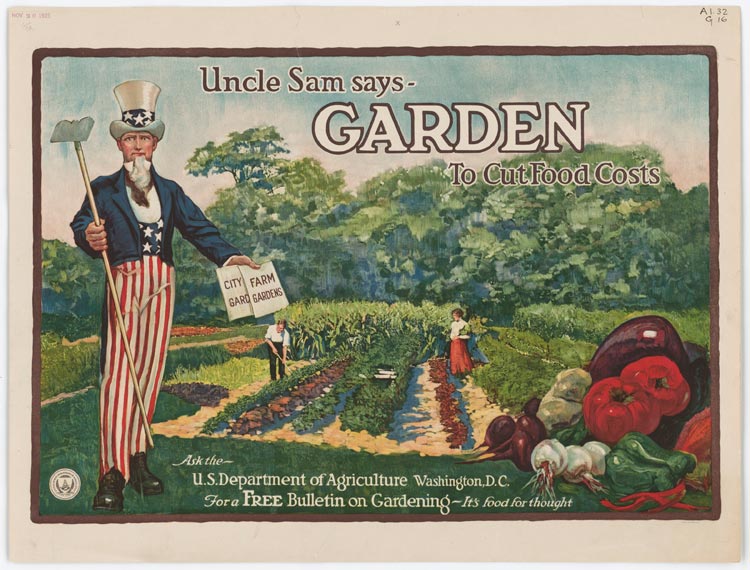
"Uncle Sam says Garden to Cut Food Costs" - 1917
I write a lot about the state of agriculture and food systems in the United States. And while I try to discuss positive steps forward, I rarely take a step back to look at how we arrived at this point. Well, I finally made it over to the National Archives' What's Cooking Uncle Sam exhibit! For its modest size (only took me about an hour to view), it was densely packed with information. The next couple of "soapboxes" will stem from the leads I gleaned during this visit.

World War I marks a serious shift in the food system of the United States. It provides some insight into the current state of affairs, as well as some insight into how we should approach a rethinking of the future.

We can consider the Great War as the point of foundation for modern agriculture in this country, shifting the priority to production of particular commodities - sugar beets, corn, and soybeans. Perhaps a transition point from small, family subsistence-level farms to more mechanized and commercial production.

At the same time, World War I, the ensuing Great Depression, and World War II all represent periods of great economy. Besides war-time rations, abstaining from sugar, wheat, and meat in the name feeding the troops was seen as a patriotic act, contributing to the war effort. For example, home gardens - or "Victory Gardens" as they were called by First Lady Eleanor Roosevelt - were offered as a solution to feed a family, cut costs, and leave other crops to feed the troops. On this same vein, ad campaigns advocated for reducing waste in the kitchen, positioning economical use of all food as a contribution to the war effort.

These latter two points are particularly salient for our current approach to food and agriculture in the country. We do not presently understand the concept of moderation and frugality. According to the UN Food and Agriculture Organization, of the food wasted in industrialized nations, it is primarily in its post-processed form on the grocery shelves or the dining room table. Taking a lesson from the restraint exercised during the earlier part of the 20th century would benefit the country as a whole.

As for gardens...well, I'm a big advocate of growing one's own food and consuming locally and seasonally. But more significantly, during World War I, Americans were still within easy reach of agrarian roots and rural lifestyles. Now, the resurgence of home gardens not only provides some food, but also reconnects people (particularly ubranites) to the land and the source of their food. Perhaps we should take some cues from our country's past interactions with agricultural production and how well patriotism tied in with food production.

Next time, taking on food guidelines!

Monday, December 26, 2011

What's Cooking? Bogged Down


As you know, I spent last week in New York. On Wednesday afternoon I stumbled across a farmers market in Union Square. Now I rarely say no to a turn around a farmers market, but little did I know what I would find...fresh cranberries!

Why is this surprising? Well, cranberries, for all they are a holiday favorite, are actually quite particular about where and how they grow. The necessary conditions are found in the northern reaches of the U.S. - primarily Wisconsin, New Jersey, Massachusetts, Washington, and Oregon. Cultivated in bogs and wetlands, cranberries require sandy soils and plenty of fresh water.

Although cranberries don't have quite the history of some of the other produce items I've discussed in the past, they are distinctly North American. Native Americans have utilized the fruit since the mid-16th century, and taught European settlers during the 17th century. The berry had many uses, from fighting scurvy to serving as a dye. I took home the Howe, one of the early varieties dating back to 1843, and cultivated largely in Massachusetts.

Many of the cranberry bogs are upwards of 100 years old, but there are still environmental concerns associated with the crop production. There is concern over loss of wetlands due to cranberry expansion, in addition to water pollution from the use of fertilizers and pesticides in the growing environment. And despite the fact that cranberries are a native wetland plant and will perform some of the filtering and drainage functions of wetland plants, the replacement of native wetlands with a monoculture crop presents serious challenges for proper wetland function. So when choosing your cranberries, make a point to buy organic and if possible, ask your farmer about his/her land and management practices. (mine were brought to the market by Breezy Hill Orchard from fourth generation Willow Cranberries, which practices IPM).

Now, what did I do with my berry-licious find? In celebration of the final days of Hanukkah, I created a twist on a classic dish:
Yeah, the photo is uglier than I had anticipated...

Root Veggie Latkes with Cranberry Sauce
1 rutabaga, grated
1 medium beet, grated
1 large carrot, grated
1/4 onion, finely chopped
1/4 cup tapioca starch
1/4 cup flour (can use millet, garbanzo, or rice)
1 tsp salt
1 tsp dried basil
1/2 tsp garlic powder

Olive oil for pan

1. Combine all ingredients in a bowl. Form patties and squeeze out any liquid.
2. In a well-oiled skillet, heat patties on medium-high heat, flipping after one side is browned and crispy.
3. Once both sides are golden, place on a paper towel on a plate. Can also place on a cookie sheet and leave in a warm oven. Serve warm.

1 cup fresh cranberries
1 apple, peeled and cubed
1/4 cup water
1 tbs orange zest
15 drops vanilla liquid stevia
1 tbs agave (optional)
1 tsp cinnamon
1/4 tsp nutmeg

1. Heat apple and water over medium heat until soft. Mash apple. Add cranberries and rest of ingredients.
2. Cook until cranberries start to melt and sauce thickens.
3. Serve warm over latkes!

Grist recently posted another rendition of Cranberry Sauce (and some cultural history) for your reference.

This recipe is included on Wellness Weekend at Diet, Desserts and Dogs. Also, check out this fun savory cranberry recipe on Choosing Raw.

Saturday, December 24, 2011

A Big Apple Intermission


Indian Plate at Candle Cafe
We interrupt the regularly scheduled programming (meaning, nothing on Saturday...) for a special holiday intermission. To those who celebrate, Merry Christmas. To those who don't...well, enjoy the fact that so many other people do and go see a movie! Or take this opportunity and read my quick recap on my jaunt to New York City. I have to admit, vegan restaurants were one of the primary foci of the trip.

Tuesday afternoon my bus arrived on time and without a hitch (a feat for Megabus). I hate to admit this, but dinner that night may have been my favorite meal of the trip, even though I literally grabbed a sandwich from Gobo. It was a grilled soy cutlet with cashew spread, sun dried tomatoes, onions with white bean soup on the side. While I didn't eat in, the atmosphere in the Upper East Side establishment was very nice and relaxing...plus the sandwich was really tasty!
See, non-vegans like it too!

Terri, a vegan sandwich shop and juice bar provided a quick grab-n-go lunch on Wednesday and Friday, but I wasn't overly thrilled. The cashew basil pesto on the marinated portobello, zucchini, mixed pepper, and red onion on gluten-free bread didn't suit my tastes. The Thai chicken wrap was much better, but not enough to keep me coming back (although the peanut butter cookie might be...).


On Wednesday evening, my friend JY and I tried out Candle Cafe. We ordered garlic focaccia (mmm); Toscana lasagna, and the daily special Indian plate - eggplant-seitan curry, yellow split pea dal, yellow basmati rice, date-raisin chutney, cabbage salad and parata bread. Surprisingly, for all its hype, none of it was earth-shattering. But perhaps that was just me, seeing as JY went on record saying, "I could eat here every meal, every day!"

Regardless, there was some tasty food to be had, amidst treking around the big city. My only food regrets are missing out on Lula's Sweet Apothecary (and the best vegan ice cream ever!) and Cocoa V being closed when I went! Now, back to my gluten-free, sugar-free existence...

Friday, December 23, 2011

Fast Fact Friday: The Gender Gap

"Over 1.1 billion women farmers are not reaching their full potential"
 Gender is a hot-button issue this year. The UN Food and Agriculture's annual State of Food and Agriculture, released this past March, focused on gender issues. Basically, the premise behind much of the discussion is that women, when provided equal access to training, technology, education, financial and technical resources, will not only produce more food, but make considerable strides towards alleviating hunger and poverty. If you ask me, women empowerment is the answer to many of our planet's problems...check out this nifty animated video below.
And happy 250th post, my lovely little blog! At this rate, we should hit 300 by April!

Thursday, December 22, 2011

Thirty Second Thursday: Life's Like a Box of Chocolate


Or at least I wish it were...Every year I celebrate a holiday season by making an assortment of chocolate truffles to give to friends. This year I acquired some vegan white chocolate, but I was sorely disappointed. It did not coat well and gummed up, so my rum raisin didn't turn out as planned. Still, I tried to be a bit more creative this year, so here are the results:


Aztec Chocolate (cinnamon and cayenne)


Peppermint

Almond

Peanut Butter Cup

Apple Cider

Pecan Pie

Rum Raisin (vg, can be raw!)
1/3 cup raisins
1/4 cup rum (can use orange juice or apple cider for non-alcoholic)
1/3 cup walnuts
2 tbs agave

1/4 cup almond meal
2 tbs powdered sugar (can blended evaporated cane or turbinado sugar until fine)

1. Soak raisins overnight in the rum.
2. Place raisins, walnuts, and agave in a food processor until coarse and coming together. Make into marble-sized balls and freeze for about 20 minutes.
3. Sift almond meal and powdered sugar. Roll each of the balls until well-coated. There you go!

Drooling yet? Happy holidays!

For more holiday goodies check out this week's Slightly Indulgent Tuesday.

Wednesday, December 21, 2011

My Munchable Soapbox: Growing a Generation of Farmers

It is no secret that the number of farms in the United States have decreased dramatically in the last century. In 1900, nearly 40% of the country's population was in farming, but by 2000 this had fallen to 1.9%! The number of farms also fell by 63%, consolidating to fewer larger operations. And while the number of farms has grown a bit in the past decade, it still only stands at one-third the number in 1900. While population moving out of agriculture is considered a sign of development, the dwindling rural population is a bit worrisome.

However, this trend may be in the process of reversal. NPR recently ran a story on the next generation of young farmers. With most young people of generations past trying to leave farm life, the average age of farmers has been on the rise for decades, 55 years in 2002. The article presented both sides of the picture (interviewing one of our farmers at Dupont Circle farmers market!), but also gave me a sliver of hope. While folks in their 20's and 30's may still be starry-eyed idealists, it seems like we want change badly enough that this may be more than a fleeting movement.

Grist, too, recently posted on the issue of young farmers, with regards to the upcoming Farm Bill re-authorization. The article stressed the difficulty of acquiring start-up capital, particularly for those interested in small-scale and diversified farming systems. Farm Bill financial assistance is more geared towards large commercial operations, producing dairy, grains, or meat. And getting a hold of land is another daunting challenge. And these hurdles don't even account for the difficulty of making a living from growing non-commodity crops!

Despite all of the road blocks, there are a couple of exciting things in the works. There is a National Young Farmers Coalition. That in and of itself is exciting! Second, a Beginning Farmer and Rancher Opportunity Act, that will hopefully be included in next year's Farm Bill, would work to alleviate some of these financial stresses that currently bar many young farmers from entering the scene.

So, nothing is settled yet, but I think we have a lot to look toward on the horizon!

Monday, December 19, 2011

What's Cooking? Ancient Grains!

Not the literally 3,000 year-old grains...
Grains make up a large portion of our diets. In fact, the three main grain commodities - wheat, rice, maize - make up nearly 2/3 of the global human energy intake! These crops are essentially grasses that we've cultivated over thousands of years to produce larger, edible fruits - the grains (composed of endosperm, germ, and bran). Some 12,000 years ago the first of the cereal crops, namely emmer, wheat and barley, were domesticated in the Fertile Crescent (yup, that region of all the Middle East unrest).

But there are other cereals that are now staples in certain regions. Sorghum and millet are staple (gluten-free!) grains of Asia and Africa. Quinoa is a pseudo-cereal grown in the Andes. Our focus today, though, is amaranth, another pseudo-cereal originally from South America and now prevalent in Africa.

Cultivation of amaranth began around 8,000 years ago by the ancient Aztecs. In fact, the dates of 7 - 26 December comprise the Aztec month dedicated to the hummingbird god Huitzilopochtli and celebrated with a wide uses of amaranth. The grain was revered for its nourishing and energizing qualities, but fell out of use when Europeans invaded the content. There are approximately 60 known varieties, however, they are often considered to be weeds. Even so, it is high in protein, fiber, amino acids, calcium, and iron! Anywho, amaranth has a long and interesting history, in addition to its currently lauded status of being a gluten-free grain.

Amaranth Porridge
1/2 cup dry amaranth
1 cup water (I subbed in 1/4 cup coconut milk; can also use cider!)
1/4 cup chopped walnuts
1/4 cup chopped apple
1 tsp cinnamon
10 drops vanilla stevia

1. Bring liquid to boil in a small saucepan. Add amaranth. Cook for about 20 minutes until grains soften (should be similar to quinoa).
2. Add stevia and cinnamon. Stir and then top with chopped apple and walnuts (or other nuts...pecans would be lovely) for a hearty breakfast...or even dessert!

Want other recipes for amaranth? Try these:
Butternut Squash, Turnip, and Green Bean Amaranth
Herbed Amaranth Veggie Patties
Mini Veggie Burgers
Leek and Amaranth Polenta
Lemon Blueberry Muffins 
Amaranth and Carrot Porridge

And visit Wellness Weekends for some other health gluten-free, vegan recipes!

Friday, December 16, 2011

Fast Fact Friday: Super Bugs!

According to the US Department of Agriculture, 94% of soy and 70% of corn produced in the U.S. is in fact genetically modified. This engineering of seeds serves different purposes depending on the crop, generally making them herbicide or insect resistant. Well, this year has been a tough one for the company in control of the majority of these seed resources - Monsanto. Its "Round-Up ready" corn, soy and alfalfa, resistant to the popular herbicide, has been linked to the appearance of "superweeds" that have also developed an immunity to the chemical. Now, there is evidence that insects that can withstand the pesticide Bacillus thuringiensis (Bt) toxin have been uncovered. Unlike other insects that are supposedly susceptible to Bt crops that emit the pesticide, the corn root worm seems to be the new "superbug," just fine munching on them. So, what's next in the "super" family?

Here a some more fast GMO facts and another post on GMOs.

Wednesday, December 14, 2011

My Munchable Soapbox: Fat Cats

No, not that kind of cat! The term refers to rich, greedy and politically motivated individuals. I might soften it to make it more widely applicable to one of the failings of a capitalistic culture (is this going to very soap-boxy...?). You might be asking yourself now why we're talking about cats and capitalism.

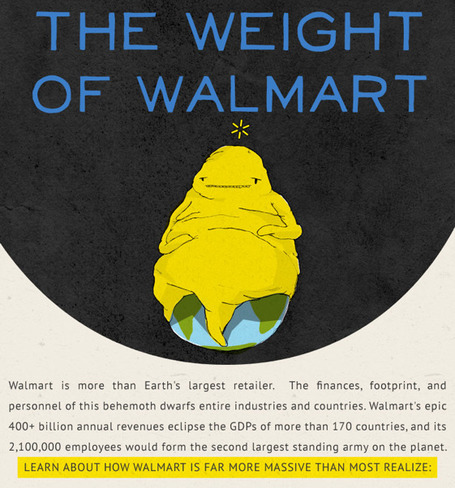
Well, recently I was perusing this infographic on Walmart. It was both funny and disturbing. The company brings in more revenue than the largest oil company and would have the 25th largest economy in the world if this represented GDP. Not only is the chain the largest retailer on the planet, it also holds the claim for highest grocery sales in the U.S. The article notes that despite Walmart's great successes, the founding family are very frugal in terms of charitable donations (compared to say Gates or Buffett).

You might have grasped that my opinion of Walmart is not very high. In fact, I have not set foot in one in many a year. So why are we talking about the behemoth of a retail chain. Well, as a business with such a huge market share and amount of leverage, the choices for product sourcing and corporate social responsibility have resounding implications. I wrote briefly on this in 2010, but I believe it bears a little more attention.

In terms of agriculture, Walmart has made commitments to source only Marine Stewardship Council certified seafood, double the sale of locally sourced U.S. produce specifically from small and medium scale farmers, and purchase only "sustainable" palm oil and beef products by 2015. Not to mention, there are numerous company-led agriculture initiatives in the States and developing countries.

Great. If a major corporate entity takes steps to make their supply chain more responsible, this must be a big step in the right direction. With greater demand for "sustainable" food products, the actual adoption of better practices at larger scale makes it overall more economical. It also brings awareness to food purchasing decisions, among populations that may not have given much thought to where the fish or the cocoa came from. And if the Walmarts of the world require certain standards from their producers, they will get them!

At the same time, I get this visceral reaction when I think of Walmart and sustainability. Its first and foremost goal is to provide products to its customers at the cheapest price possible. Now I'm not saying that sustainable agriculture can't be lucrative, just that Walmart's business model does not account for the external costs or merely passes them on to its producers - demanding higher quality for the same low prices. There is also simply something unsettling about so much control being held by one company...

Ok, I admit it. I'm torn, conflicted, and don't think there is a really clear-cut this-is-good vs. this-is-bad conclusion. Enough preaching; feel free to voice your own thoughts!

Monday, December 12, 2011

What's Cooking? If I had a Turnip...


...I'd-a-eat in the morning, I'd-a-eat in the evening, all over this la-and...eh-em. I mean, if I happened to acquire two bunches of sweet White Lady turnips this week at the farmers market... As it has come to pass, turnips have figured prominently in my diet for the past few weeks. This sweet root veggie, with a hint of bite, it excellent - morning, noon, or night. You may recall a post nearly two years ago on the origins and nutrition of the veggie, back when my Produce of the Week series was still running.

Like many brassicas and cold-weather greens, turnips become bitter and tough under high temperatures. This probably has to do with the signal heat gives to the plant to go "to seed" - putting energy into reproducing and not deterring other other creatures from consuming its structure. Then again, I am no plant physiologist. I just cook things; and let me say, turnips in some form have been featured in every meal.

Mornin' Cajun Tomato Turnips  (adapted from La Dolce Vegan)

2 medium sweet turnips, diced
1/2 medium onion, diced
1/2 cup tomatoes, chopped (I used ones I had preserved this summer)
1/4 tsp oregano
1/4 tsp thyme
1/4 tsp cumin
1/4 tsp paprika
1/8 tsp cayenne
Salt to taste
Olive oil to coat the skillet

1. Heat oil in a skillet over medium heat, cooking onions and cook until translucent.
2. Throw in the turnips, until the turnips begin to soften. Then add in the tomatoes and seasonings. Continue to cook until turnips are fork-tender and liquid has boiled off from tomatoes.
3. Serve with a tofu scramble! Mmmm.

Lunch: Quickie Kale Salad with Turnips and Tahini Dressing

3 large Red Russian kale leaves, chopped
1 medium sweet turnips, diced

1 tbs tahini
1 tbs lemon juice
1 tsp garlic powder
salt to taste
water or vegetable/olive oil as needed for texture

1. This is my new favorite dressing...Whisk all dressing ingredients together with a fork until smooth and acceptable flavor. Dress salad...how scandalous!

Dinner: Beans and Greens

Small bunch of turnip greens, coarsely chopped
1 cup white beans
Garlic powder and salt to taste
Olive oil to coat skillet

1. Seriously, just pan fry some greens with garlic, salt, and oil until stems are soft. Add beans for the last few minutes. Enjoy this take on a classic Italian country dish.

Well, you got not one, but three yummy turnip recipes today! For more healthy recipes, check out Wellness Weekends.

Friday, December 9, 2011

Fast Fact Friday: Organic to the Rescue

According to an article in the Atlantic, organic agriculture CAN feed the world! Well, actually several UN reports and a Rodale Institute study are actually behind that assertion. It's not so much about producing as much corn, wheat, rice, etc. from the one plant. We increasing have to worry about taking care of the natural systems that allow us to continue growing food - supporting pollinators; keeping water clean; increasing resilience to climate changes. And for some fruits and vegetables, eating organic is considerably safe and healthier for your person and the planet. But while organic is not everything ... you can have large and destructive organic farms - it's a start. I wrote about what other considerations are as important, if not moreso, this summer.

Read more here and here.

Thursday, December 8, 2011

Thirty Second Thursdays: Comfort in a Bowl

It was a dark and stormy night...

...and all I really wanted to do was curl up in a chair and read my book. However, I also really wanted something nice and warm to nourish my body and soul (ok, that's a bit much). And honest to goodness, nothing says comfort like winter squash! I took inspiration from this recipes for Pumpkin Soup with Smoked Paprika, and topped my bowl with toasted squash seeds. We also all know now that smoke paprika is my new favorite savory spice (cinnamon will always win for "sweet").

Smoky Butternut Soup (2 servings)
1 medium butternut squash, quartered and eighthed
1/2 medium onion, rough chop
2 cloves garlic
1 tbs olive oil
1/2 cup vegetable stock or water
1/2 cup almond or soy milk (or water/stock if you don't want it as creamy)
1/2 tsp smoked paprika
1/4 tsp thyme
1/4 tsp cumin
salt to taste

1. Cover baking pan with olive oil. Roast squash, onion and garlic at 400F for about 45 minutes, until very soft.
2. Scoop out flesh and place in a food processor or blender. Throw in the onion and garlic, too. Add liquid and seasonings. Puree until smooth.

3. Serve warm with toasted seeds or perhaps some nice garlicky croutons.

I'm also posting this on Slightly Indulgent Tuesdays, so check out the other recipes there!

Wednesday, December 7, 2011

My Munchable Soapbox: Nouveaux Riche and Old Money

The apple is a remarkable fruit. It has a long, global history and manifests in a diversity of size, shapes, and flavors. (Also, not that all three of those links are my musings on the magnificence of apples). This is sort of the crux of today's blog title. New varieties of apples are constantly in the works, being crossed and bred to produce something tastier, crunchier, juicier, you name it. At the same time, we are experiencing a resurgence of heirloom varieties of apples. I have to admit to struggling a little - do I give in to the crisp deliciousness of the recently unveiled Honey Crisp or stay loyal to the centuries-old Golden Russet or Black Twig?

Well, I was listening to a podcast the other day, when I learned of the newest star on the apple stage: SweeTango. Oh yes, it sounds like an enticing dance, but sadly it is too late in the year to give the apple a taste. Child of the Honey Crisp and the Zestar, both relatively young apples. What struck me was that the SweeTango is 'managed.' Meaning that there are strict guidelines and contingencies to even get permission to grow the patented apple. That said, I still wouldn't mind trying one...
What do you think about intellectual property rights of food crops? Do you have any preferences between the 'nouveau riche' and the 'old money' of the apple world?

Monday, December 5, 2011

What's Cooking? Ginger and Spice and Everything Nice...

The holiday season is officially upon us. Now, I am not one to revel in the holiday spirit - decorating to excess; turning up the Christmas (or Channukah) music; and basking in the commercialization of religious observances. But I like to bake and I like cookies. So when I decided to throw a board game party, I really could not omit gingerbread cookies from the menu! Sadly, I am currently unable to consume said cookies; therefore, I created an alternate, gluten-free, sugar free version that is in no way, shape, or form remotely like gingerbread. If anyone has suggestions for non-sugar molasses substitutes, I'd love to hear...

Gingerbread Flowers (vg, from Vegan Cookies Take Over Your Cookie Jar)
Cookie on the left. Might post recipe later, but might not be appropriate, since I did not alter it in the least!


Ginger Chews (vg, gf, sf)
3/4 cup almond meal
1/2 cup millet flour
1/4 cup ground flax seed
1/2 tsp baking soda
1/2 tsp baking powder
1/2 tsp salt
1 tsp cinnamon
2 tsp ginger (or to taste)
1/8 tsp concentrated stevia powder (or to taste).
1/4 cup almond milk
2 tbs tahini
2 tbs coconut oil, melted

1. Combine almond meal, millet, baking soda and powder, salt, cinnamon, ginger, and stevia
2. In a separate bowl, mix ground flax and almond milk, letting sit for 5 minutes. Add to flours, along with tahini and melted coconut oil. Add more milk as necessary to create a non-stick dough ball.
3. Refrigerate dough for at least an hour. Then roll out to about 1/4 inch thickness. Cut out circles. flowers, gingerbread people, whatever. Place on a lined cookie sheet and bake at 350F for 8-12 minutes until beginning to set. Should still be pretty soft.
4. All to cool for a couple of minutes on the tray, before transferring to a cooling rack. Enjoy!

Wellness Weekend has some really marvelous submissions, with a lot of squash involved!

Friday, December 2, 2011

Fast Fact Friday: Fair Trade Feuds

While I have not consumed a cup of coffee in over a month now, that doesn't mean I have lost my taste for the beans and the issues that surround them. Fair trade is not a new topic for this blog, even regarding coffee specifically. And I would never argue that the label is a panacea for sustainable and equitable production. However, I had primarily from a farmer's standpoint and not from the farm size angle. NPR recently introduced a podcast about scaling up fair trade to include large producers. Apparently, different certifying bodies have different views on the matter.

What might this mean for coffee consumers and producers? You will just have to listen to find out, I guess!